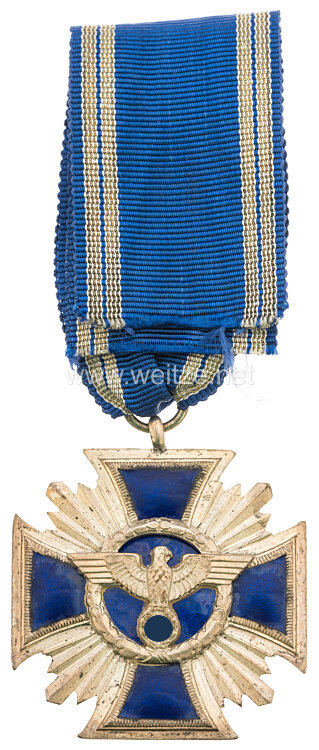
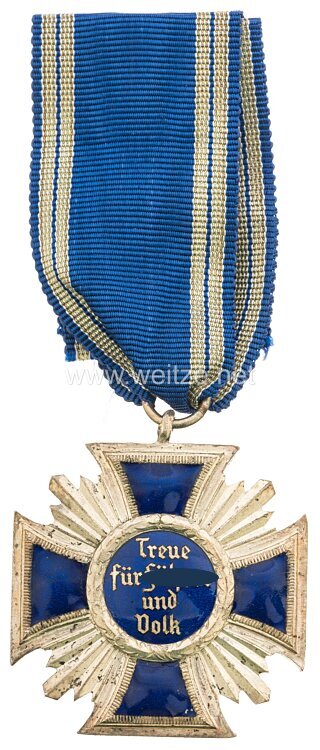
NSDAP Long Service Award in Silver

flat 3-piece construction, blue enameled, with full-length ribbon. Condition 2.
456259
700,00

NSDAP Long Service Award in Silver

The NSDAP Long Service Award in Silver (also known as the Silver Badge of Honor of the NSDAP) was a political decoration of the National Socialist German Workers' Party awarded during the Nazi era in Germany. This award represents a significant artifact of Nazi rule between 1933 and 1945.

Historical Background and Foundation: The NSDAP Long Service Awards were instituted by Adolf Hitler on January 29, 1939, to recognize the long-standing loyalty and service of party members. The decoration was awarded in three grades: Bronze for 10 years of service, Silver for 15 years of service, and Gold for 25 years of service in the NSDAP. The award was granted retrospectively, with service calculated from the date of party membership.

Technical Description: The silver version of the service award consisted of a circular badge approximately 30 mm in diameter. The center displayed the party badge of the NSDAP with a swastika on a white background, surrounded by a laurel wreath. The flat three-piece construction described here was one of the most common manufacturing variants. The blue enameling on the swastika was characteristic of this decoration and served to color the central symbol. The long red ribbon corresponded to the party colors of the NSDAP.

Manufacturing and Variants: The NSDAP service awards were produced by various authorized manufacturers, including renowned firms such as Deschler & Sohn of Munich and other minting establishments. The three-piece construction typically consisted of a base body, the enameled center piece, and a rear closure. This design allowed for efficient mass production while maintaining quality standards.

Award Practice: The silver award for 15 years of service was theoretically granted to members who had belonged to the NSDAP continuously since 1924. In practice, this meant that recipients were among the “Old Fighters” (Alte Kämpfer) who had joined the party during the Weimar Republic or shortly after its refounding in 1925. The presentation usually took place through local party officials in ceremonial settings.

Significance in the NS System: These awards served not only to honor long-standing members but also to consolidate hierarchy and loyalty within the party structure. They symbolized ideological fidelity to National Socialism and were worn as signs of commitment to the movement. Bearers of these decorations often enjoyed special privileges and prestige within the party organization.

Legal Classification Today: Following the end of World War II and the collapse of the Nazi regime, all NSDAP decorations were banned by Control Council Law No. 1 of September 20, 1945. In Germany today, wearing such decorations is generally punishable under § 86a of the Criminal Code (Use of Symbols of Unconstitutional Organizations). Exceptions apply for scientific, historical, or educational purposes.

Collector Value and Historical Research: Despite the prohibition, NSDAP decorations have documentary value for historical research. They serve as material witnesses to the Nazi era and help understand the structures and practices of the party organization. For museums, archives, and serious collectors of military historical objects, they are important study objects, though handling such items must always be done responsibly and within the context of historical examination.

Condition and Preservation: The stated “Condition 2” indicates a well-preserved specimen with minor signs of use. The enameling and ribbon appear to be largely intact, which is remarkable for an object over 80 years old. The preservation of such historical objects is important for museum documentation and scientific research.

Historical Context: These awards were part of a broader system of Nazi honors and decorations designed to create loyalty and bind members to the party. They reflect the totalitarian nature of the regime, which sought to control and reward political conformity through elaborate systems of recognition and honor. Understanding these artifacts helps historians and the public comprehend the mechanisms through which the Nazi party maintained control over its membership and German society at large.