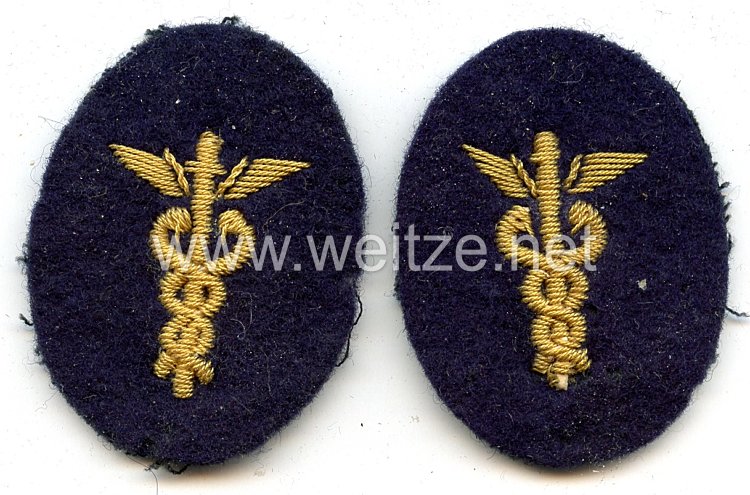
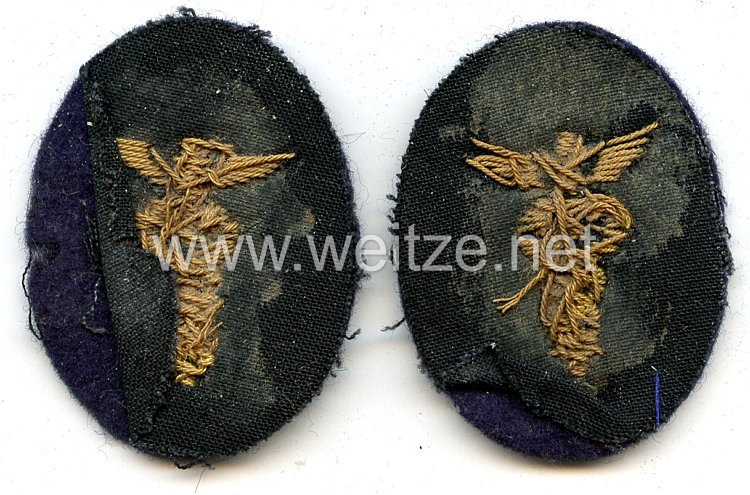
Kriegsmarine Pair of Sleeve Insignia for an Administrative Officer
The sleeve insignia for administrative officers of the Kriegsmarine represent a fascinating example of the complex rank badge system of the German naval forces during World War II. These hand-embroidered insignia on Cellon material testify to the importance that the NS regime attached to the visual distinction between different officer corps.
The Kriegsmarine, founded in 1935 after the official abandonment of the Treaty of Versailles, developed an extensive system of rank badges and specialization markings. Administrative officers formed a separate corps responsible for logistical, financial, and administrative support of fleet operations. These officers wore special sleeve insignia that distinguished them from seagoing officers.
The material Cellon was a semi-synthetic fabric frequently used as a base for high-quality hand-embroidered badges. The hand embroidery indicates manufacture for officers, as this was customary in contrast to machine-made versions for enlisted ranks. The use of Cellon provided a stable, water-resistant base for the elaborate embroidery work and was particularly advantageous in the maritime environment.
The administrative officers of the Kriegsmarine typically wore dark blue-violet badges that identified their affiliation with the administrative corps. In contrast to the gold braids of seagoing officers or the specific colors of other specializations (such as light blue for medical officers or crimson for engineers), the characteristic color of the administrative service was an important distinguishing feature.
The organization of the Kriegsmarine was based on Marine Service Regulation M.Dv. No. 51, which detailed the various uniform regulations and badges. These regulations were updated several times during the war, although the basic structure of the badge system remained largely constant. Administrative officers underwent special training and were generally not active seafarers, but were deployed at naval bases, in naval administration, or with fleet commands.
A pair of sleeve insignia was necessary as these were worn on both sleeves of various uniform jackets – both on the service jacket and on the dress uniform. The symmetrical placement was an essential element of military dress code and enabled the immediate identification of an officer's rank and function from any direction.
The hand embroidery of such badges required considerable craftsmanship. Specialized effects embroiderers and military tailors manufactured these insignia according to precise specifications. The quality of the embroidery work varied depending on the manufacturer, with private production often showing higher quality than the standardized versions from military clothing offices.
In the context of the Kriegsmarine hierarchy, administrative officers played an indispensable role. They were responsible for pay, provisions, equipment, and the complex logistics of a modern navy. Without their work, the operation of warships, submarines, and naval bases would not have been possible. Their badges thus symbolized not only a rank but specific expertise in the administrative field.
Today, such authentic Kriegsmarine badges are the subject of military historical collections and research. They provide important insights into the organizational structure of the German naval forces and the material culture of World War II. The preservation of such objects is important for understanding military history, whereby the historical context and critical examination of this era must always be paramount.