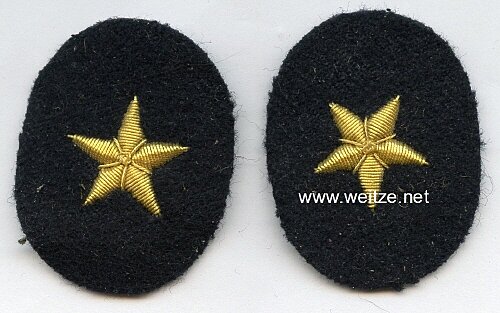
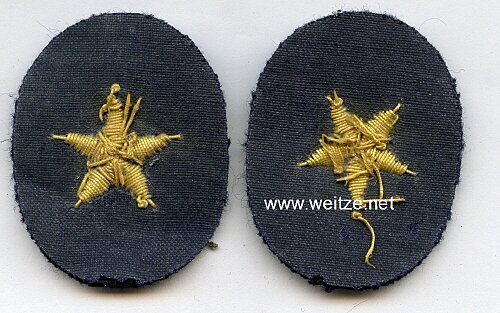
Kriegsmarine Pair of Sleeve Insignia for a Naval Officer

Executed with celleon embroidery, condition 2.
228259
15,00

Kriegsmarine Pair of Sleeve Insignia for a Naval Officer

The sleeve insignia for naval officers of the Kriegsmarine represent a significant element of German naval uniform regulations during the Third Reich era. These paired badges, manufactured using celleon embroidery, exemplify the traditional rank identification system that had its roots in the Imperial Navy and was continued in modified form after 1935.

The Kriegsmarine was officially established on June 1, 1935, through the Defense Law, replacing the Reichsmarine of the Weimar Republic. This reorganization brought comprehensive reforms to the uniform system, deliberately reviving many traditional elements from the Imperial Navy. Officer sleeve insignia were among the central rank indicators and followed a clearly defined system.

Celleon embroidery was a special manufacturing technique in which the base material was coated with a plastic-like, cellulose-based substance. This technique enabled particularly durable and weather-resistant execution of gold or silver embroidery. Celleon was an early cellulose-based plastic frequently used for military insignia in the 1920s and 1930s, as it represented a more cost-effective alternative to genuine metallic threads without significant visual compromises.

The rank insignia for naval officers were strictly regulated according to the uniform regulations (Anzeigeordnung - AZO) and corresponding dress codes. Officers wore identical badges on both sleeves of their uniform jackets, consisting of gold braids in various widths and arrangements. The number and thickness of the stripes precisely indicated the wearer's rank. Line officers wore gold braids, while officers of various branches and specialized services displayed additional colored distinction stripes between the braids.

The hierarchy ranged from Leutnant zur See (Sub-Lieutenant) with one narrow stripe to Großadmiral (Grand Admiral) with broad, multiple braids and stars. For example, a Kapitänleutnant wore two medium-width stripes, a Korvettenkapitän two broad and one narrow, while a Kapitän zur See displayed four medium-width stripes. Flag officers from the rank of Konteradmiral (Rear Admiral) upward carried gold stars in addition to the braids.

The manufacture of these sleeve insignia was carried out by specialized military effects manufacturers who were licensed as official suppliers to the Wehrmacht. Well-known firms such as Friedrich Linden of Berlin and other traditional manufacturers of military equipment produced these badges in different quality grades. The highest quality versions were hand-embroidered, while later wartime productions were increasingly machine-made.

Wearing the sleeve insignia was prescribed on various uniform types. They were worn on the service uniform, the formal service dress, as well as on coats and other outerwear. The position on the sleeve was precisely specified and was typically located in the lower third of the upper arm, approximately 10 to 12 centimeters above the cuff.

Historically, these sleeve insignia document not only the military rank structure but also the artisanal tradition of German military effects manufacturing. The use of celleon as a material also reflects the technological developments of the 1930s, when early plastics increasingly found their way into various areas of life.

After the war ended in 1945, all uniform parts and insignia of the Wehrmacht, including the Kriegsmarine, were banned by the Allies. Many pieces were destroyed or taken as souvenirs. Preserved examples like this pair of sleeve insignia are today important historical documents that provide insight into the military organization and uniform traditions of the German Navy between 1935 and 1945.

For collectors and historians, such insignia are of interest for studying the various manufacturing techniques, makers, and wearing practices. The condition, material quality, and craftsmanship are important criteria for evaluating and historically classifying such military-historical objects.

r