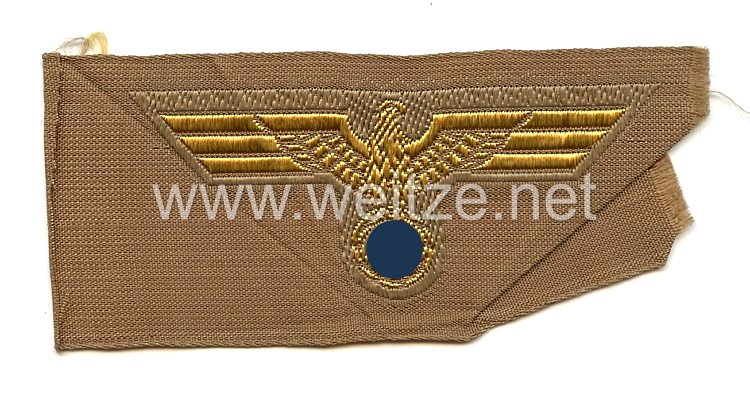
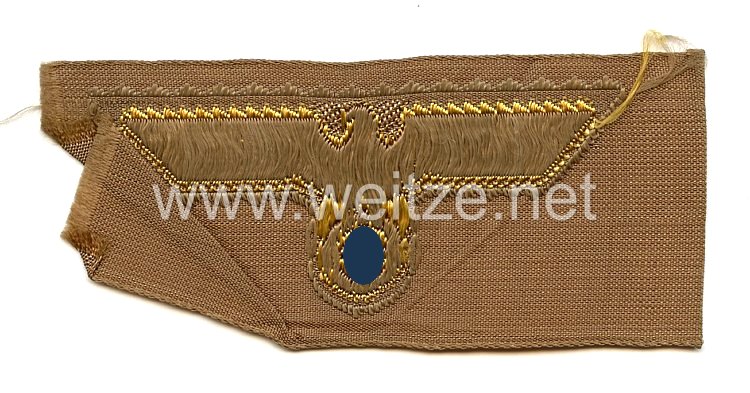
Kriegsmarine Afrikakorps Tropical Eagle for Side Cap or Tropical Field Cap

Bevo-woven version in yellow on sand color. Unworn, condition 2-, rare.
366059
100,00

Kriegsmarine Afrikakorps Tropical Eagle for Side Cap or Tropical Field Cap

The Kriegsmarine Afrikakorps Tropical Eagle represents a fascinating example of German military insignia from World War II, particularly those designed for use in tropical and North African climates. This badge was specifically developed for the side cap (Schiffchen) or tropical field cap of the Kriegsmarine and demonstrates the adaptability of German armed forces to different theaters of war.

The Bevo weaving technique used to manufacture this specimen was a characteristic feature of German military badges during the Nazi era. The company Bevo (Barmer Bandwaren- und Verbandstoff-Fabrik Wuppertal-Barmen) specialized in the production of woven insignia. This technique enabled precise, durable, and cost-effective mass production of badges. The yellow embroidery on sand-colored backing reflected the characteristic colors of tropical uniforms and was intended to provide both identification and camouflage in the North African desert environment.

The German Afrika Korps (DAK) was dispatched to Libya in February 1941 under the command of Lieutenant General Erwin Rommel to support Italian allies. While the main contingents of the Afrika Korps consisted of Army units, the Kriegsmarine also played an important role in the Mediterranean region and North Africa. Naval units were active in ports, coastal defense duties, and various support functions.

The introduction of special tropical uniforms and equipment became necessary when it became clear that German troops would be deployed for extended periods in climatically extreme regions. The tropical field cap, also known as the tropical side cap, was part of this adaptation. It offered better protection from intense solar radiation than standard field caps and was made from lighter, more breathable materials in olive, sand, or khaki tones.

The eagle as a symbol had a long history in German military tradition and was continued during the Third Reich. The national eagle with swastika was the official national emblem and was attached to uniforms, headgear, and equipment. In the Kriegsmarine, the eagle was traditionally worn on the upper part of caps, while the cap band bore the inscription “Kriegsmarine.”

The yellow-on-sand coloring was specifically chosen for tropical deployment areas. While the standard Kriegsmarine uniform featured the eagle in silver-gray or white on a dark background, the light tropical uniforms required adapted coloring. The yellow of the eagle formed a clear contrast to the sand-colored or olive fabric of the tropical cap, thus ensuring the insignia's visibility.

The production of such badges was subject to strict military regulations. The Army Regulation Sheets (Heeres-Verordnungsblätter) and corresponding naval regulations precisely defined how uniforms and badges should appear. Manufacturers had to be authorized and maintain certain quality standards. The Bevo technique enabled consistent quality and rapid production, which was crucial in wartime.

The condition of this specimen as “unworn” makes it particularly valuable for collectors and historians. Many such badges were never used, either because they were no longer issued at the end of the war or because they were held back as replacements. After the German capitulation in May 1945 and the complete dissolution of the Wehrmacht, large quantities of uniform parts and equipment were destroyed or lost.

The rarity of this piece is explained by several factors: First, the number of Kriegsmarine personnel in North Africa was relatively small compared to Army units. Second, the African campaign ended as early as May 1943 with the capitulation of the Axis powers in Tunisia, which limited the production time and thus the total number of pieces. Third, after the war, many such items were deliberately destroyed or lost in the chaos of the post-war period.

Today, such tropical badges are important historical artifacts that provide insight into the material culture of the German Wehrmacht. They document not only the technical aspects of uniform production but also the adaptation strategies of a modern army to different operational conditions. For military historians, they offer valuable information about logistics, production, and the daily reality of soldiers during World War II.

The sand-colored background of this Bevo-woven insignia was carefully selected to match the tropical uniforms issued to German forces in North Africa. The manufacturing process involved specialized looms that could produce intricate designs with multiple colored threads, creating a durable badge that could withstand the harsh conditions of desert warfare. The contrast between the yellow eagle and the sand background ensured visibility while maintaining the overall camouflage properties of the tropical uniform.

r