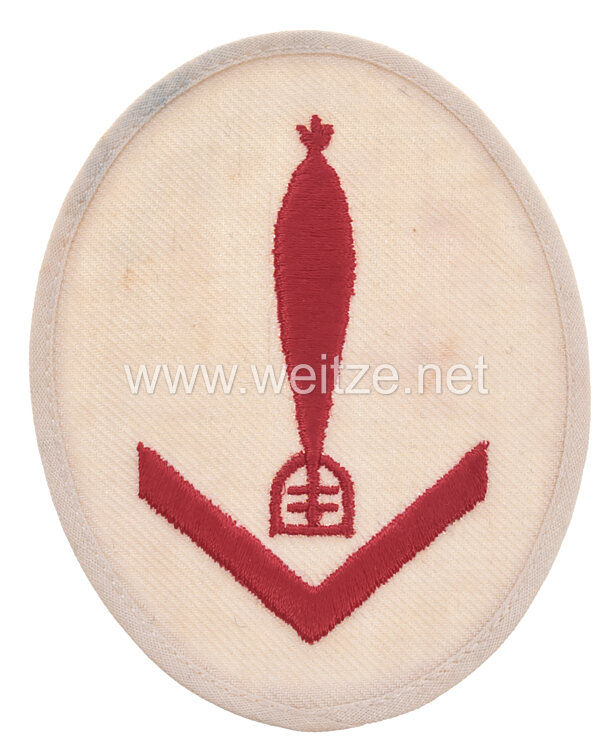
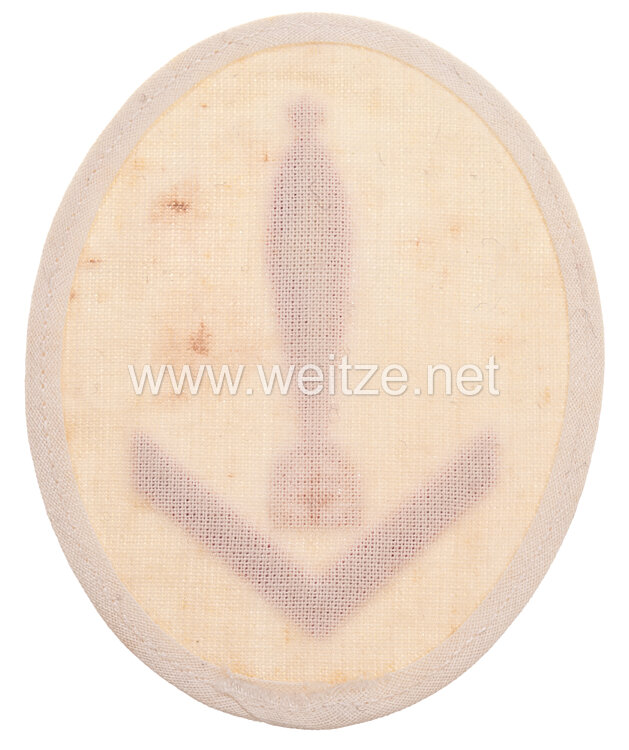
Kriegsmarine Sleeve Insignia Special Training Torpedo Weapons Control Petty Officer III

for the white blouse. Unissued condition, condition grade 2.
466359
35,00

Kriegsmarine Sleeve Insignia Special Training Torpedo Weapons Control Petty Officer III

The Kriegsmarine Sleeve Badge for Special Training Torpedo Weapons Leading Petty Officer III represents a highly specialized qualification badge of the German Navy during World War II. These badges were introduced to identify non-commissioned officers and enlisted men who had successfully completed special technical training in the field of torpedo weapons.

The Kriegsmarine introduced a comprehensive system of career and specialist badges from 1936 onwards to visually represent the various qualification levels and specializations within the navy. These markings served not only for external presentation but also enabled rapid identification of specialist personnel in emergency situations aboard ship. The torpedo weapon was considered one of the most complex and dangerous weapon systems of the time and required highly qualified personnel.

The Torpedowaffenleitvormann (Torpedo Weapons Leading Petty Officer) was a specialized non-commissioned officer responsible for directing and supervising torpedo weapons systems aboard warships, submarines, and fast attack craft. The designation “Vormann” identified an experienced petty officer who was superior to other crew members. The Roman numeral III designated the third qualification level within this specialization, whereby higher numerals represented lower qualification levels, while lower numerals indicated higher training stages.

The training to become a Torpedo Weapons Leading Petty Officer was extremely demanding and included theoretical instruction as well as practical exercises on complex torpedo systems. Participants had to acquire comprehensive knowledge in mechanics, hydraulics, electrical engineering, and ballistic calculations. Training took place at specialized naval schools, including the Torpedo School Mürwik near Flensburg and the Mine Warfare School in Kiel-Wik.

The sleeve badge for the white blouse was intended for wear on the summer uniform. The Kriegsmarine strictly distinguished between different uniform variants, and for each type of uniform there were corresponding badges in different designs. While on dark blue uniforms the badges were embroidered in light colors, the variants for the white summer uniform were typically in dark shades, usually in dark blue or black thread on a white background.

The wearing of these specialist badges was precisely regulated in the uniform regulations of the Kriegsmarine. Sleeve badges were usually worn on the left upper arm, with the exact position depending on the respective rank and type of badge. Career badges were placed on the right arm, specialist badges on the left arm.

The torpedo weapon played a central role in German naval warfare, particularly in the submarine war in the Atlantic. The complex mechanical and later electromechanical torpedoes required constant maintenance, adjustment, and proper handling. A Torpedo Weapons Leading Petty Officer bore considerable responsibility, as malfunctions not only led to the loss of valuable ammunition but could also endanger one's own ship. So-called “circle runners” – torpedoes that returned to one's own ship in a circular path after firing – posed a real threat.

The manufacture of these badges was carried out by various authorized manufacturers who had to meet the strict quality standards of the Kriegsmarine. The badges were hand-embroidered or machine-made, with hand-embroidered variants being preferred by officers. For the white uniform, a white cloth backing was often used on which the motif was applied.

After the end of World War II in 1945, the Kriegsmarine was dissolved, and all its rank badges, specialist badges, and decorations lost their official significance. Today, these historical militaria are sought-after collector's items that represent important testimonies of naval history. Unworn examples in good condition are particularly rare, as most badges were actually used and show corresponding signs of wear.

The preservation of such historical objects serves scholarly research and understanding of military history, whereby the historical context and critical examination of this era must always remain paramount.