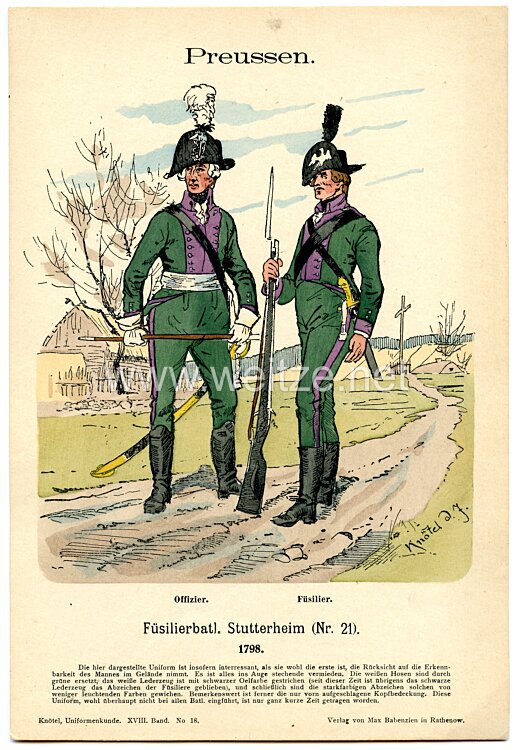
Knötel Uniform Plate “Füsilierbatl. Stutterheim (Nr. 21)” 1798

Condition 2.
456559
15,00

Knötel Uniform Plate “Füsilierbatl. Stutterheim (Nr. 21)” 1798

The Knötel uniform plates rank among the most significant documentations of military uniforms in the German-speaking world. The present plate depicts the Füsilierbataillon Stutterheim (No. 21) in the year 1798 and forms part of a comprehensive work that visually documents Prussian military history.

Richard Knötel (1857-1914) was the most prominent representative of an artist family that dedicated itself to depicting military uniforms across three generations. Together with his father Richard Knötel senior (1816-1898) and later his son Herbert Knötel (1892-1963), they created a monumental work comprising several thousand uniform plates. These plates remain indispensable sources for military historical research to this day, serving museums, collectors, and historians as reference works.

The Füsilierbataillon Stutterheim was a unit of the Prussian army of the late 18th century. Its numbering as Regiment No. 21 places it within the Prussian army system, which underwent strict organization under Frederick the Great and his successors. Fusiliers were originally light infantry equipped with shorter muskets called fusils. These weapons were more manageable than regular infantry muskets and enabled greater mobility in combat.

The year 1798 marks an important transitional period in European military history. Prussia found itself in a phase of relative neutrality following the Peace of Basel (1795), which had withdrawn Prussia from the First Coalition War against revolutionary France. Nevertheless, the army remained a central pillar of the Prussian state, and uniforming continued to follow the strict traditions of the Frederician system.

The uniforms of this period were characterized by distinctive features: the typical bicorne as headgear, the long coat in regimental colors, the mostly white or cream-colored knee breeches, and the gaiters. Fusiliers typically wore Prussian dark blue coats with regiment-specific facings and trimmings. These color combinations enabled identification of individual regiments on the battlefield and were strictly defined by royal regulations.

The Knötel plates are based on intensive source research. The artists studied historical documents, uniform regulations, contemporary depictions, and preserved uniform pieces in collections. Their works are therefore not only artistically valuable but also scientifically founded. Each plate typically shows several figure types of a regiment: officers, non-commissioned officers, and common soldiers, often also musicians such as drummers or hornists.

The Condition 2 of the present plate indicates a very good state of preservation. In the collector's world, the condition of military graphics and documents is usually evaluated on a scale, with Condition 1 being the best and Condition 5 the worst state of preservation. Condition 2 typically means that the plate is almost completely preserved, possibly with minor signs of aging, but without significant damage, stains, or discoloration.

The significance of such uniform plates for historical science can hardly be overestimated. While written sources often provide only general descriptions, the Knötel plates offer precise visual representations. They document not only the main components of uniforms but also details such as button arrangement, braiding, sword knots, rank differences, and equipment items such as cartridge pouches, sabers, or knapsacks.

For collectors of military historical graphics, original Knötel plates today represent coveted objects. Particularly plates from before 1900, still created by Richard Knötel senior or the middle Richard Knötel, are highly valued. They are testimonies of a time when military splendor and uniforming still held high value in society and before photography and modern printing techniques replaced hand-drawn plates.

The Füsilierbataillon Stutterheim bears its name after the respective regimental chief, a practice common in Prussia. These chiefs were often high-ranking nobles or distinguished generals whose names lent honor and tradition to the regiment. Identification through numbers and names enables precise historical classification of these units today.

The artistic and documentary value of these plates extends beyond mere military history. They provide insights into textile technology, dye production, tailoring techniques, and the material culture of the late 18th century. Each uniform represented a significant investment of resources and craftsmanship, reflecting the importance placed on military appearance and discipline in the Old Prussian army.

r