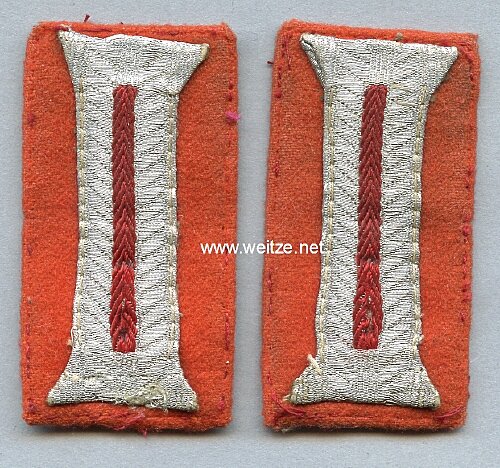
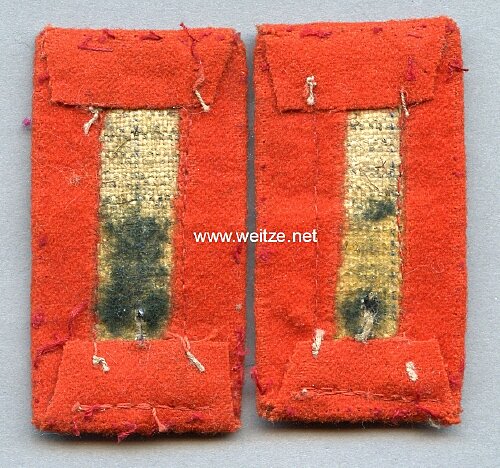
Wehrmacht Heer Pair of Sleeve Patches for Enlisted Men in Kreiswehrersatzamt or Feldgendarmerie

for the parade tunic, metal thread woven execution, condition 2-
183858
50,00

Wehrmacht Heer Pair of Sleeve Patches for Enlisted Men in Kreiswehrersatzamt or Feldgendarmerie

The enlisted men's sleeve patches of the Wehrmacht Heer (German Army) presented here represent an interesting testament to German military organization during World War II. These specific insignia were worn by members of the Kreiswehrersatzamt (District Recruitment Office) or the Feldgendarmerie (Field Gendarmerie) on their parade dress tunics.

The Kreiswehrersatzämter (KWEAs) formed the lowest level of the German military replacement administration from 1935 onwards. They were responsible for medical examinations, conscription, and registration of men liable for military service in their respective districts. Following the reintroduction of universal conscription through the Defense Law of March 16, 1935, a comprehensive system of recruitment agencies was established. The District Recruitment Offices were subordinate to the Wehrersatzdienststellen and later to the Wehrersatzinspektionen. Their importance grew considerably during the war, as they were responsible for the continuous supply of replacement personnel to the fighting troops.

The Feldgendarmerie, on the other hand, constituted the Wehrmacht's military police force. Their main duties included maintaining order in the rear army areas, traffic control, combating desertion and looting, and supervising prisoners. Field gendarmerie units were typically deployed with army corps and divisions. Members of the Feldgendarmerie wore the characteristic gorget (chain collar), which led to them being colloquially referred to as “chained dogs” (“Kettenhunde”).

The present sleeve patches are manufactured in metal thread woven execution, indicating their use for the parade dress tunic (Parade-Waffenrock). The Waffenrock was the Wehrmacht's dress uniform and was worn at ceremonial occasions, parades, and honor guards. Unlike the field-gray field uniform intended for daily service and combat deployment, the Waffenrock represented the more traditional, more representative uniform.

Identification through sleeve patches had a long history in German military tradition. They served for quick identification of the branch of service and specific function of a soldier. The metal thread execution was more elaborate and expensive than embroidered or printed variants and was therefore primarily used for parade uniform pieces. The weaving technique enabled precise patterns and greater durability.

For enlisted men – that is, soldiers without non-commissioned or commissioned officer rank – special uniform regulations applied. The Heeresdienstvorschrift (H.Dv., Army Service Regulation) and the Dress Regulations for the Army detailed precisely which insignia were to be worn where and in what form. Enlisted ranks included Schütze/Grenadier (Private), Oberschütze/Obergrenadier (Private First Class), Gefreiter (Lance Corporal), and Obergefreiter (Corporal). The sleeve patches of these ranks differed in material and execution from those of higher ranks.

The organizational connection between the District Recruitment Office and the Field Gendarmerie may seem unusual at first glance. In fact, personnel could transfer between different assignments, and members of recruitment offices could be detailed to field gendarmerie functions. Additionally, there were overlaps in responsibilities in the rear areas, particularly in collecting and returning stragglers.

The historical significance of such uniform items lies not only in their military function but also in their evidentiary value for the complex organization of the Wehrmacht. The military replacement administration was essential for warfare, as it ensured the supply of personnel replacements. By the end of the war, millions of men had been registered and conscripted through these offices. The Field Gendarmerie played an important, though often controversial, role in maintaining military discipline, with its members sometimes involved in war crimes.

The preservation of such uniform pieces in good condition is remarkable, as many items from this period fell victim to the ravages of war or were destroyed after 1945. Metal thread work was particularly susceptible to damage from mechanical stress and oxidation. The presence of a pair allows viewing as a complete set, as it was originally worn.

From a military-historical and collecting perspective, these sleeve patches document a specific aspect of German military organization between 1935 and 1945 and contribute to understanding the uniform studies and administrative structures of this era.