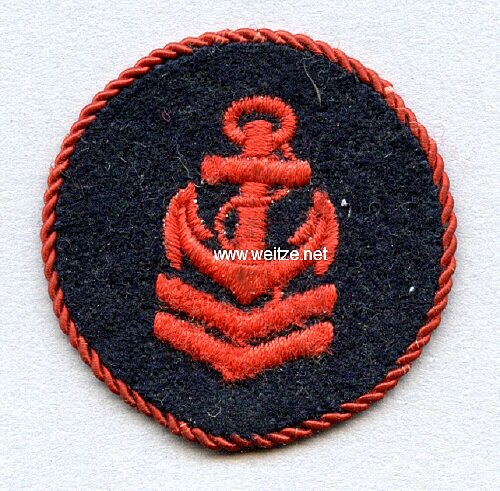
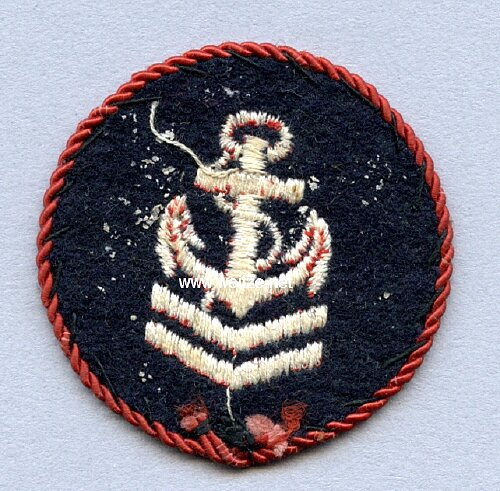
Marine-HJ Sleeve Insignia Reichsseesportprüfung B, as K-Schein
The Marine-HJ sleeve badge for the Reich Sea Sports Examination B, also known as the K-Schein (Coastal Skipper's Certificate), represents a significant artifact of the National Socialist youth organization and its maritime training programs. This machine-embroidered badge was worn on the blue naval blouse of the Marine-Hitlerjugend (Naval Hitler Youth) and documented the successful completion of specific nautical examinations.
The Marine-Hitlerjugend was established as a specialized formation within the Hitler Youth to prepare young men for service in the Kriegsmarine (German Navy). This organization played a central role in pre-military training and was designed to secure recruits for the German Navy. The Reich Sea Sports Examination was part of a systematic training program that conveyed theoretical knowledge and practical skills in seamanship.
The Reich Sea Sports Badge was awarded in various levels, with Examination B representing an advanced qualification. The term K-Schein refers to the Coastal Skipper's Certificate, a nautical qualification that certified the holder's specific knowledge in coastal navigation. The examinations typically included navigation, seamanship, meteorology, ship knowledge, and practical skills in sailing or motorboat operation.
Training in the Marine-HJ was strictly organized and followed the guidelines of the Reich Youth Leadership and the Kriegsmarine. Young men between 14 and 18 years of age were instructed in maritime skills, with theoretical training supplemented by practical exercises on waterways. Passing the examination entitled the bearer to wear the corresponding badge, which was affixed to the left upper arm of the uniform.
The machine-embroidered execution of this badge was characteristic of the period and reflects the standardized manufacturing methods typical of Third Reich uniform insignia. Unlike hand-embroidered variants, which were often reserved for officers, machine-embroidered badges were produced in larger quantities and were intended for the broad membership. The embroidery was typically done on blue cloth, matching the color of the naval blouse.
The blue naval blouse was the characteristic uniform of the Marine-HJ and was modeled after the clothing of the Kriegsmarine. It differed distinctly from the brown uniform of the general HJ and emphasized the special position of the maritime youth organization. Wearing achievement badges such as the Reich Sea Sports Badge served not only to document acquired skills but also to promote motivation and esprit de corps within the organization.
The rarity of such badges today is due to several factors. First, they were only awarded to members who successfully completed the corresponding examinations, which limited their distribution from the outset. Second, many NS memorabilia were destroyed or hidden after 1945. Surviving examples are often in varying states of preservation, with lightly worn pieces being particularly sought after as they show authentic traces of use without being heavily damaged.
The historical classification of such objects requires a nuanced understanding. They are testimonies of a time when youth were systematically instrumentalized for military purposes. The Marine-HJ was an integral component of the National Socialist system for preparing youth for war. At the same time, these badges document the maritime training tradition and the technical requirements placed on their bearers.
Collectors and historians value such objects as material remnants of a significant, albeit dark, epoch in German history. They enable a better understanding of the organization, hierarchies, and training systems of the Third Reich. The authenticity and rarity make these badges important study objects for military history and the research of National Socialist youth organizations.