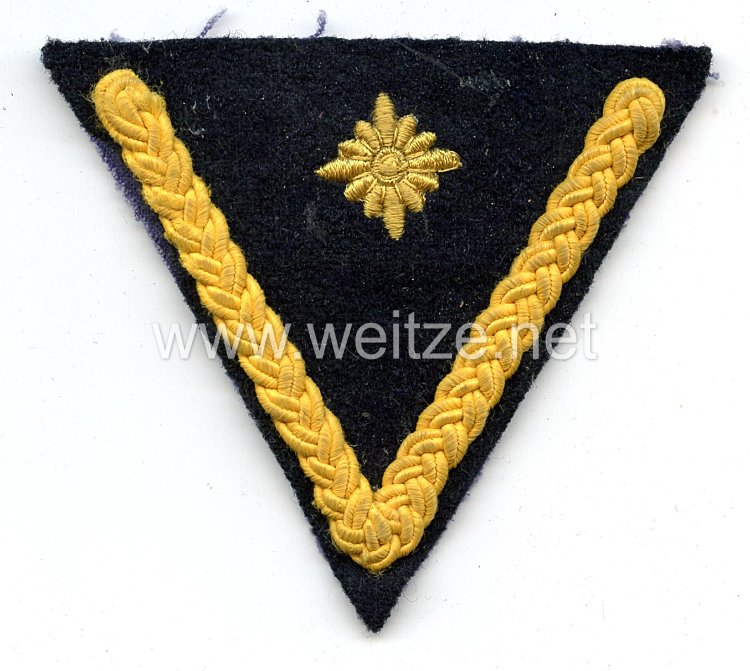
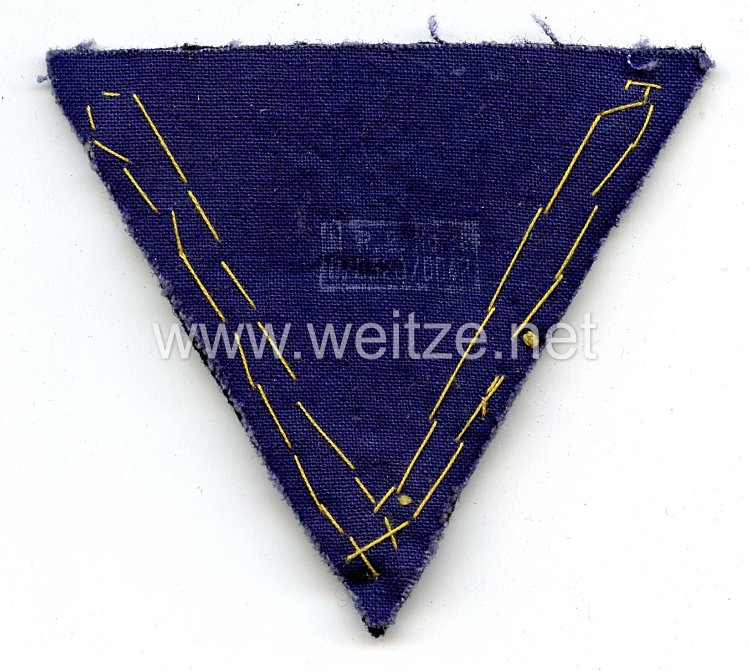
Kriegsmarine Sleeve Insignia for a Matrosenobergefreiter with More Than 6 Years of Service
This Kriegsmarine sleeve insignia for a Matrosenobergefreiter (Able Seaman) with more than 6 years of service represents a significant example of the rank badges and service time decorations of the German Kriegsmarine during World War II. This particular version for the blue uniform documents the sophisticated system of rank identification used in the German Navy between 1935 and 1945.
The Kriegsmarine was officially established on June 1, 1935, as the successor to the Reichsmarine, after National Socialist Germany openly rejected the military restrictions of the Treaty of Versailles. Under the leadership of Grand Admiral Erich Raeder and later Karl Dönitz, the Kriegsmarine developed a comprehensive system of uniforms and rank insignia that partially drew upon the traditions of the Imperial German Navy.
The rank of Matrosenobergefreiter (MObergefr.) was positioned in the lower hierarchy of enlisted ranks. In ascending order, the enlisted ranks were: Matrose (Seaman), Matrosengefreiter (Seaman First Class), Matrosenobergefreiter (Able Seaman), and Matrosenhauptgefreiter (Leading Seaman). The Matrosenobergefreiter thus stood above the simple Gefreiter but below the Hauptgefreiter. This rank was typically awarded after approximately three to four years of service, taking into account the sailor's performance and conduct.
The service time badge for more than six years of service was a special distinction documenting long-term affiliation with the Navy. The Kriegsmarine introduced various service time badges worn on the left forearm. These badges were designed in the form of chevrons and were worn in different numbers depending on length of service. One chevron typically indicated four years of service, while additional chevrons indicated longer service periods.
The blue uniform, for which this badge was made, was the standard walking-out uniform of the Kriegsmarine. In contrast to the white summer uniform or the various working and shipboard uniforms, the blue uniform was worn on official occasions, during shore leave, and in garrison duty. The uniform regulations of the Kriegsmarine were detailed in the Dress Regulations for the Kriegsmarine (M.Dv. Nr. 410), which was revised and supplemented several times.
The manufacture of such badges was carried out by various manufacturers in the German Reich and in occupied territories. Quality and workmanship could vary depending on the manufacturer and availability of materials, especially in the later war years. The badges were typically embroidered on dark blue cloth and sewn onto the sleeve. The embroidery was usually done with yellowish or golden artificial silk that simulated traditional gold embroidery.
A Matrosenobergefreiter with more than six years of service was an experienced soldier in the Kriegsmarine who had likely completed several deployments or service periods. In the early war years, six years of service meant that the wearer had been serving since approximately 1939 or earlier, possibly still in the pre-war Kriegsmarine. Such experienced crew members were valuable for training younger recruits and formed the backbone of ship crews.
The Kriegsmarine deployed its forces in all maritime theaters of war, from the Atlantic to the North Sea, the Mediterranean, and Arctic waters. Sailors served on a wide variety of units: from the famous U-boats to surface warships, coastal batteries, and naval bases. The actual duties of a Matrosenobergefreiter could vary greatly depending on whether he was deployed as a boatswain, radio operator, gun crew, or in other specializations.
The condition grade 2 of this specimen indicates a well-preserved piece that has survived the years. Such badges are today important military-historical artifacts that provide insight into the rank system and organizational structure of the Kriegsmarine. They serve as material witnesses to the personal history of thousands of soldiers who served in the German Navy.
The study of such uniform items contributes to the understanding of the military culture and organization of the Third Reich. At the same time, they remind us of the complex and often tragic history of the Kriegsmarine, which was involved in a criminal war of aggression and whose members experienced different fates.