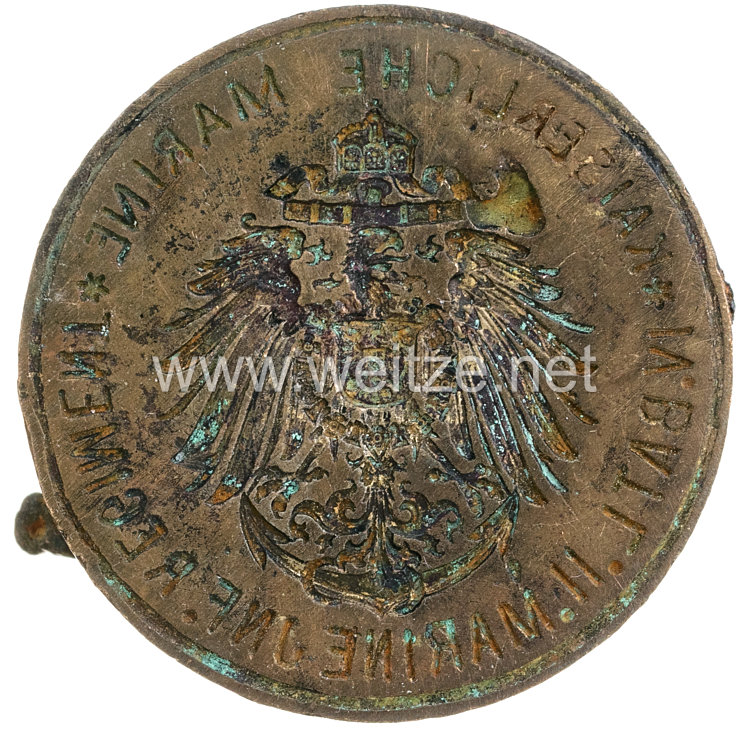
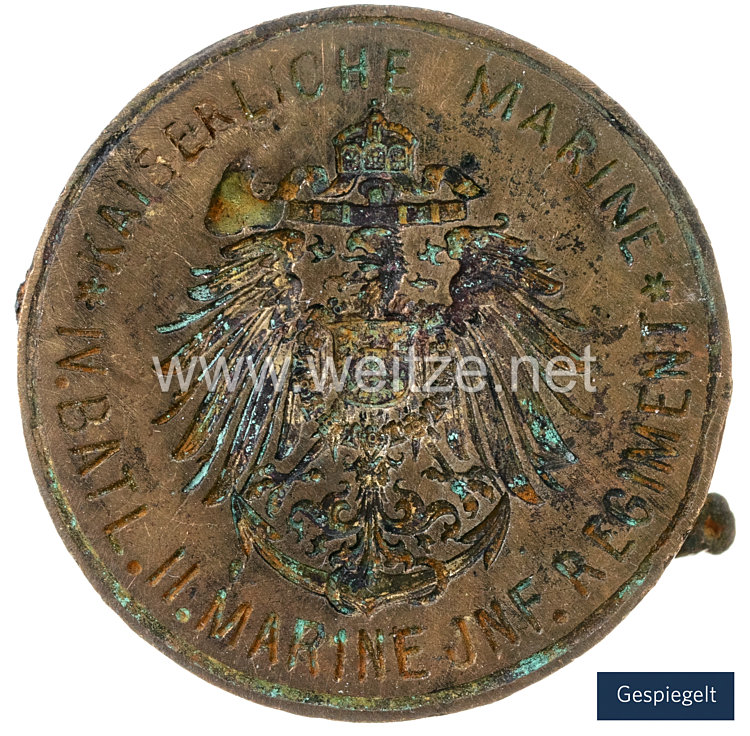
Imperial German Navy Seal/Petschaft "IV. Batl. II. Marine Inf. Regiment"
Remaining stock from the former Imperial Naval Office, circa 1919.
The 2. Marine-Infanterie-Regiment belonged to the 3rd Division of the Marinekorps Flandern.
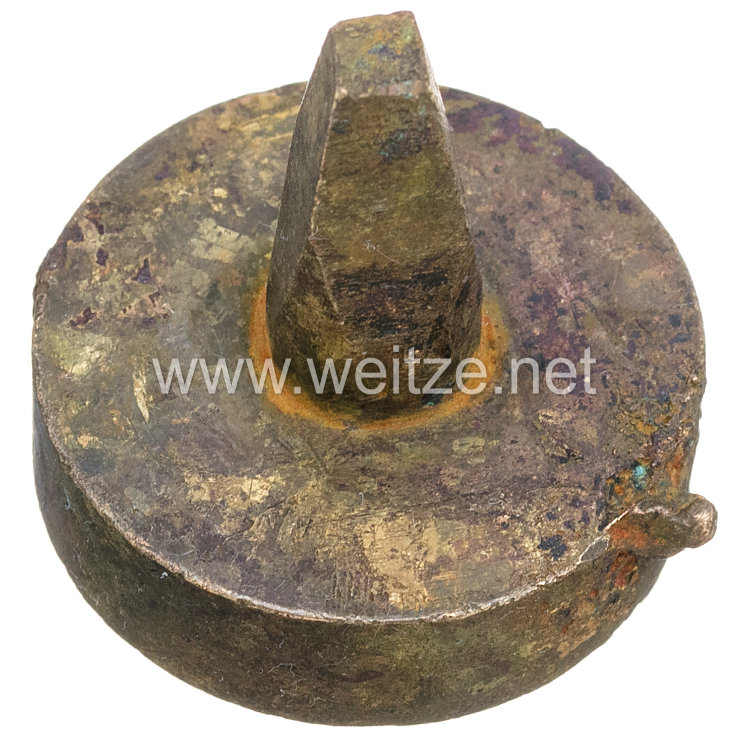
This seal or signet stamp of the IV. Battalion of the II. Marine Infantry Regiment of the Imperial German Navy represents a significant artifact of German naval history during World War I. Its construction of a lead core with a brass casing exemplifies the standardized manufacture of official seal stamps used throughout the various offices of the imperial armed forces.
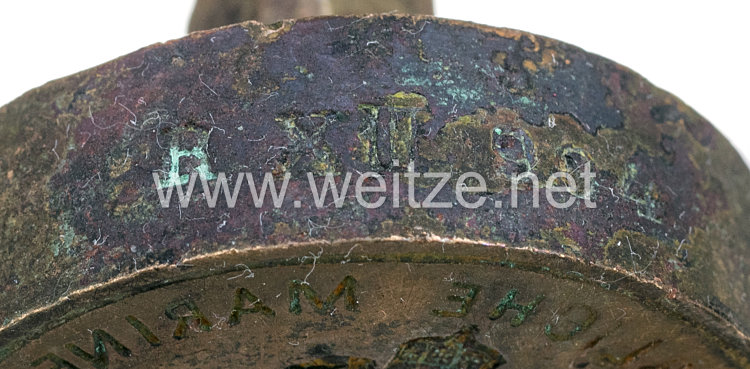
The edge marking "R XII 904" refers to the systematic inventory system within the Imperial Naval Office (Reichsmarineamt), the central administrative authority of the Imperial Navy. This institution, founded in 1889 under State Secretary Vice Admiral Alexander von Monts, was responsible for the entire organization, administration, and development of the German war navy. The Reichsmarineamt in Berlin coordinated not only shipbuilding and strategic planning but also the administration of all naval offices, including the Marine Infantry units.
The 2nd Marine Infantry Regiment belonged to the 3rd Division of the Marine Corps Flanders, a special formation deployed on the Western Front during World War I. The Marine Corps Flanders was established in the summer of 1914 and was initially responsible for defending the Belgian coast and the German U-boat bases located there. These marine infantrymen were specially trained soldiers prepared for both amphibious operations and regular land warfare.
The Marine Infantry Regiments of the Imperial Navy held a special position within the German armed forces. They were administratively subordinate to the Navy but frequently fought on land. During the course of World War I, these units were increasingly involved in trench warfare on the Western Front, particularly in Flanders, where they distinguished themselves in the fierce battles around Ypres, Dixmude, and the coastal areas.
The use of seals and signet stamps was of central importance in the German military system for authenticating documents, orders, and official correspondence. Each unit possessed its own seals used for certification and to prevent forgery. The craftsmanship featuring a lead core and brass casing was typical for military seals of this period—robust, durable, and designed for daily service use.
The survival of this seal as "remaining stock from the former Imperial Naval Office, circa 1919" is historically significant. After the German defeat in November 1918 and the signing of the Armistice of Compiègne, the dissolution of the imperial armed forces began. The Reichsmarineamt was dissolved as part of the restructuring of the German Navy and the founding of the Weimar Republic. Many administrative files, seals, and other official items were discarded, archived, or sold.
The dissolution of the Marine Corps Flanders occurred after the war's end, when German troops had to withdraw from Belgium. The units were demobilized, and their administrative legacies were returned to the Reichsmarineamt or kept in its holdings. Such seals, no longer needed, frequently entered private ownership or were acquired by collectors.
The IV. Battalion as part of the 2nd Marine Infantry Regiment represents the typical organization of these units. A regiment typically consisted of several battalions, each comprising several hundred men. These battalions were the basic tactical units that could operate independently but remained under the superior regimental command.
Today, such seals represent important historical artifacts that provide insight into the administrative structures and organizational history of the Imperial Navy. They are of interest not only from a military-historical perspective but also for researching the everyday history of military administration. The preserved seals enable historians to trace the structure and hierarchy of various units and to verify the authenticity of historical documents.
The provenance from the Reichsmarineamt gives this object additional historical credibility and documents the direct connection between the fighting troops and the central naval administration in Berlin. It is a silent witness to a bygone era of German military history that ended with the conclusion of World War I and the collapse of the German Empire in 1918/19.
The Marine Infantry units were elite formations recruited from sailors with extensive training in land combat. Their esprit de corps and naval traditions set them apart from regular army units. The Marine Corps Flanders particularly became known for its tenacious defensive fighting and high morale even under the most difficult conditions of trench warfare. The official seals of these units thus represent not merely administrative tools but symbols of organizational identity and military tradition during the final years of Imperial Germany.