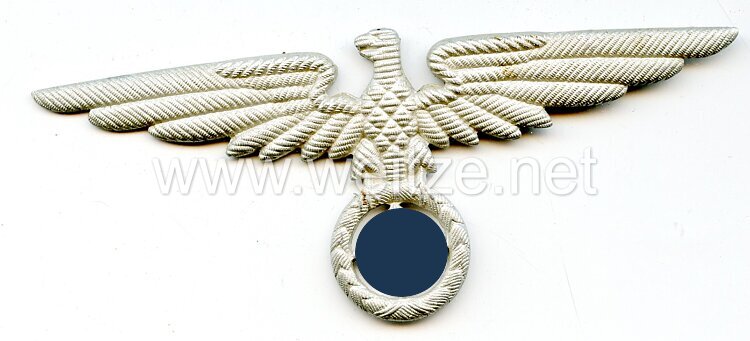
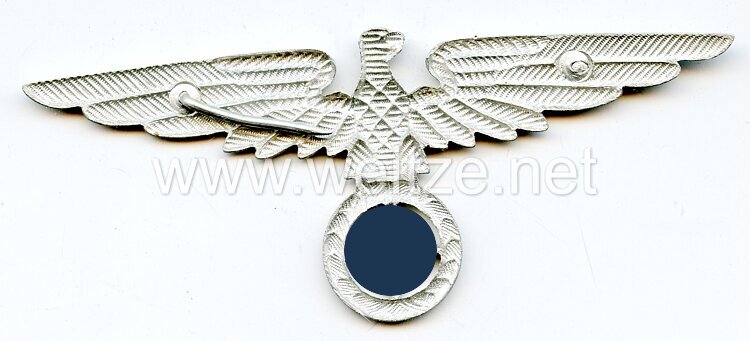
XI. Olympic Games 1936 Berlin - Eagle for the Visor Cap of the German Olympic Team and for the Members of the German NOC

Aluminum, wingspan approx. 95 mm, 1 split pin present, condition 2.
463057
650,00

XI. Olympic Games 1936 Berlin - Eagle for the Visor Cap of the German Olympic Team and for the Members of the German NOC

The Olympic eagle cap badge for the German Olympic team of 1936 represents a significant historical artifact from one of the most politically controversial Olympic Games in history. These badges were specifically manufactured for the XI. Summer Olympic Games in Berlin, which took place from August 1 to 16, 1936.

The 1936 Games were the first Olympic Games hosted by Nazi Germany. The International Olympic Committee had selected Berlin as the venue in 1931, two years before Adolf Hitler came to power. The Nazi leadership quickly recognized the propaganda value of this event and used the Games as a platform to present the “Third Reich” to an international audience.

The present specimen is manufactured from aluminum, a material increasingly used for military and official badges during the 1930s. With a wingspan of approximately 95 millimeters, it corresponds to the standardized dimensions for cap badges of that era. The attachment was accomplished by means of split pins on the reverse side, one of which is still present on this piece.

The eagle as a symbol had a centuries-long tradition in German heraldry. During the Nazi period, however, the eagle was imbued with specific ideological connotations. With Olympic badges, an attempt was made to maintain a compromise between Nazi symbolism and Olympic neutrality. The eagle for the Olympic team often differed subtly from purely party or military eagles through its design and orientation.

These badges were worn by two groups: members of the German Olympic team itself and officials of the German National Olympic Committee (NOK). The German NOK, initially under Theodor Lewald and later under other leadership figures, was responsible for organizing and coordinating German participation.

The German Olympic team in 1936 comprised a total of 348 athletes, making it one of the largest national delegations. Germany placed first in the medal count with 33 gold medals, 26 silver medals, and 30 bronze medals - a result that was extensively exploited by Nazi propaganda.

The uniforming of the German delegation was carefully planned and intended to demonstrate discipline, order, and national unity. The peaked caps with Olympic eagles were part of this official attire and were worn at official events, ceremonies, and during competitions.

From today's perspective, such objects are of historical and museological interest. They document not only sporting history but also the political instrumentalization of sports by totalitarian regimes. The 1936 Games were a turning point in Olympic history and are often referred to as the “Nazi Olympics,” although they also produced moments of international sportsmanship, such as the triumphs of African American athlete Jesse Owens.

The preservation and collection of such objects is important from a historical perspective but also raises ethical questions. They serve as tangible reminders of a time when sports and politics were intertwined in a fateful manner. Museums and collectors today treat these artifacts with the necessary historical context to convey their significance as witnesses to a problematic past.

The present specimen in condition 2 shows typical signs of wear, suggesting that it was actually worn and not merely warehouse stock. The aluminum construction has survived the decades relatively well, although the light metal is susceptible to oxidation and mechanical damage.

Such badges were partially confiscated after the Olympic Games or kept by their wearers as memorabilia. The survival rate varies, with many pieces destroyed or hidden after 1945 for understandable reasons. The specimens still existing today are found in museums, historical collections, or with private collectors of military historical artifacts.