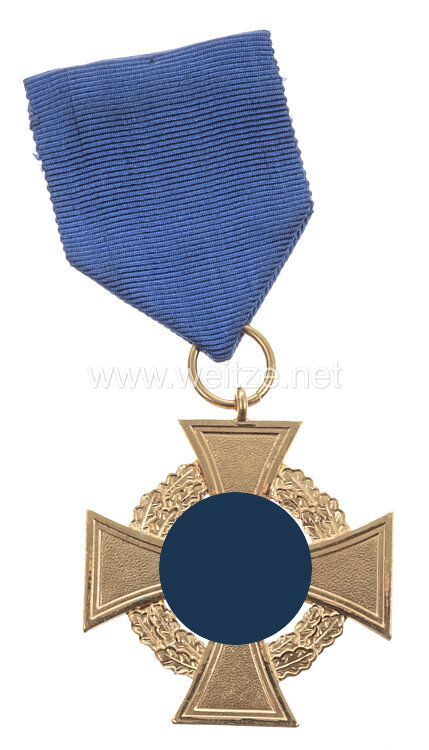
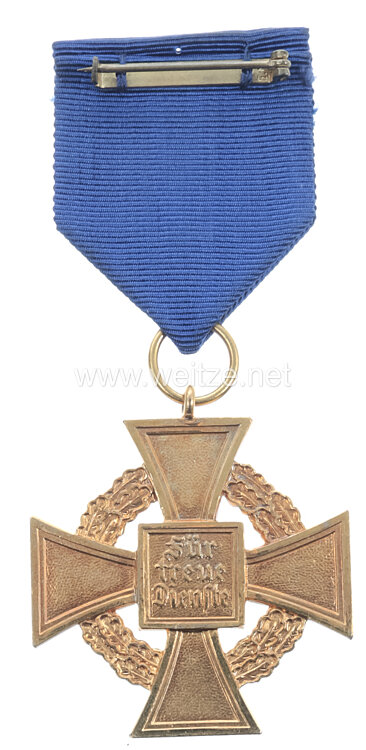
Faithful Service Decoration 1st Class for 40 Years

Gilt bronze, on ribbon with pin-back mounting, condition 2.
464957
120,00

Faithful Service Decoration 1st Class for 40 Years

The Treudienst-Ehrenzeichen (Faithful Service Award) ranks among the most significant decorations of National Socialist Germany for long-term service in the civil service. The 1st Class for 40 Years of Service presented here represented the highest attainable grade of this award and was only conferred upon individuals who could demonstrate four decades of uninterrupted service.

The legal foundation for this decoration was established by the Decree on the Institution of a Faithful Service Award of March 1, 1939, signed by Adolf Hitler as Führer and Reich Chancellor. The award was intended to honor the loyalty and dutiful service of employees in the German civil service and consisted of three grades: for 25, 40, and 50 years of service. The 1st Class for 40 years was manufactured from gilt base metal, distinguishing it from the 2nd Class (25 years) in silver-plated metal and the Honorary Class (50 years) in genuine gold.

The design of the award followed typical National Socialist aesthetic principles. The central element featured a swastika, surrounded by an oak leaf wreath as a traditional symbol of loyalty and constancy. The reverse typically bore the inscription “Für treue Dienste” (For Faithful Service) along with the year of manufacture. The award was worn on a ribbon whose colors indicated the respective grade. The 1st Class for 40 years was characterized by a red-white-black ribbon, with colors referencing the Reich colors of the German Empire.

The conferral practice was strictly regulated. Civil servants, employees, and workers in Reich service, in the service of the states, municipalities, and other public law corporations were eligible. Members of the NSDAP and its affiliated organizations could also receive the award for corresponding periods of service. The 40-year service period had to be documented without gaps, though certain periods such as military service could be credited under specific conditions.

Production was carried out by various authorized manufacturers throughout the Reich territory. The base metal used was gilded to achieve the required golden appearance of the 1st Class. The wearing pin enabled attachment of the award to the ribbon, which in turn was worn on the uniform or civilian clothing. The craftsmanship quality varied depending on the manufacturer and war year, with later examples frequently made from substitute materials.

The historical significance of the Treudienst-Ehrenzeichen must be viewed ambivalently. On one hand, it continued a long tradition of honoring faithful service that had already existed in the Imperial period and the Weimar Republic. On the other hand, it served the National Socialist leadership as an instrument for binding and motivating civil servants to the regime. The conferral carried a certain prestige and was recorded in personnel files.

After the end of World War II in 1945, wearing all National Socialist decorations was prohibited by the Allied occupation powers. The Law on Titles, Orders and Decorations of 1957 of the Federal Republic of Germany regulated the handling of these awards anew. Wearing them in modified form without National Socialist symbols was permitted under certain conditions but remained highly controversial and was rarely practiced.

Today, Treudienst-Ehrenzeichen are collector's items and testimonies to a dark epoch of German history. They document the penetration of all areas of public life by National Socialist ideology. The historical value of these objects lies in their function as illustrative material for research on the NS regime and its mechanisms of rule. Scholarly engagement with such decorations contributes to understanding the social and administrative history of the Third Reich.

The present example in condition grade 2 indicates good preservation, though slight signs of use may be present. The gilding and the wearing pin on the ribbon correspond to the original form of execution. Such pieces are important historical documents that contribute to education and enlightenment about the National Socialist past in museum collections and scholarly contexts.

r