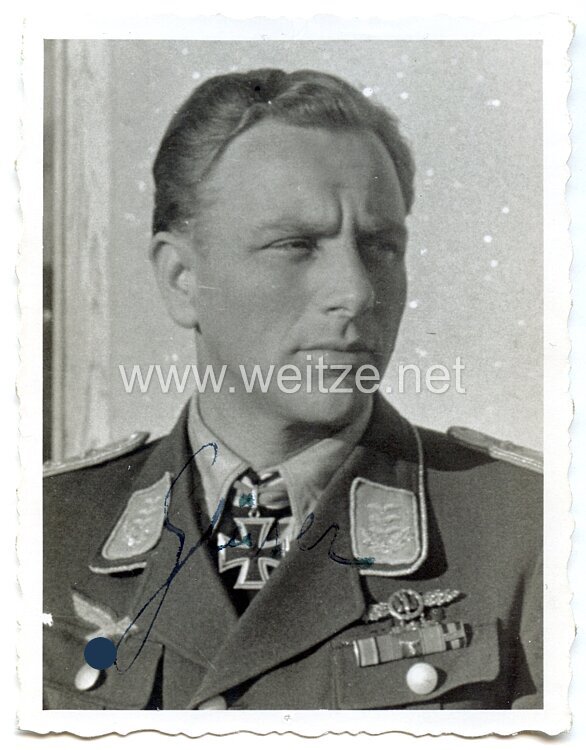
Luftwaffe - Original Signature of Knight's Cross Recipient Hauptmann Alexander Gläser

on a portrait photograph 8.5 x 10.5 cm wearing full decorations, with very fine ink signature "Gläser", condition 2.
Alexander Gläser received the Knight's Cross as Oberleutnant and Staffelkapitän of 4./Stuka-Geschwader 77 on February 19, 1943 and the 811th Oak Leaves on March 28, 1945.
289157
200,00

Luftwaffe - Original Signature of Knight's Cross Recipient Hauptmann Alexander Gläser

This signed portrait photograph documents Hauptmann Alexander Gläser, a highly decorated dive bomber pilot of the German Luftwaffe during World War II. Such signed photographs of Knight's Cross recipients represent important historical documents that provide insight into the propaganda and honors culture of the Nazi regime as well as the personal fates of the soldiers involved.

Alexander Gläser served as squadron commander of the 4th Squadron of Sturzkampfgeschwader 77 (StG 77), one of the most famous Stuka units of the Luftwaffe. On February 19, 1943, he was awarded the Knight's Cross of the Iron Cross as an Oberleutnant, one of the highest military decorations of the German Reich. Even more remarkable is the award of the Oak Leaves to the Knight's Cross on March 28, 1945, when he received number 811 of this rare decoration. At this late stage of the war, just weeks before Germany's capitulation, such honors were only awarded to very few soldiers.

Sturzkampfgeschwader 77 participated in nearly all major Wehrmacht campaigns, from Poland through France, the Balkans, the Eastern Front to North Africa and Italy. The Junkers Ju 87 “Stuka”, the characteristic dive bomber with its inverted gull wings and distinctive siren, became a symbol of German Blitzkrieg tactics. Stuka pilots conducted precision dive attacks against enemy positions, tanks, ships, and infrastructure, exposing themselves to enormous dangers from anti-aircraft fire and enemy fighters.

Signed portrait photographs like this one were widespread during World War II. They served several purposes: on one hand, they were given by soldiers to family members, comrades, or superiors. On the other hand, they played an important role in Nazi propaganda, which built up war heroes and used their deeds to boost morale on the home front. Knight's Cross recipients were particularly highlighted and often used for propaganda purposes, appearing in newspapers, newsreels, and at events.

The photograph shows Gläser in full uniform with his decorations, which was typical for such official or semi-official photographs. Wearing all awards during portrait sessions corresponded to military customs and was intended to make the wearer's rank and merits visible. The ink signature confirms the document's authenticity and makes it a personal testimony.

The format of 8.5 x 10.5 cm corresponds to a common postcard format of the time, suggesting possible use as a field postcard or personal memento. Such formats were practical for mailing and storage in photo albums or personal archives.

From a military-historical perspective, such objects document not only individual careers but also the organization and hierarchy of the Wehrmacht, the decoration system of the Third Reich, and the role of the Luftwaffe in World War II. The late award of the Oak Leaves in March 1945 also sheds light on Germany's desperate military situation in the final weeks of the war, when the regime continued to attempt to maintain fighting morale through decorations.

Today, such signed photographs are of historical interest to collectors, researchers, and museums. They help reconstruct the history of individuals and provide authentic primary sources for military history research. The indicated condition 2 suggests a well-preserved photograph with minor signs of use, which is remarkable for documents over 80 years old.

The preservation of such objects serves historical examination and remembrance, not glorification. They enable subsequent generations to better understand the reality of war, the propaganda mechanisms of totalitarian regimes, and the individual fates of those involved.