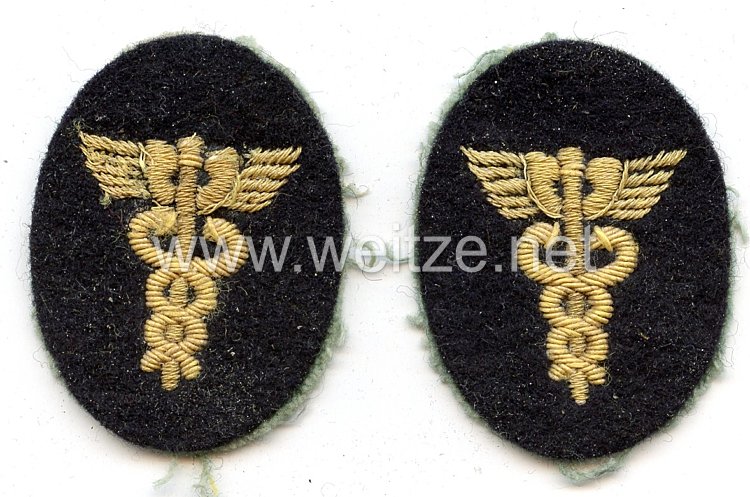
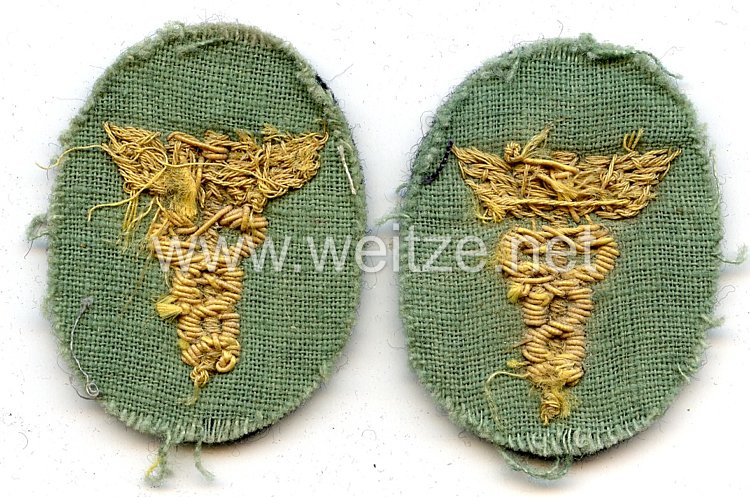
Kriegsmarine Pair of Sleeve Insignia for an Administrative Officer

Celleon hand-embroidered version, Condition 2.
441057
55,00

Kriegsmarine Pair of Sleeve Insignia for an Administrative Officer

The sleeve insignia for Administrative Officers of the Kriegsmarine represent an important aspect of the complex rank insignia system of the German Navy during World War II. These hand-embroidered celluloid badges were part of the rank identification system that made it possible to recognize not only an officer's rank but also his specific assignment within the Kriegsmarine.

The Kriegsmarine, as the official designation of the German Navy from 1935 to 1945, developed a differentiated system of rank insignia and career path identifications. Following the reintroduction of conscription and the breaking of the Versailles Treaty in 1935, the Reichsmarine was renamed Kriegsmarine. With the rapid growth of the navy, a clear structuring of the various officer assignments became necessary.

Administrative Officers (Verwaltungsoffiziere) formed an essential part of the naval organization. They were responsible for administrative, financial, and logistical tasks within the Navy. Their duties included the management of provisions, clothing, pay, accounting, and other bureaucratic matters essential for the smooth operation of a modern navy. These officers belonged to the so-called Special Officers or Officers in Special Assignment, who were distinct from sea-going naval officers.

The sleeve insignia of Administrative Officers were worn on the sleeves of service jackets and consisted of gold-yellow stripes on a dark blue background. The distinctive feature of Administrative Officers lay in the coloring between the rank braids: while sea-going officers had no intermediate color, Administrative Officers wore a dark blue color between the golden braids. This color coding enabled immediate identification of the career group.

The badges described here in Cellon execution represent a high-quality variant of sleeve insignia. Cellon was a cellulose-based material that provided a smooth, glossy surface and served as a backing for hand embroidery. The hand-embroidered execution was typically of higher quality than machine-made variants and was often preferred by officers who valued quality and correct appearance. The embroidery was usually done with gold wire or gold-colored thread on the appropriate background.

The wearing of sleeve insignia was precisely regulated in the Dress Regulations for the Kriegsmarine (Anzugordnung für die Kriegsmarine). These regulations, which were updated several times during the war, specified which insignia were to be worn on which uniform items and on which occasions. Paired sleeve insignia were attached to both sleeves of the uniform jacket, typically on the naval service jacket and coat.

The rank structure of Administrative Officers largely corresponded to that of sea-going officers, from the lowest officer ranks to the highest rank of an Admiral of Administration. The number and arrangement of gold braids on the sleeves indicated the exact rank: thinner braids for lower ranks, wider and additional braids for higher ranks, with possible stars for flag officers.

The production of such insignia was carried out by specialized military effects manufacturers and private companies supplying naval equipment. Well-known manufacturers were based in cities such as Hamburg, Kiel, and Wilhelmshaven, the traditional naval bases of the German Reich. The quality of insignia varied depending on the manufacturer and time of production; toward the end of the war, simpler materials were often used.

Today, such original Kriegsmarine sleeve insignia are sought-after collectors' items that provide insight into the military organization and hierarchy of the German Navy during World War II. They document not only the craftsmanship quality of military effects production of that era but also the importance attached to correct uniforming and rank identification. The indicated condition 2 suggests well-preserved pieces, which is remarkable for textile militaria from this period.