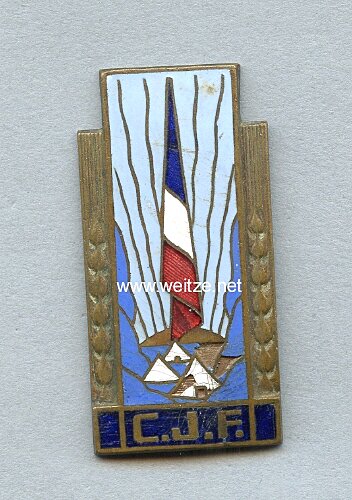
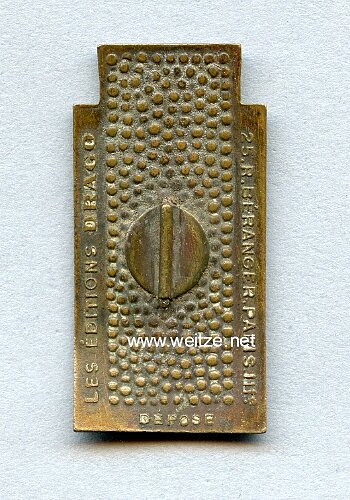
France World War II Vichy Government Membership Badge "Chantiers de la Jeunesse"
The Chantiers de la Jeunesse (Youth Worksites) was a paramilitary youth organization of the Vichy Regime in France during World War II. This organization was established by law on July 30, 1940, just weeks after the French capitulation and the establishment of the Vichy government under Marshal Philippe Pétain.
The creation of the Chantiers de la Jeunesse came as a direct response to the provisions of the Armistice Agreement of June 22, 1940, which prohibited France from maintaining a regular army in the occupied zone. General Joseph de La Porte du Theil was appointed as General Commissioner and significantly shaped the organization. The Chantiers officially served as a replacement for compulsory military service and were intended to encompass all young men aged 20 for a period of eight months.
The ideological orientation of the organization reflected the values of the “Révolution nationale” (National Revolution) propagated by the Vichy regime: Travail, Famille, Patrie (Work, Family, Fatherland). Young men were housed in rural camps where they participated in reforestation projects, agricultural work, and infrastructure projects. Training included physical fitness, moral education in line with Vichy ideology, and practical work in nature.
The membership badge described here represents a typical example of the decorations awarded to members of the Chantiers de la Jeunesse. These enameled badges were produced in various versions and served to identify membership in the organization. The craftsmanship quality varied depending on the production period and manufacturer, with enameled versions considered higher quality than simple metal versions.
Between 1940 and 1944, an estimated 400,000 young Frenchmen passed through the Chantiers de la Jeunesse. The organization initially operated only in the unoccupied zone but later expanded its activities. Camps were distributed throughout southern France, with concentrations in the mountain regions of the Pyrenees, the Massif Central, and the Alps.
The role of the Chantiers de la Jeunesse in French history remains ambivalent. While the organization was officially supposed to be apolitical and focused on physical labor and moral education, it was nonetheless an integral part of the collaborationist Vichy system. However, some members and even individual camp leaders used their position to later defect to the Résistance or support resistance fighters.
After the German occupation of the southern zone in November 1942, the organization came under increasing pressure. The German occupation forces and more radical collaborators in the Vichy government attempted to exert stronger control over the Chantiers and instrumentalize them for their purposes. Many young men deserted to avoid forced labor in Germany under the Service du Travail Obligatoire (STO), instead joining the Maquis units of the Résistance.
The organization was officially dissolved on June 16, 1944, shortly after the Allied landing in Normandy. General de La Porte du Theil, who had attempted to maintain a degree of independence from the German occupation, was arrested and deported by the Germans in 1944.
In the postwar period, the Chantiers de la Jeunesse and their symbols became the subject of historical controversy. While some condemned the organization as part of the collaborationist Vichy system, others argued that it helped many young Frenchmen avoid deportation for forced labor to Germany and in some cases even served as a cover for resistance activities.
Today, badges and documents of the Chantiers de la Jeunesse are sought-after collectibles that document an important, albeit controversial, chapter of French history during the German occupation. They serve as reminders of a time when France stood under the authority of the Vichy regime and young Frenchmen had to choose between loyalty, survival, and resistance.