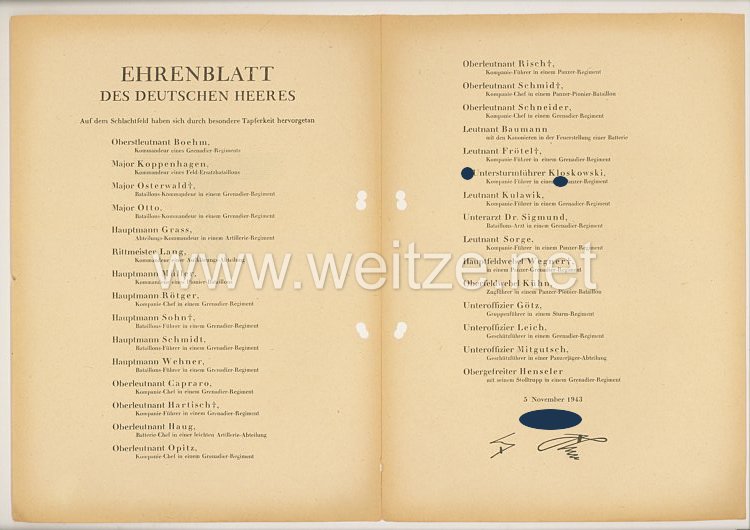
Honor Roll of the German Army - Issue of November 5, 1943

DinA4 double sheet in used condition.
348156
100,00

Honor Roll of the German Army - Issue of November 5, 1943

The Ehrenblatt des deutschen Heeres (Honor Roll of the German Army) represented one of the highest distinctions that could be bestowed upon a Wehrmacht soldier during World War II. This issue dated November 5, 1943 documents a significant moment in German military history, at a time when the fortunes of war had already turned decisively against the German Reich.

The Honor Roll was established by Adolf Hitler on January 30, 1944, replacing the Ehrentafel des deutschen Heeres (Honor Board of the German Army) that had existed since September 1, 1939. The award recognized exceptional bravery in the face of the enemy that far exceeded normal service requirements. Inclusion in this Honor Roll was not accompanied by a physical decoration but rather constituted a documentary honor published in the form of these printed sheets.

Issues of the Honor Roll appeared at irregular intervals and were printed in DIN A4 format as double sheets. Each issue contained the names of decorated soldiers, their ranks, units, and brief descriptions of their heroic deeds. These documents were distributed to military units where they were to be acknowledged and preserved. They served to motivate the troops and promote military virtues.

The historical context of the November 1943 issue is particularly significant. At this time, the Wehrmacht found itself in an increasingly desperate situation. The Battle of Stalingrad had ended in catastrophic defeat in February 1943. In Italy, the Allies had already landed, and on the Eastern Front, German troops had been definitively pushed onto the defensive after the failed Operation Citadel (Kursk) in July 1943. Soviet forces had begun recapturing Ukraine in autumn 1943, and Kiev was liberated on November 6, 1943—just one day after the date of this Honor Roll issue.

During this phase of the war, the propagandistic function of such awards and honors gained considerable importance. The Nazi leadership attempted to maintain combat morale and strengthen the troops' perseverance by highlighting individual acts of bravery. The Honor Roll served as an instrument to create role models and motivate soldiers to make extreme sacrifices.

The format as a double sheet allowed for practical handling and storage within military units. Typically, these documents were printed on quality paper and often bore the Wehrmacht's national insignia as well as the signature or name of high-ranking military officials. The “used condition” of the specimen described here testifies to its actual use in a military unit and lends historical authenticity to the document.

The criteria for inclusion in the Honor Roll were strictly defined. The acts had to considerably exceed the normal measure of military duty fulfillment. Often these involved actions carried out at risk of one's own life, such as rescuing comrades, repelling overwhelming enemy forces, or exceptional leadership in critical situations.

After the war's end, the awards documented in the Honor Roll of the German Army were recognized as legitimate in the Federal Republic of Germany according to the Law on Titles, Orders and Decorations of 1957, provided they were not associated with Nazi symbolism. This distinguishes them from purely National Socialist decorations.

Today, such documents represent important contemporary historical sources. They provide insights into military history, propaganda practices, and the everyday reality of the Wehrmacht. For historical research, they are significant for understanding the motivation and mentality of soldiers as well as the functioning of the military honor system in Nazi Germany. At the same time, they serve as reminders for critical engagement with this dark epoch of German history.

r