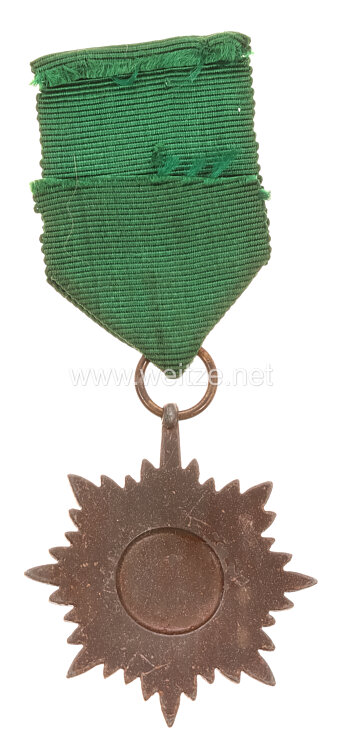
Bravery Decoration for Eastern Peoples 2nd Class in Bronze
The Bravery Decoration for Eastern Peoples 2nd Class in Bronze represents a remarkable testament to National Socialist decorations policy during World War II. This award was instituted on July 14, 1942 by Adolf Hitler and was specifically intended for members of the so-called “Eastern Peoples” who served in German military formations.
The historical background of this decoration is complex and reflects the ideological contradictions of the Nazi regime. Although National Socialist racial ideology considered Slavic peoples as inferior, from 1942 onwards the German Reich found itself forced, due to enormous personnel losses on the Eastern Front, to recruit auxiliary troops from occupied territories of the Soviet Union. These units, often referred to as Eastern Legions or Osttruppen, comprised volunteers and forced recruits from various nationalities, including Ukrainians, Cossacks, Turkmens, Georgians, Armenians, and many others.
The Bravery Decoration for Eastern Peoples was awarded in two classes: the 1st Class in Silver and the 2nd Class in Bronze, as seen here. The decoration was intended to serve as an incentive and strengthen the fighting morale of the Eastern troops. The award criteria were established in the regulation of July 14, 1942 and provided that the decoration could be awarded for special bravery in the face of the enemy.
The present specimen displays the typical characteristics of this decoration: manufactured from fine zinc, a material frequently used during the war due to the scarcity of more noble metals. Bronze plating was applied to achieve the desired color tone. The piece is complete with its original ribbon and wearing pin, which is of particular significance for historical authenticity.
The design of the medal followed a characteristic pattern: The obverse typically featured a sword with oak leaves, surrounded by the inscription “FÜR TAPFERKEIT” (For Bravery). The reverse often showed the date of institution. The ribbon of the 2nd Class was light blue with white stripes, making the decoration clearly distinguishable from other German orders.
The historical significance of this decoration is ambivalent. On one hand, it documents the military reality of the German Wehrmacht, which became increasingly dependent on foreign auxiliary troops. Estimates suggest that up to one million members of the Eastern Peoples served in various capacities for the German Wehrmacht. On the other hand, it symbolically represents the exploitation and instrumentalization of these people by the Nazi regime.
The recipients of this decoration often found themselves in tragic situations. Many were prisoners of war who were given the choice of either starving in camps or serving in German units. Others were collaborators who fought out of anti-Soviet convictions or nationalist motives. After the war ended in 1945, many of these soldiers were regarded by the Soviet Union as traitors and persecuted accordingly.
From a collecting perspective, these decorations are relatively rare today, as many recipients destroyed their orders after the war to avoid being identified as former collaborators. The indicated Condition 2 suggests a well-preserved specimen showing only slight signs of wear.
The scientific study of these decorations contributes to understanding the complex history of World War II, particularly regarding collaboration phenomena in the occupied Eastern territories. The Bravery Decoration for Eastern Peoples remains an important historical document that reflects both the military constraints and ideological contradictions of the Third Reich.