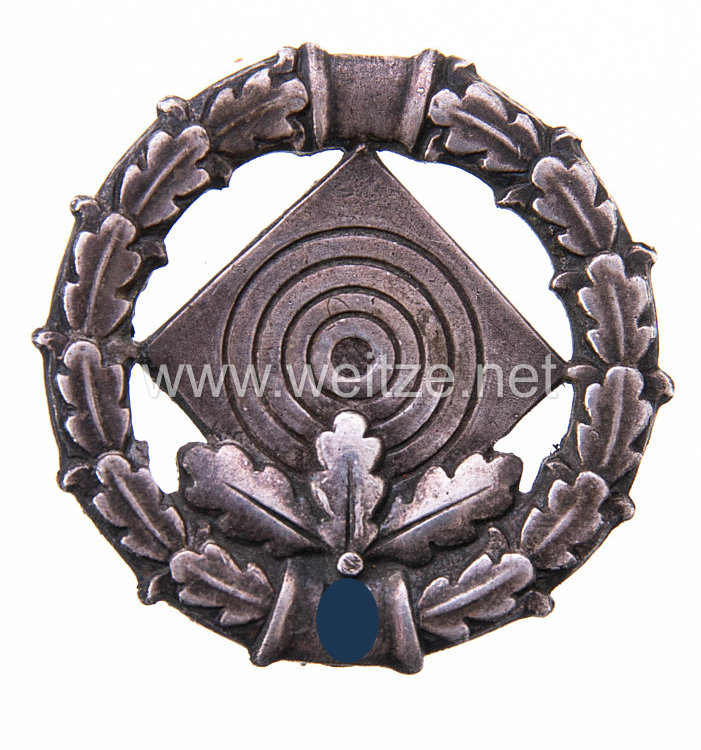
SS Marksmanship Badge, 3rd Class for Sharpshooters
One of the few originals, extremely rare.
The SS Marksmanship Badge 3rd Class for Sharpshooters represents a rare and historically significant example of paramilitary training insignia and rank badges within the Schutzstaffel (SS) during the National Socialist regime in Germany. This award was introduced around 1937, when the SS developed its own training standards and performance badges to distinguish itself from other organizations and foster an elite identity.
The SS marksmanship badges were awarded in several grades and served to document and honor the shooting skills of SS members. The hierarchical system comprised various levels, with the 3rd Class representing an advanced level of marksmanship proficiency. The awards were granted based on standardized shooting tests that had to be completed with both rifle and pistol.
The present example displays the typical design of this decoration: At the center is a shooting target, surrounded by an oak leaf wreath, which traditionally symbolized bravery and merit in German military symbolism. Below the target are the characteristic SS runes, flanked by three oak leaves indicating the third class. The use of oak leaves as a decorative element had a long history in German military tradition and was deliberately adopted by the SS.
The badge was manufactured from silver-plated aluminum, a material commonly used for insignia in the 1930s. It was more cost-effective than solid silver alloys while still providing a prestigious appearance. The firm Otto Gahr of Munich was among the officially authorized manufacturers of SS insignia and awards. The maker's mark - SS runes within an octagon - together with the notation “ges. gesch.” (legally protected) on the reverse, confirms official manufacture and was a quality indicator.
The awarding of these marksmanship badges was subject to strict conditions. Candidates had to achieve specific scores in multiple shooting exercises with various weapons. The tests typically took place annually, and the results achieved were carefully documented. The SS placed great emphasis on military training and regarded marksmanship as a fundamental skill for its members.
The historical context of this award is inseparably linked to the history of the SS, which was founded in 1925 as Adolf Hitler's personal bodyguard and developed under Heinrich Himmler from 1929 onwards into a powerful organization. During the 1930s, the SS expanded considerably and built its own structures, including the armed SS-Verfügungstruppe, the predecessor of the later Waffen-SS.
The introduction of distinctive awards and badges around 1937 coincided with a phase of consolidation and professionalization of the SS. The organization sought to establish itself as an elite formation and developed a complex system of ranks, badges, and decorations. The marksmanship badges were part of this system and were intended to make performance and competence visible.
Today, authentic SS marksmanship badges, particularly those of the 3rd Class, are extremely rare. Many were destroyed after 1945, and the survival rate is low. The scholarly and museum significance of such objects lies in their evidentiary value for the history of National Socialism. They document the structures, hierarchies, and self-perception of an organization that was centrally responsible for the crimes of the Nazi regime.
Authenticating such pieces requires specialized knowledge, as numerous reproductions and forgeries were manufactured after 1945. Features such as the correct maker's mark, material composition, manufacturing quality, and stylistic details are crucial for assessing authenticity. The present example, with the verifiable maker's mark of Otto Gahr and the typical construction characteristics of the period, meets the criteria of an authentic piece from before 1945.
From a collector's and historical research perspective, such objects serve as important primary sources for understanding the internal organization, training practices, and hierarchical structures of the SS. They illustrate how the organization used visual symbols and awards to create identity and motivate its members within a broader system of National Socialist ideology and practice.