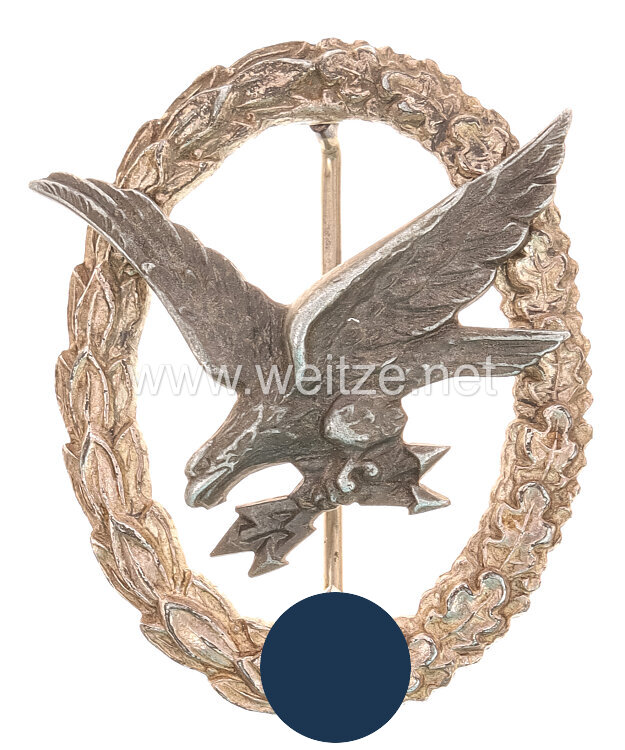
Luftwaffe Air Gunner Badge with Lightning Bolts
The Air Gunner Badge with Lightning Bolts (Fliegerschützenabzeichen mit Blitzbündel) represents a significant decoration of the German Luftwaffe during World War II. This special variant of the Air Gunner Badge was awarded to aerial gunners and radio operators who served in combat aircraft and had demonstrated exceptional performance in aerial combat.
The Air Gunner Badge was instituted on January 19, 1942 by Hermann Göring as Commander-in-Chief of the Luftwaffe. The award regulations stipulated that aerial gunners could receive this decoration after a certain number of enemy flights or after particular distinction in aerial combat. The badge existed in several grades, with the basic grade manufactured from zinc or aluminum.
The characteristic feature of this decoration is the lightning bolt bundle (Blitzbündel), which symbolized the role of the aerial gunner. The design typically shows a left-facing eagle with spread wings, clutching a laurel wreath in its talons. In the lower part of the wreath is the eponymous bundle of lightning bolts, representing the combat power and speed of the Luftwaffe.
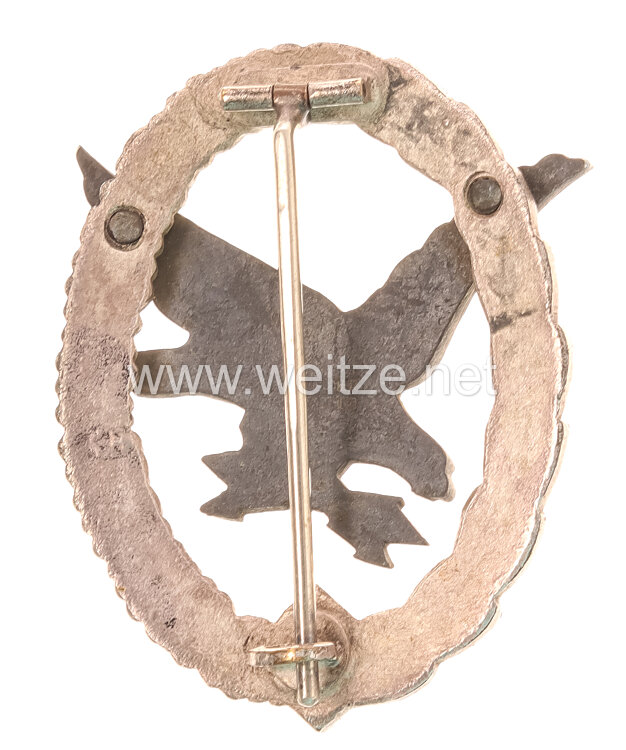
The manufacturer W. Deumer of Lüdenscheid was one of the most significant producers of military decorations during the Nazi era. The company, founded in the 19th century, had specialized in the production of orders, medals of honor, and military badges. Deumer was among the officially authorized manufacturers and produced decorations in various quality grades. The reverse manufacturer marking “W. Deumer Lüdenscheid” is a typical characteristic of this company's products and today serves as an important authenticity feature for collectors and historians.
The manufacture from zinc is characteristic of badges produced during the war years. As the war progressed and material shortages increased, substitute materials were used with growing frequency. While early specimens were often made from higher-quality materials such as brass or silver-plated metal, zinc and aluminum alloys dominated production from 1942/43 onwards. This enabled more cost-effective and material-saving production while maintaining production capacity.
The award practice of the Air Gunner Badge followed strict guidelines. Aerial gunners had to prove their capability and courage in combat operations. Documentation of awards was carried out by the respective units, and the decoration was ceremonially presented during parades or special ceremonies. The badge could be worn on the left breast of the uniform and enjoyed high prestige among Luftwaffe soldiers.
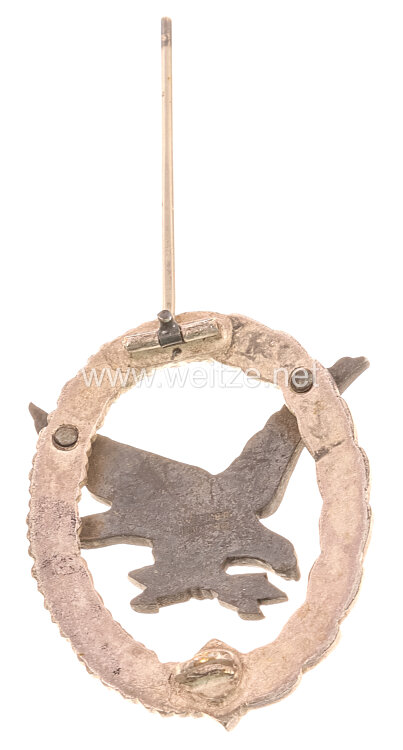
Technically speaking, the badge was connected to the pin through riveting, which enabled attachment to the uniform. The loose riveting described in this case is a commonly encountered problem with older specimens. Through decades of storage, mechanical stress, or material fatigue, the rivet connections can loosen, causing parts of the badge, particularly the eagle, to become movable.
From a historical perspective, such badges document the organizational structure and award system of the German Luftwaffe. They testify to the importance attributed to the aerial gunner function within the framework of air warfare. Aerial gunners played a crucial role in protecting bombers and other aircraft against enemy fighters and contributed significantly to the success or failure of air operations.
The role of aerial gunners became increasingly critical as Allied air superiority grew during the later war years. These men faced extreme dangers, operating in cramped, cold positions while defending their aircraft against enemy fighters. The award of such badges recognized not only skill but also the extraordinary courage required for this duty.
Today, such badges are important military-historical objects preserved in museums and collections for the documentation and research of 20th-century military history. They serve as material witnesses to a dark epoch of German history and help deepen understanding of the military structures and everyday reality of soldiers of that time.