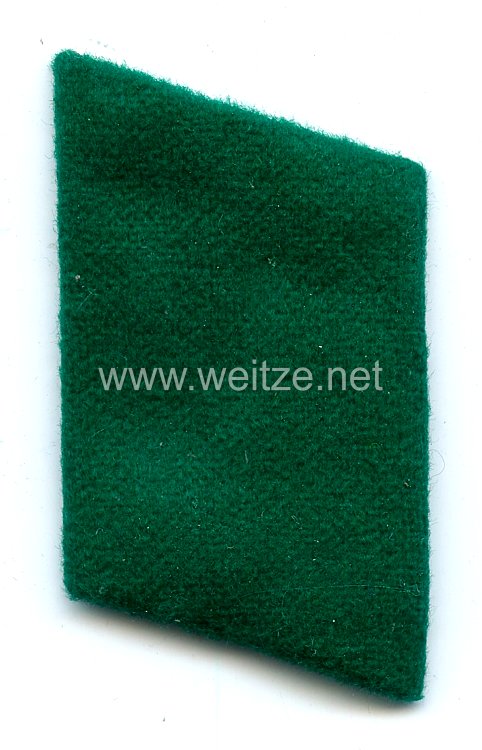
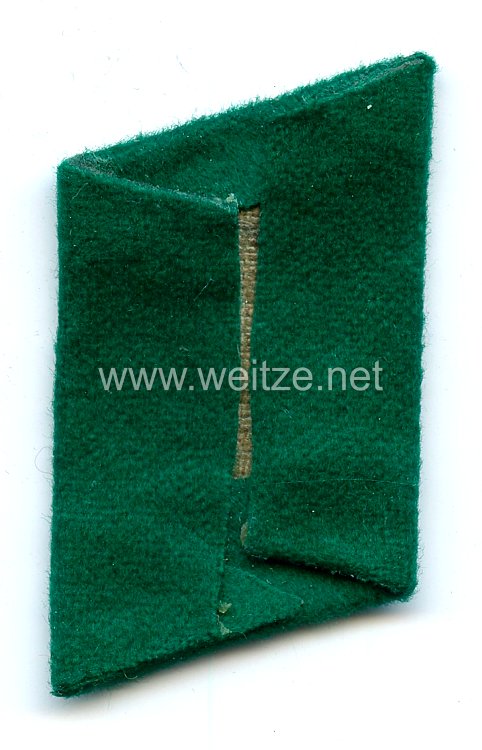
SA Collar Tab Rank Side for Enlisted Men SA-Gruppe Kurpfalz or Nordsee
The present SA collar patch (Kragenspiegel) for enlisted ranks represents a characteristic example of the uniform insignia of the Sturmabteilung (SA) from the National Socialist period. The piece is executed in steel-green and was assigned to one of the two SA groups Kurpfalz or Nordsee, which were identified by this specific color.
The Sturmabteilung was founded in 1921 as a paramilitary combat organization of the NSDAP and developed into a mass organization with several million members by 1934. The SA played a central role in the National Socialists' rise to power by intimidating political opponents and maintaining a violent presence during the street fights of the Weimar Republic. After the so-called Röhm Affair in June 1934, however, the SA lost much of its political significance.
The SA's uniform system was strictly regulated and followed detailed regulations. The collar patches were an essential component of the SA uniform and served multiple purposes: they indicated the wearer's rank and identified membership in a specific SA group through their color. The collar patch system was modified and refined several times over the years, though the basic structure remained until the end of SA uniforming.
SA-Gruppe Kurpfalz was created on September 1, 1933, by renaming the former Untergruppe Kurpfalz and was territorially organized in the Palatinate region. Its headquarters was located in Mannheim. The SA group consisted of several brigades and standards covering various cities and regions of the Palatinate.
SA-Gruppe Nordsee was also established in 1933 and encompassed the coastal areas in northern Germany. Its area of responsibility extended over parts of Schleswig-Holstein and the North German coastal regions. The staff of this group was located in Hamburg-Altona.
Both SA groups wore the characteristic steel-green color on their collar patches, enabling clear identification. The SA collar patch color system was complex: there were a total of 21 different SA groups, each with its own identifying color. These colors ranged from various shades of green and blue to red and yellow, including more specialized colors such as wine-red or orange.
The term rank side (Rangseite) refers to the right side of the collar, where the wearer's rank was indicated by specific insignia. For enlisted men (the lowest ranks of the SA hierarchy), the rank side was typically without additional rank insignia, as these were only added from the rank of SA-Rottenführer upward. The left side of the collar typically bore the standard number or other unit designations.
The manufacture of SA collar patches was carried out by various manufacturers and workshops throughout the German Reich. Quality and execution could vary, with both factory-produced mass goods and higher-quality pieces for higher ranks or special occasions. The unworn condition of the described piece suggests that it was either never issued or kept as a spare part.
The steel-green color was applied to wool fabric through special dyeing processes, which was sewn onto a stabilizing backing. The collar patches were attached to the uniform by means of buttons or pins and could be replaced when necessary, such as during promotions or transfers to other units.
From a historical perspective, such uniform parts are important documents of contemporary history today. They enable researchers and historians to trace the organizational structure, appearance, and territorial organization of the SA. At the same time, they require critical and contextualized examination in view of the criminal nature of the Nazi regime and the role the SA played in establishing the dictatorship.
The collection and preservation of such historical objects serves exclusively for scholarly research and museum documentation of a dark period in German history. They serve as warnings to remain vigilant against extremist and totalitarian tendencies in the present.