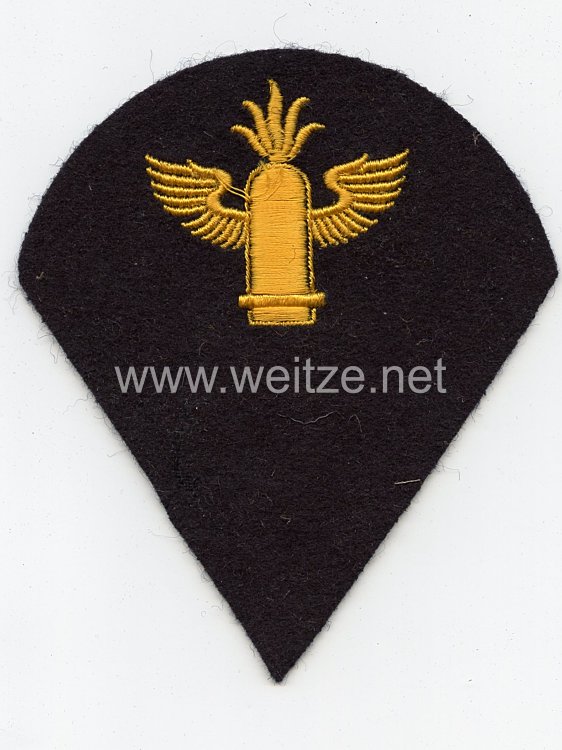
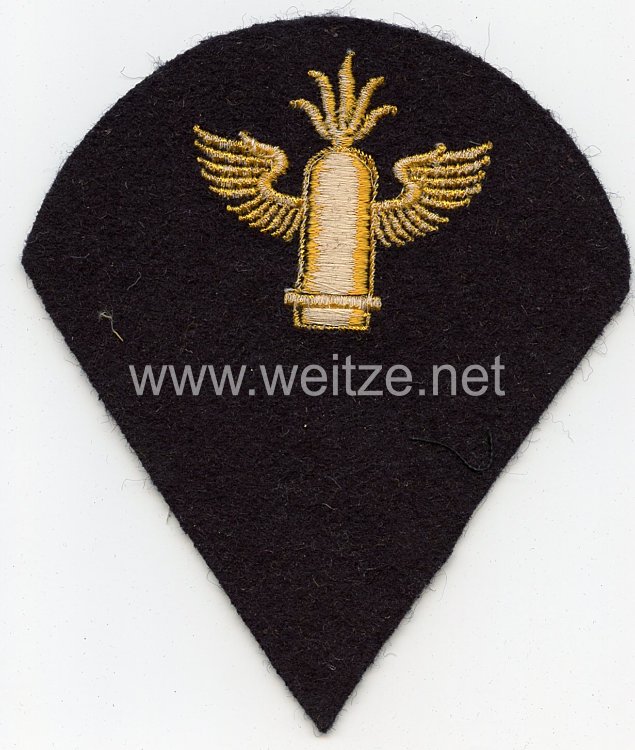
Kriegsmarine Enlisted Ranks Sleeve Insignia Naval Artillery Career Path
The Kriegsmarine enlisted personnel sleeve badge for the naval artillery career path represents a significant example of military rank insignia and career identification markings of the German Kriegsmarine during World War II. These special badges served for visual identification of the branch of service and area of activity of naval personnel within the complex organizational structure of the German naval forces between 1935 and 1945.
The Kriegsmarine was officially founded on June 1, 1935, after National Socialist Germany rejected the military restrictions of the Treaty of Versailles. With the rearmament of German forces, an extensive system of uniform regulations and insignia developed that built upon the traditions of the Imperial Navy while being adapted to new political and military realities.
The naval artillery career path encompassed all enlisted men and non-commissioned officers who worked in the areas of ship artillery, anti-aircraft artillery, and coastal artillery. These soldiers formed the backbone of the offensive and defensive firepower of Kriegsmarine units. Their training was technically demanding and required thorough knowledge of ballistics, target identification, range finding, and operation of complex weapons systems ranging from small anti-aircraft guns to heavy naval guns with calibers up to 380mm on battleships.
The described badge was intended for wear on the Colani, a special form of naval clothing. The term “Colani” designates a uniform jacket made of blue cloth that was part of the working and shipboard clothing of the Kriegsmarine. This practical garment was worn during daily service aboard ship and differed from parade dress through its functionality and durability.
The enlisted personnel sleeve badges were typically worn on the right upper arm and showed through their specific design the affiliation to a particular career path. For the naval artillery career path, this was usually a representation featuring artillery symbols. The badges were manufactured in various versions: machine-embroidered for standard uniforms or hand-embroidered for higher-quality versions.
The production of such badges was carried out by specialized effects companies authorized by the Kriegsmarine. These companies had to maintain strict quality standards established in the corresponding clothing regulations of the Kriegsmarine. Materials typically included wool, artificial silk, or cotton as backing fabric, while the embroidery was made from colored threads.
The system of career path badges was regulated by the Kriegsmarine clothing regulations, which were updated multiple times to account for changing organizational requirements. The regulations precisely specified when, where, and how these badges were to be worn, as well as which versions were designated for various uniform types.
During the war, naval artillery played a crucial role in numerous naval engagements, from early surface actions in the North Sea to later defensive operations along the coasts. Artillerymen were deployed not only on warships but also in coastal batteries, harbor defense vessels, and anti-aircraft batteries protecting naval bases.
The preservation and collection of such militaria has significant historical value today. It enables researchers and historians to study the material culture of the Kriegsmarine and better understand the organization, hierarchy, and daily life of naval personnel. Condition ratings such as “Condition 2-” follow standardized evaluation scales in the militaria collecting community, with this grade indicating a well-preserved piece with minor signs of use.
The study of these badges contributes to understanding military social history and demonstrates how modern armed forces communicated identity, hierarchy, and specialization through visual symbols. They are material witnesses to a complex military organization and its internal structures, providing tangible evidence of the systematic categorization and identification systems employed by one of the major naval powers of the Second World War era.