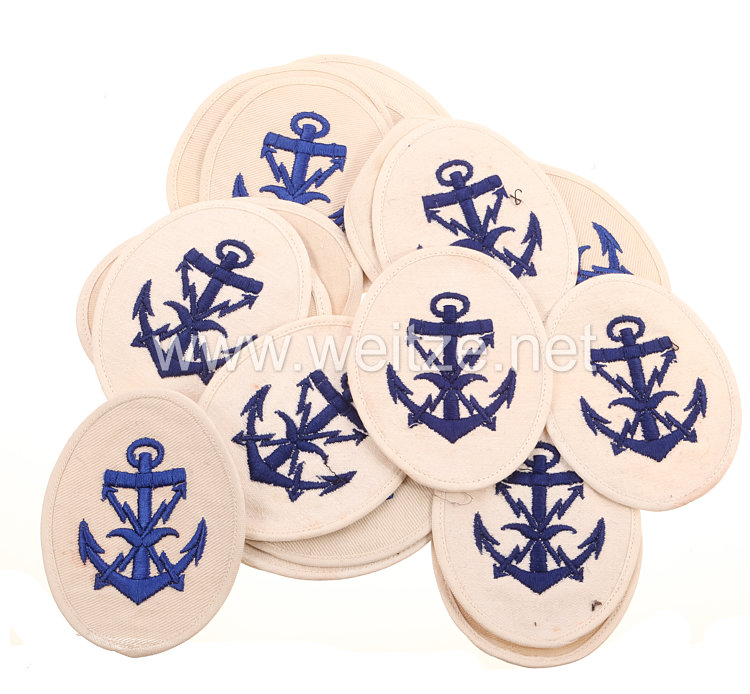
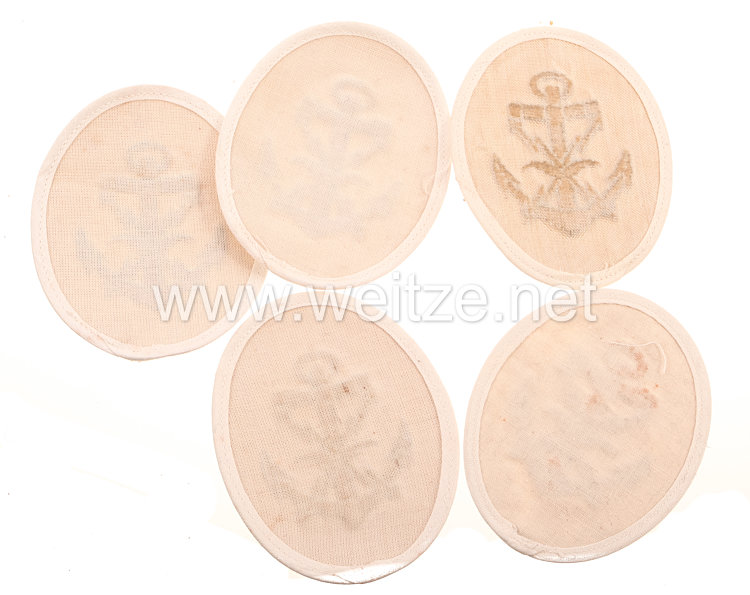
Kriegsmarine Sleeve Insignia Career Track Aircraft Reporting Petty Officer

Machine-embroidered, for white blouse, Condition 2.

Price per piece: 10 Euro.

Condition may vary.
440854
9,00

Kriegsmarine Sleeve Insignia Career Track Aircraft Reporting Petty Officer

The Kriegsmarine sleeve badge for Flugmeldemaat (Aircraft Reporting Petty Officer) represents a specialized rank within the German Kriegsmarine during World War II. These machine-embroidered badges were worn on the white summer blouse and identified non-commissioned officers serving in the aircraft reporting service career path.

The Kriegsmarine, as the naval warfare branch of Nazi Germany from 1935 to 1945, developed a complex system of rank insignia and career path identifiers. The term Laufbahn (career path) designated professional specialization within the navy, while rank indicated hierarchical position. The system of career path badges was introduced to visually distinguish the various specialized fields and structure the military organization.

The Flugmeldemaat was a petty officer rank within the aircraft reporting service career path. This specialization was crucial for coordination between naval and air forces. Flugmeldemaaten were responsible for detecting, identifying, and reporting aircraft, both friendly and hostile. They worked closely with the observation service and radar stations to create a comprehensive air situation picture.

Kriegsmarine sleeve badges were worn according to the Uniform Regulations of the Kriegsmarine, which precisely governed which uniform items were to be worn on which occasions and in what combinations. For the white summer blouse, worn in warmer climates or during summer months, special badges were designated that would be clearly visible on the lighter fabric.

The machine embroidery of these badges was typical for the mass production of military equipment during the war. Unlike hand-embroidered variants, often used for officer badges, machine production allowed for faster and more cost-effective manufacture. The badges were typically produced by civilian contractors who held contracts with the Wehrmacht.

The appearance of the badge followed standardized Kriegsmarine specifications. Career path badges were typically worn on the right upper arm and indicated the respective specialization through their specific design and coloring. The aircraft reporting service career path belonged to the communications services of the navy, an area that gained increasing importance in modern naval warfare.

The organizational context of this career path was complex. The Kriegsmarine maintained its own aircraft reporting services at coastal stations, on ships, and in occupied territories. The integration of air and naval reconnaissance was particularly important for coordinating fleet operations, submarine warfare, and coastal defense. Flugmeldemaaten had to be capable of identifying aircraft types, estimating distances, and transmitting precise reports to superior commands.

Training as a Flugmeldemaat included theoretical instruction in aircraft recognition, practical exercises in observation and identification, and operation of reporting and communications equipment. Training took place at special naval schools, where prospective Flugmeldemaaten were prepared for their responsible duties.

After the end of World War II in 1945, the Kriegsmarine was dissolved, and its uniforms, badges, and equipment became historical artifacts. Today, such sleeve badges are collectible items that provide insight into the military organization and specialized structure of the German navy. They document the technical development of naval warfare, in which air reconnaissance and defense played an increasingly important role.

For collectors and historians, these badges are important primary sources for studying the Kriegsmarine. They allow conclusions about production methods, wearing regulations, and the organizational structure of the German naval forces. The preservation and scholarly documentation of such military-historical objects contributes to understanding this period of history.

r