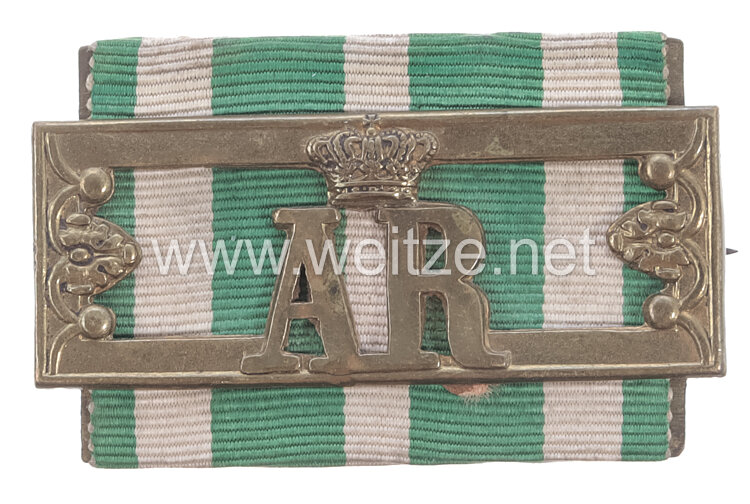
Saxony Kingdom Landwehr Long Service Award 2nd Class 1874-1913
The Saxon Landwehr Service Award Second Class represents a significant chapter in the military history of the Kingdom of Saxony during the constitutional monarchy within the German Empire. This decoration was awarded in recognition of faithful service in the Saxon Landwehr, an important institution for territorial defense.
The Kingdom of Saxony retained its own military administration and distinctive award system after the founding of the German Empire in 1871. The Landwehr Service Award was established by royal decree and divided into two classes. The Second Class was typically awarded for shorter periods of service than the First Class, with exact requirements specified in military regulations.
The period 1874-1913 marks an era of significant military and social developments in the German Empire. After the Franco-Prussian War of 1870/71 and the founding of the Empire, the German military system underwent fundamental reforms. The Landwehr formed the second line of armed forces and consisted of trained soldiers who had completed their active service period.
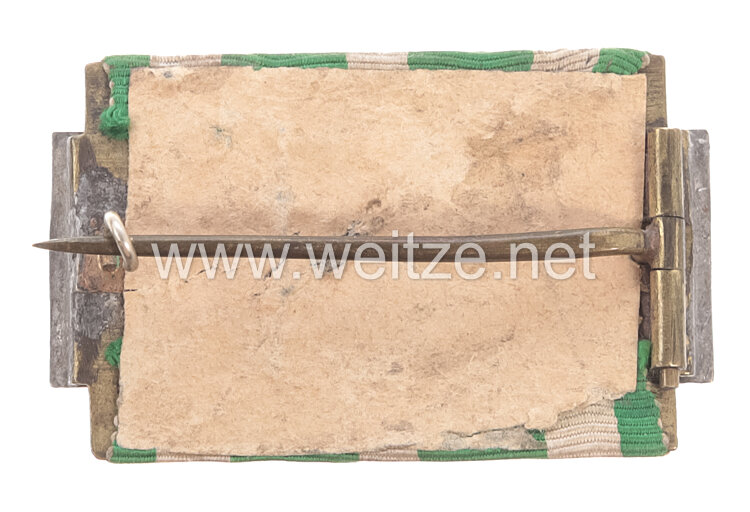
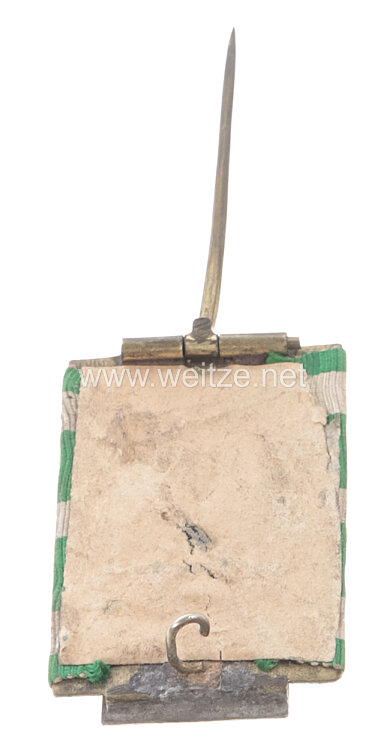
The present piece appears as a ribbon bar with gilt overlay, a typical form of wear for veterans in civilian life. Such ribbon bars were worn when full decoration wear was inappropriate, such as at less formal occasions or in smaller gatherings. The gilt overlay indicates high-quality manufacture, possibly by a renowned Saxon jeweler or court supplier.
The Saxon Landwehr had its roots in the Wars of Liberation against Napoleon, when citizen militias and volunteer units played a crucial role. During the 19th century, the institution was systematized and integrated into the general conscription system. Men who had completed their active service with line troops transferred to the Landwehr and could serve additional years there.
The awarding practice of such decorations followed strict rules. Recipients had to not only complete the required service period but also demonstrate impeccable conduct. The decoration was awarded in the name of the King of Saxony and recorded in the recipient's military papers. During the relevant period, the kings Johann (until 1873), Albert (1873-1902), Georg (1902-1904), and Friedrich August III (1904-1918) reigned.
The design of Saxon military decorations was characterized by distinctive elements: frequently the Saxon crown, coats of arms with the typical black and gold lozenges, and inscriptions in German Fraktur script. The ribbons typically bore the state colors of green and white, sometimes with additional stripes.
The manufacture of such decorations was carried out by state-authorized producers. In Dresden, the Saxon capital, several renowned firms existed that produced military orders and badges of honor. Quality varied depending on the execution – from simple pieces for broad distribution to more luxurious variants for higher ranks or private purchase.
The historical context of the years until 1913 was characterized by increasing militarism and arms race in Europe. The Landwehr played an important role in German mobilization plans. In case of war, these reserve units were to be quickly activated to reinforce active troops or undertake occupation duties.
With the outbreak of World War I in 1914, the Landwehr indeed gained great importance. Many of the older age groups were mobilized and deployed on various fronts. Bearers of the Landwehr Service Award were often experienced soldiers whose expertise proved valuable during the long war years.
After the collapse of the monarchy in 1918 and the founding of the Weimar Republic, the royal Saxon decorations lost their official status. However, they could still be worn and remained important mementos of their service time for many veterans. The Kingdom of Saxony ceased to exist, became part of republican Germany, and its military traditions were absorbed into the new Reichswehr.
Today, such decorations are important witnesses to German military history. They document not only the awards system but also social-historical aspects: Who served? How were merits recognized? What significance did military service have in society? For collectors and historians, they offer valuable insights into the era of the Imperial period and the specific traditions of the German individual states.