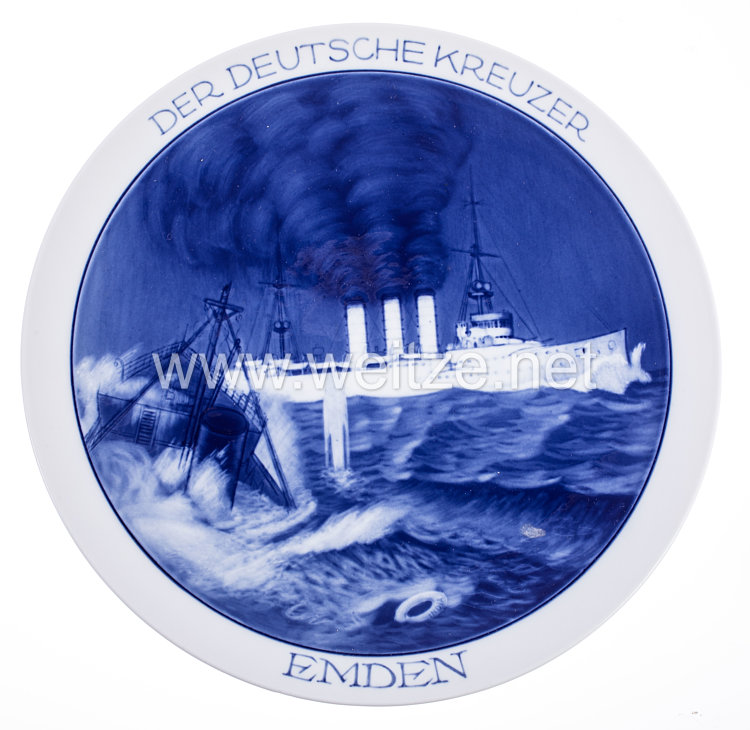
Imperial German Navy World War I Meissen Commemorative Plate “The German Cruiser Emden”

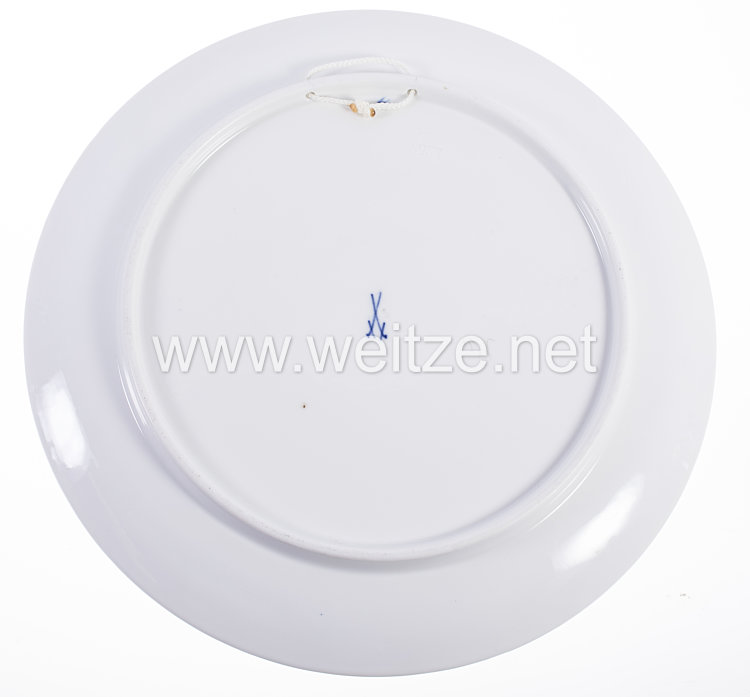
Plate from the Meissen porcelain manufactory depicting S.M.S. Emden in combat. Blue underglaze decoration. Reverse with crossed swords mark, condition 2+.
372053
650,00

Imperial German Navy World War I Meissen Commemorative Plate “The German Cruiser Emden”

This commemorative plate from the Meissen Porcelain Manufactory depicting the S.M.S. Emden represents a significant category of maritime militaria from the First World War era. Such memorial plates served as patriotic keepsakes and document the hero worship prevalent in German naval history during this period.

The S.M.S. Emden was a light cruiser of the Imperial German Navy, built between 1906 and 1908 at the Imperial Dockyard in Danzig. The ship belonged to the Dresden class and gained international attention during World War I through its successful commerce raiding operations in the Indian Ocean. Under the command of Korvettenkapitän Karl von Müller, the Emden sank or captured more than 30 Allied merchant vessels and two warships between August and November 1914.

The State Porcelain Manufactory Meissen, founded in 1710, was Europe's first porcelain manufactory and enjoyed the highest reputation. The characteristic crossed swords mark in underglaze blue has been the manufactory's trademark since 1722, guaranteeing the authenticity of its products. During World War I, Meissen produced patriotic commemorative objects alongside its regular range, reflecting wartime enthusiasm and national pride.

The blue underglaze decoration was a technically demanding decorative technique in which the color was applied before the final glaze firing. This method guaranteed exceptional durability and color fastness. The maritime depiction typically shows the Emden in battle, alluding to the cruiser's numerous victorious naval engagements.

The military successes of the Emden made the ship a symbol of German naval power. On November 9, 1914, however, the raiding cruise ended abruptly when the Emden was intercepted by the Australian cruiser HMAS Sydney during the Battle of Cocos and heavily damaged. Von Müller beached the burning ship on North Keeling Island. Despite the defeat, the Emden became legendary – even opponents respected the crew for their chivalrous conduct of warfare.

Such commemorative plates were acquired as collectibles during and after the war. They served the culture of remembrance and maintained morale on the home front. Families of naval sailors preserved them as mementos, and veterans collected them as documents of their service. The Meissen manufactory produced various maritime motifs, with the Emden being particularly popular due to its fame.

The quality of Meissen production is evident in the precise execution of the ship's depiction and the craftsmanship's perfection. Today, collectors particularly value examples in good condition, as many of these utilitarian objects were damaged or destroyed over the decades. The condition grading follows traditional standards of the militaria collecting community, with the stated condition indicating minimal signs of use.

In the context of naval history, such objects document the propaganda efforts of the German Empire and the significance of the fleet for national identity. The navy, massively expanded under Admiral Alfred von Tirpitz, was meant to manifest Germany's rise to world power status. Commemorative plates like this were part of a comprehensive maritime memory culture that also included postcards, newspaper articles, and public monuments.

Today, such Meissen naval pieces are sought-after collectibles that combine both maritime and porcelain manufacturing history. They provide insight into the mentality of the German Empire and document the veneration of individual ships and their crews. The name “Emden” was later carried by several German warships, underscoring the enduring significance of this symbol in German naval tradition.

r