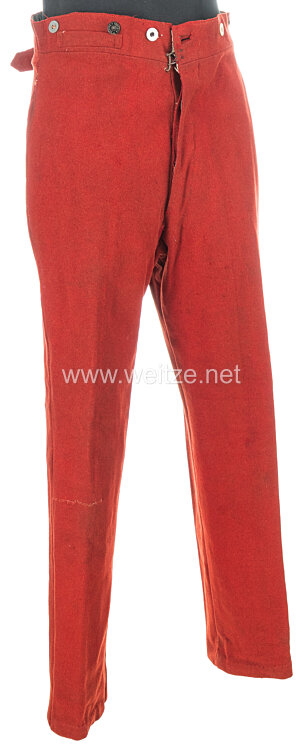
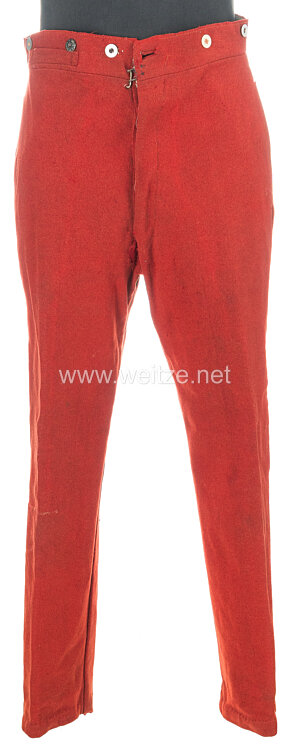
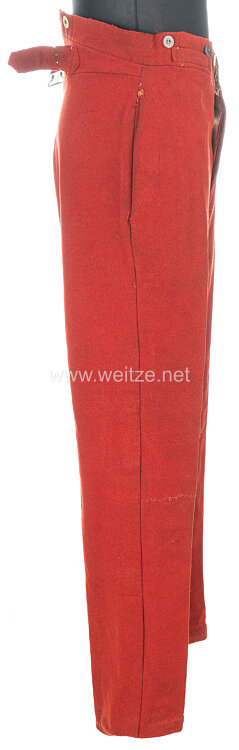
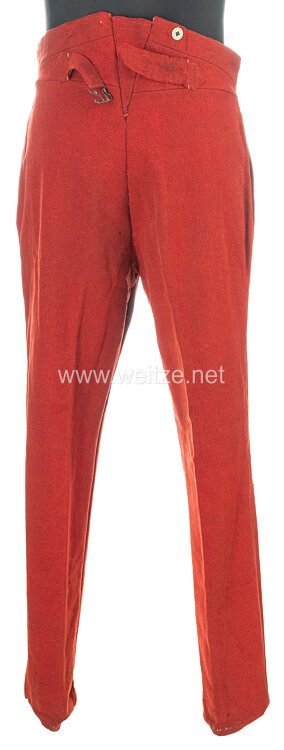
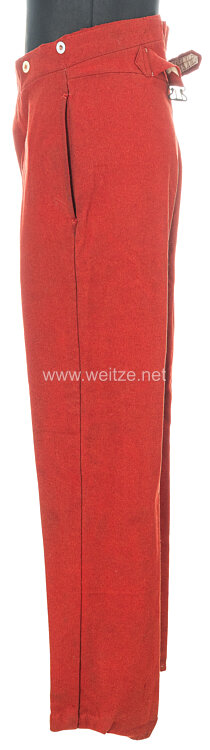
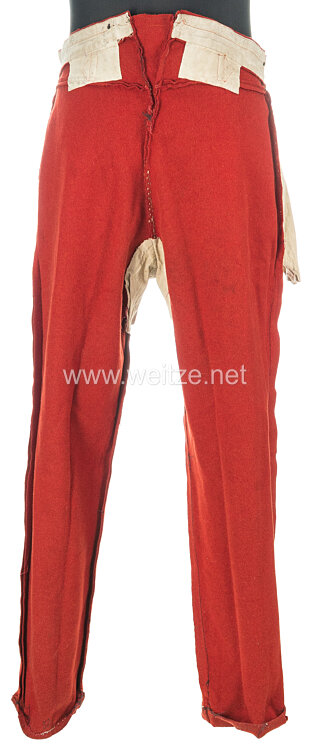
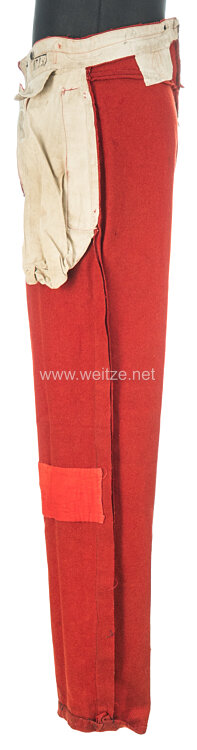
France 3rd Republic Red Service Trousers for Enlisted Men “17e T.E.”
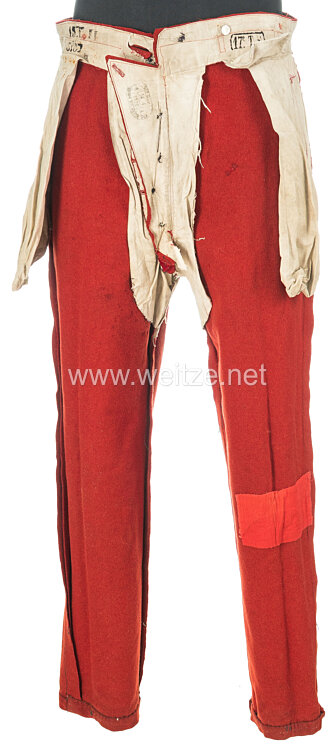
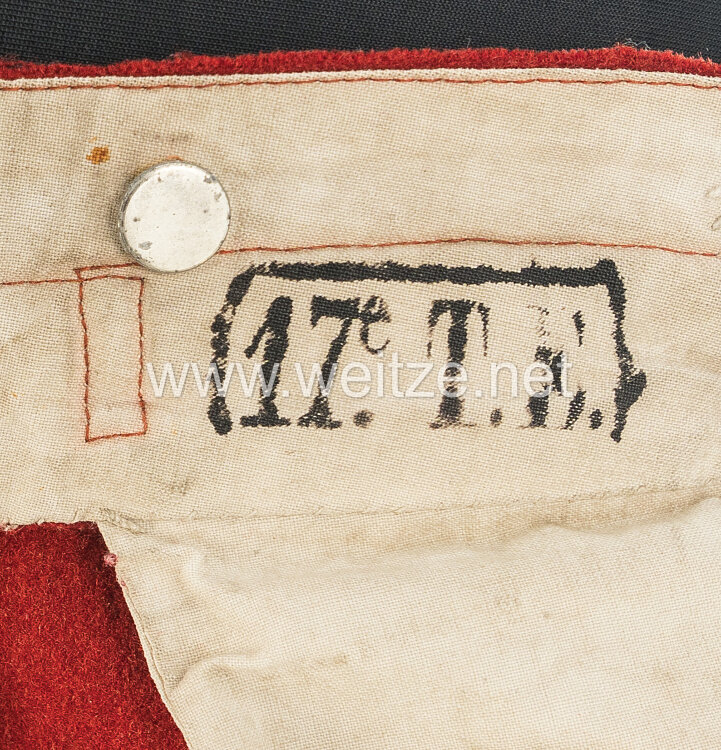
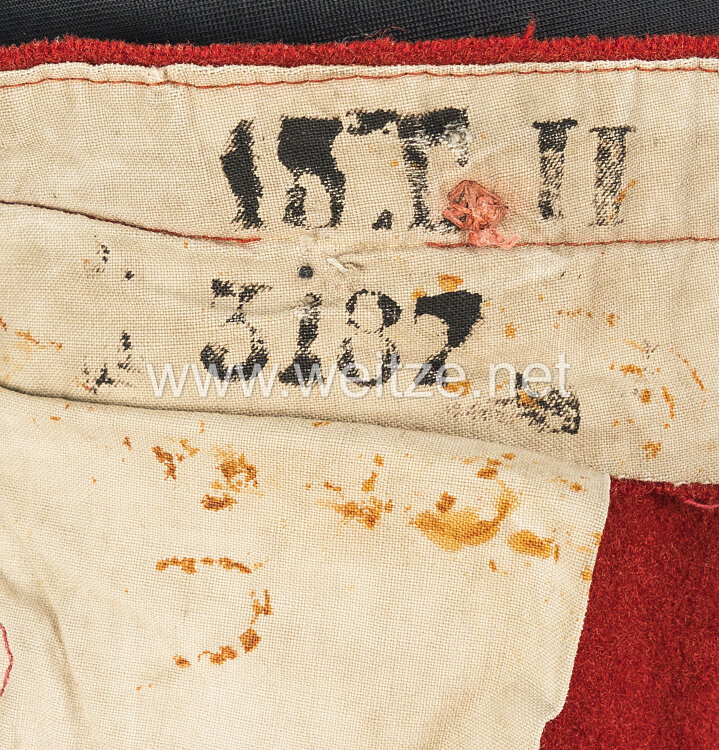
This madder red service trousers from the French Army of the Third Republic represents a fascinating chapter in military history immediately preceding World War I. Dating from around 1908, this garment bears the unit stamp “17e T.E.”, which stands for the 17th Regiment of the Train des Équipages Militaires, a unit of the military transport troops.
The characteristic red color of these trousers was more than just an aesthetic feature – it was a symbol of French military tradition dating back to the Napoleonic era. The madder red (garance) used was derived from the madder root and had been the predominant color of French infantry and cavalry uniforms since the early 19th century. This color choice not only reflected military tradition but was also closely tied to the French textile industry, which profited considerably from madder production.
The Train des Équipages Militaires was a specialized unit responsible for military transport, supply, and logistics. These troops played a crucial role in the movement of equipment, ammunition, and provisions. The 17th Regiment was part of a comprehensive network of transport units distributed throughout France. The enlisted men of these units wore the same characteristic red trousers as their comrades in the infantry, emphasizing the common military identity of the French Army.
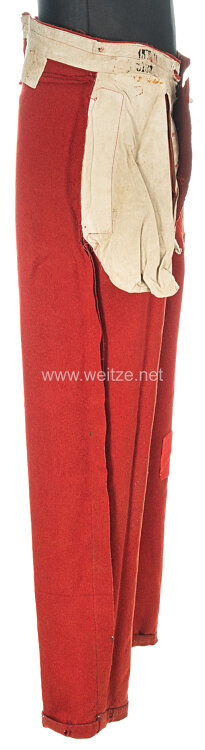
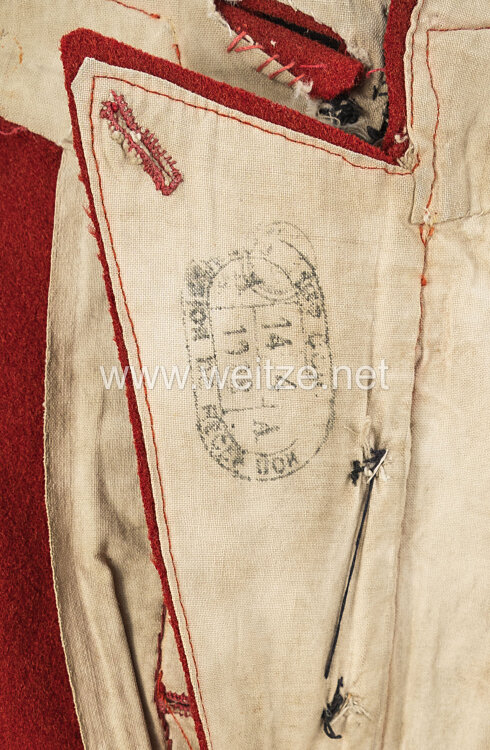
The Third Republic uniform of around 1908 followed regulations that had been established in various military ordinances. The basic form of enlisted men's trousers remained relatively constant over decades: two side pockets, button closure, and straight-cut design. The internal stamps served military administration purposes and enabled attribution to specific units, manufacturers, and production years. This systematic marking was part of the highly developed French military administration system.
The historical significance of these uniform pieces cannot be overstated when considering the dramatic changes that were imminent. Within a few years, World War I would break out, and the conspicuous red trousers would prove to be a deadly weakness. The brightly colored red trousers made French soldiers easily identifiable targets on the battlefield for enemy snipers and machine gunners. Despite this obvious danger, there was considerable resistance to changing this traditional uniform.
French War Minister Adolphe Messimy attempted in 1911-1912 to introduce a less conspicuous uniform but encountered fierce resistance. Former War Minister Étienne reportedly declared: “Le pantalon rouge c'est la France!” (“The red trousers are France!”). This statement illustrates how deeply the symbolic meaning of this uniform color was rooted in French military culture.
Only in 1914, after the catastrophic losses of the first months of war, were the red trousers finally replaced by a field gray or horizon blue uniform. The new “bleu horizon” uniform offered better camouflage and became standard issue from 1915 onward. This marked the definitive end of an era of colorful military uniforms that had characterized European armies for centuries.
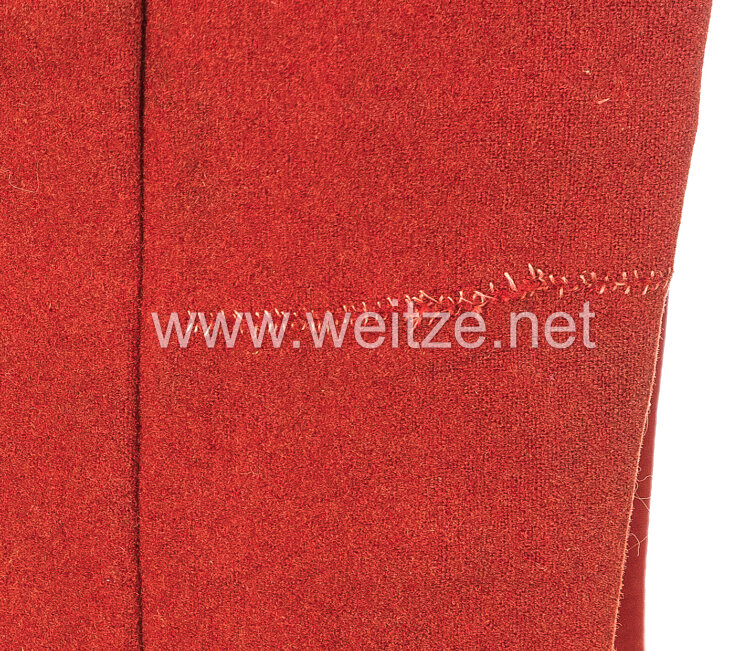
The present trousers with their measurements (waist circumference approximately 90 cm, length approximately 104 cm) correspond to the standard sizes for enlisted men's uniforms of this era. The traces of use – signs of aging, one repair, and partially replaced buttons – testify to their actual use in military service. Such authentic traces of wear significantly increase the historical value of the object, as they reflect the real military experience of the soldiers.
For collectors and historians, such uniform pieces from the period before World War I are particularly valuable as they document a transitional period in military history. They symbolically represent the moment when centuries-old traditions met the brutal reality of modern warfare. The Belle Époque, that seemingly peaceful and optimistic era before 1914, is reflected in the carefree colorfulness of these uniforms – a colorfulness that would soon yield to the somber tones of industrialized warfare.
The Train des Équipages itself would undergo significant expansion during the war, as the logistical demands of trench warfare far exceeded anything anticipated in peacetime planning. The men who once wore these red trousers would find themselves operating in an entirely new type of conflict, one that would fundamentally transform military doctrine, equipment, and uniform design for generations to come.