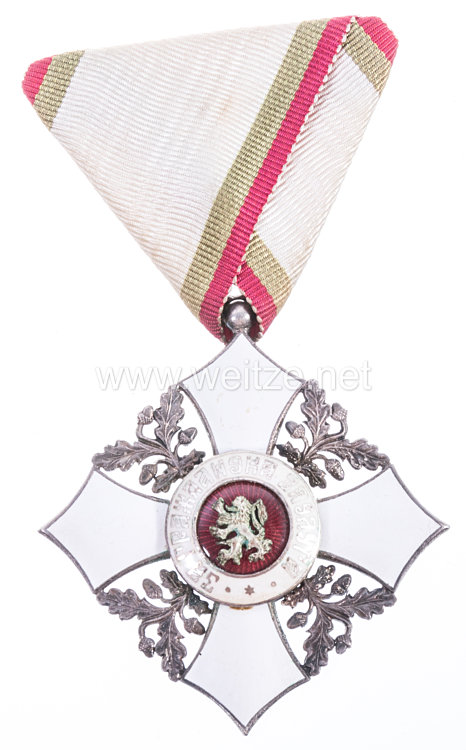
Bulgaria Civil Order of Merit Model (1944-1946) 5th Class

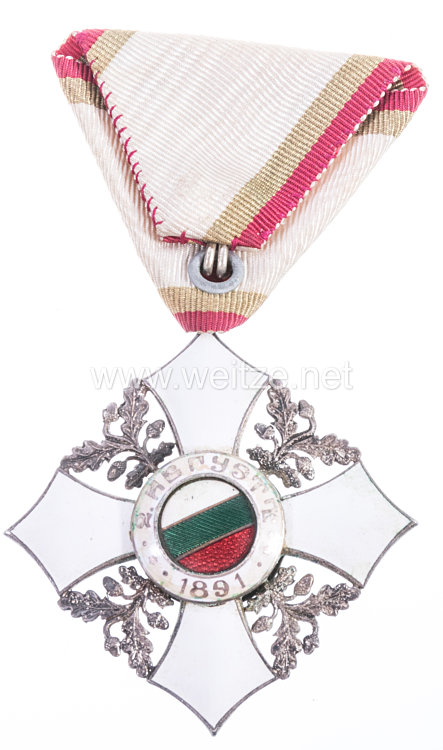
Cross silver-plated and enameled, the medallion with enameled national colors, on triangular ribbon, condition 2.
356753
200,00

Bulgaria Civil Order of Merit Model (1944-1946) 5th Class

The Bulgarian Order of Civil Merit represents a significant state decoration awarded in recognition of exceptional service to the Bulgarian state and nation. This example of the 5th Class dates from the brief but historically significant period of 1944 to 1946, a transitional era in Bulgarian history between the end of World War II and the final establishment of the communist regime.

The historical roots of the Bulgarian Order of Merit extend back to the 19th century, when modern Bulgaria developed its own system of decorations following liberation from Ottoman rule in 1878. The Order of Civil Merit was created to honor individuals who distinguished themselves through exceptional achievements in administration, science, culture, economics, or other civilian fields, as opposed to military decorations.

The period from 1944 to 1946 marks a dramatic turning point in Bulgarian history. In September 1944, the Soviet Union declared war on Bulgaria, and shortly thereafter the Fatherland Front, a communist-dominated coalition, seized power through a coup d'état. King Boris III had already died in 1943, and his minor son Simeon II was under regency. This transitional period ended in 1946 with the abolition of the monarchy through a referendum and the proclamation of the People's Republic of Bulgaria.

The present order cross displays the characteristic features of Bulgarian decorations from this era. The silver-plated and enameled execution corresponds to the standards for the 5th Class, the middle rank in the typically six-tiered hierarchy of Bulgarian orders. The central medallion with enameled national colors - white, green, and red - symbolizes the Bulgarian nation and its sovereignty. This color combination was officially adopted as the national flag in 1878 and has since played a central role in Bulgarian symbolism.

The triangular ribbon is a characteristic feature of Bulgarian orders and distinguishes them from the rectangular ribbons of many other European decorations. This particular form has a long tradition in Bulgarian phaleroistics and was maintained across various political systems.

The 5th Class of the Order of Civil Merit was typically awarded to mid-ranking officials, meritorious citizens, and foreign individuals who had rendered service to Bulgaria without their achievements justifying the highest levels of decoration. The hierarchical structure of the order allowed the state to recognize merit in a differentiated manner while preserving the significance of higher classes.

The brief time span from 1944 to 1946, from which this example originates, makes it a particularly interesting historical artifact. During this phase, elements of the monarchical system still existed parallel to the already dominant communist structures. Orders and decorations from this transitional period bear both traditional monarchical and new republican elements. After 1946, the decoration system was fundamentally reformed and adapted to Soviet models, resulting in the abolition or substantial modification of many traditional orders.

The craftsmanship of the order reflects the standards of Bulgarian metalworking and enamel art of this period. Despite the economic difficulties of the war and post-war period, state decorations continued to be manufactured with great care, as they symbolized the authority and continuity of the state. The silver plating and enamel were not merely decorative but also expressions of the esteem the state showed to those honored.

For collectors and historians, decorations from this specific period are of particular interest as they are relatively rare. The brief time span of their award and the subsequent political upheavals led to many of these orders being lost, hidden, or melted down. Examples in good condition document not only the phaleristic traditions of Bulgaria but also a crucial turning point in 20th-century European history.

The designation Condition 2 in numismatic and phaleristic grading scales indicates very good preservation with only minimal signs of wear, underscoring the quality and historical significance of this example.

r