Award Document for the Italian Military Pilot Badge to a German Major

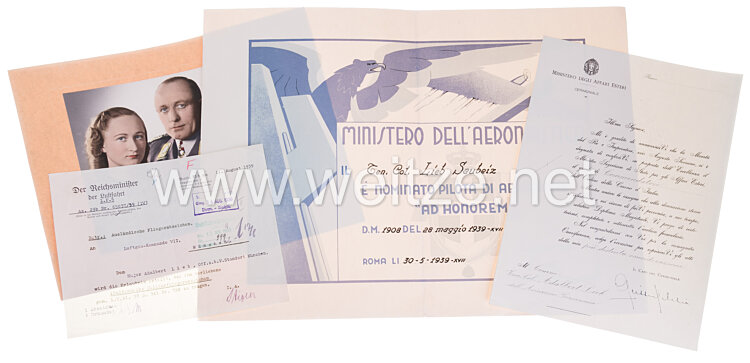
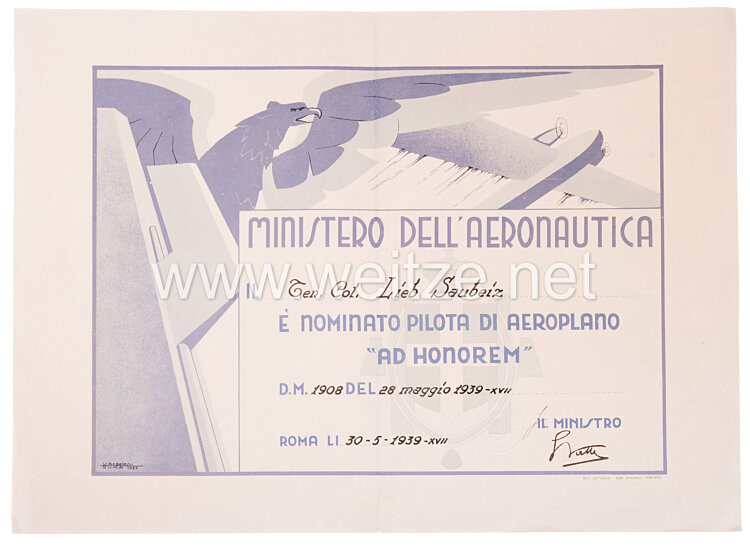
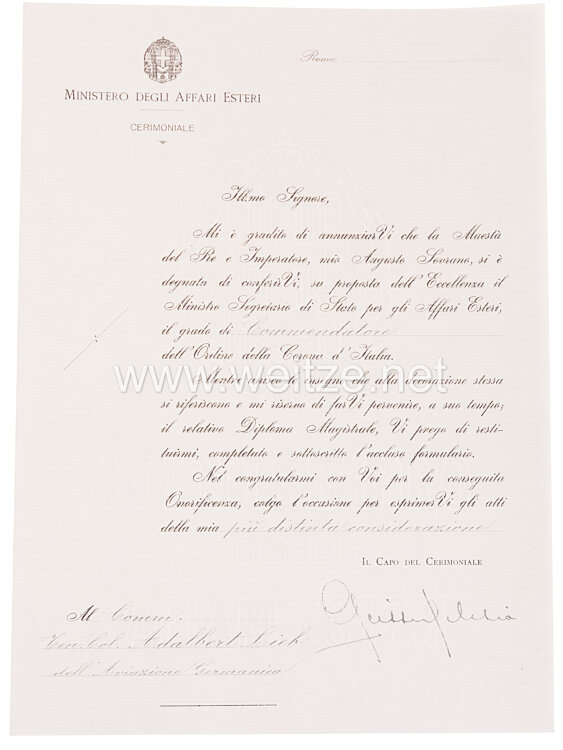
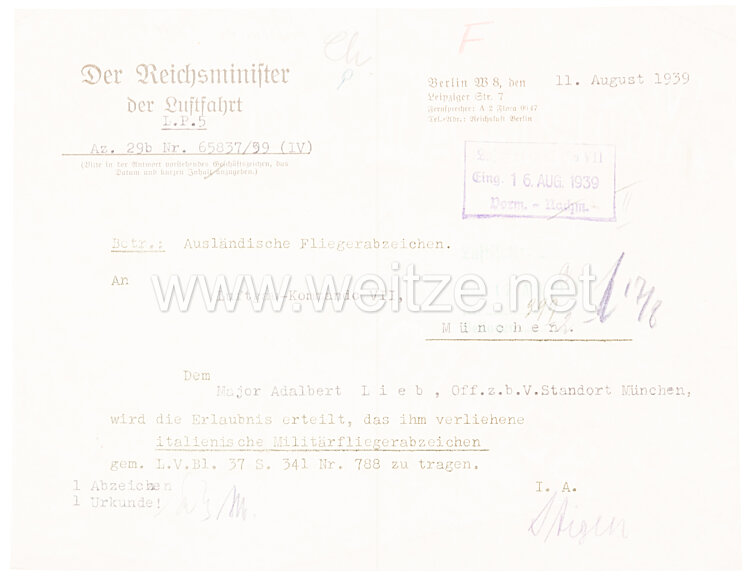
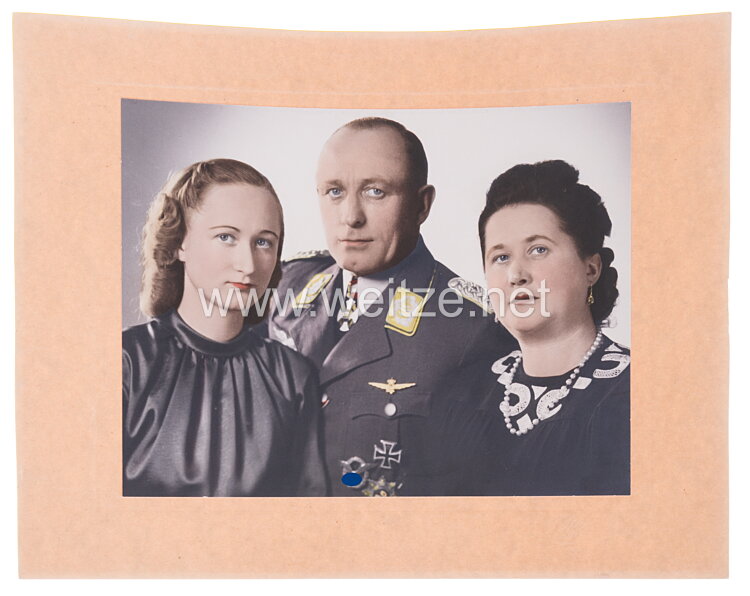
Large format sheet 32.5 x 45 cm, awarded on May 28, 1939 and issued in Rome on May 30, 1939; Italian cover letter included; letter from the Reich Minister of Aviation regarding foreign pilot badges, granting permission to wear to the Major and Officer for Special Duty stationed in Munich, dated August 11, 1939; large, very beautiful colorized photograph of the man with wife and daughter on which he wears the Italian and other badges; used condition.
278252
450,00

Award Document for the Italian Military Pilot Badge to a German Major

This award certificate for the Italian military pilot's badge to a German major from 1939 represents a significant testament to the military relations between Nazi Germany and Fascist Italy in the immediate pre-war period. The large-format document (32.5 x 45 cm), issued on May 30, 1939, in Rome for an award dated May 28, 1939, documents the close cooperation between the two Axis powers in the field of air forces.

The Italian military pilot's badge (Brevetto di Pilota Militare) had been awarded to qualified military pilots since World War I and represented one of the highest distinctions of the Italian Regia Aeronautica. The bestowal upon foreign officers was a sign of special recognition and symbolized military cooperation between allied nations. In the context of 1939, this decoration reflects the intensified relations between Germany and Italy, which found formal expression in the Pact of Steel of May 22, 1939 – only a few days before this award.

Of particular significance is the accompanying letter from the Reich Minister of Aviation dated August 11, 1939, which granted the major and officer for special employment stationed in Munich official permission to wear the foreign badge. This corresponded to the strict regulations of the Wehrmacht, whereby wearing foreign orders and decorations required explicit authorization. The regulations for this were established in various ordinances that ensured central control over the representation of military honors.

The Reich Minister of Aviation, at this time Hermann Göring, held extensive powers as Commander-in-Chief of the Luftwaffe regarding decorations and their wear authorization. The fact that approval was granted in August 1939, although the award had already taken place in May, indicates the bureaucratic process that accompanied such recognitions. This three-month period was also of utmost importance in foreign policy terms, as Europe was inexorably heading toward World War II.

The mention of an officer for special employment (Offz.z.b.V.) provides insight into the recipient's special function. This designation was used for officers who performed special duties outside the regular troop structure, frequently in liaison, coordination, or diplomatic functions. The location of Munich, which played a central role in the NS regime as the “Capital of the Movement,” underscores the importance of this position.

The accompanying colorized photograph showing the officer together with his wife and daughter, wearing the Italian and other badges, offers a rare personal glimpse into the lives of senior officers of this period. Such family portraits were common in the military culture of the 1930s and served both private remembrance and the representation of military status. The fact that several badges are visible suggests an extensive military career with international connections.

The temporal context of the award – May 1939 – is of extraordinary historical significance. Italy and Germany were in a phase of intensive military cooperation. German officers participated in exchange programs, visited Italian military installations, and vice versa. This collaboration extended particularly to the field of aviation, where both nations contributed their experiences from the Spanish Civil War (1936-1939), in which the German Legion Condor and Italian units had fought on Franco's side.

The document collection in its entirety – award certificate, Italian cover letter, German authorization letter, and family photograph – forms a coherent ensemble that illuminates the administrative, diplomatic, and personal aspects of military decorations in the pre-war period. The “used condition” of the documents testifies to their authenticity and their significance for the recipient and his family.

Such award certificates are today important sources for military history research, as they document not only individual careers but also illuminate the complex relationships between the Axis powers. They provide insights into the mechanisms of military recognition, international protocols, and the personal networks that connected the military elite of the 1930s.

r