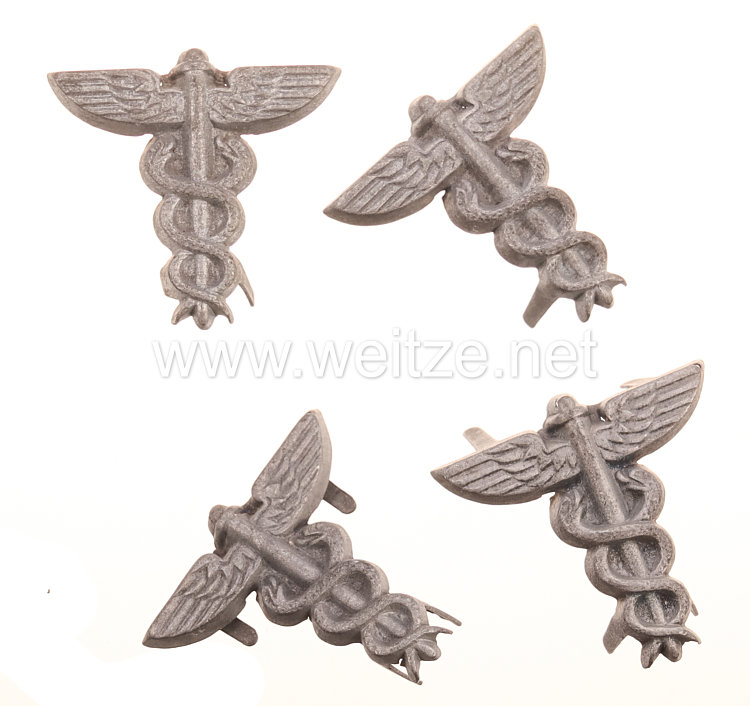
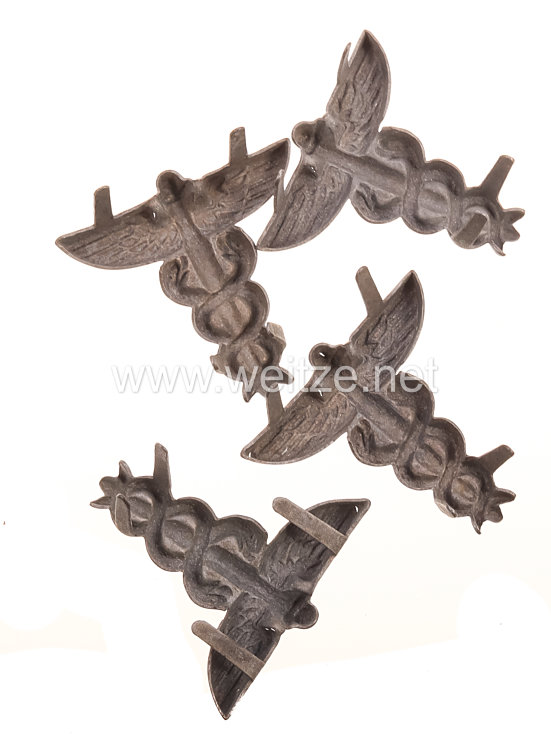
Kriegsmarine Pair of Shoulder Board Underlays for an Administrative Officer
Price per pair:
The Kriegsmarine shoulder board insignia for administration officers represent a fascinating example of the complex rank identification and functional differentiation within the German Kriegsmarine during World War II. These special insignia served for immediate identification of officers in the naval administration service and reflected the highly organized structure of the German armed forces.
The Kriegsmarine, officially founded on June 1, 1935, as the successor to the Reichsmarine, developed a sophisticated system of uniforms and rank insignia that distinctly differed from the Army and Air Force. Administration officers formed a separate branch within this organization, responsible for logistical, administrative, and economic tasks. Their identification through special shoulder board insignia allowed immediate distinction from sea officers, engineers, and other specialist services.
The insignia described here were manufactured from fine zinc, a material that gained increasing importance during the war years. While high-quality materials such as silver-plated or gold-plated metal were frequently used in the early years of the Kriegsmarine, the wartime economic situation from approximately 1940 onwards forced increased use of substitute materials. Zinc proved to be a practical alternative, being malleable, corrosion-resistant, and available in sufficient quantities.
The administration officers (Marineintendanten) wore special insignia on their dark blue shoulder boards that identified their affiliation with the administration service. These insignia typically displayed stylized emblems that differed from the anchors of sea officers or the cogwheels of engineers. The rank identification system for administration officers fundamentally followed that of sea officers, but with characteristic insignia for differentiation.
Attachment was accomplished by means of clips on the reverse side, which allowed the insignia to be securely fixed to the shoulder boards. This system was practical and permitted exchange or adjustment when necessary. The uniform regulations of the Kriegsmarine, established in various decrees and implementing provisions, precisely regulated when and how these insignia were to be worn.
The naval administration service itself had a long tradition in the German Navy. Administration officers already existed in the Imperial Navy, responsible for economic management, provisions, clothing, and pay. In the Kriegsmarine, this system was further developed and professionalized. The training of administration officers took place at special naval schools and encompassed both military and commercial as well as legal content.
The hierarchical structure ranged from naval paymaster candidate through various officer ranks to Admiral Intendant. Each rank was identified by specific combinations of shoulder boards, sleeve insignia, and the insignia described here. Wearing them in pairs on both shoulders was naturally obligatory and corresponded to general military conventions.
In the context of the Kriegsmarine, administration officers played an indispensable role. They were present on all larger ships, at naval stations, shipyards, and in the Naval High Command structure. Their duties included budget management, procurement, provisions organization, payroll, and legal consultation. Without functioning administration, the operation of the complex naval organization would have been impossible.
From a collector's perspective, such shoulder board insignia are today important testimonies of military history. Their condition, indicated here as “Condition 2,” suggests a well-preserved pair with possibly slight signs of use. The authenticity of such pieces is of particular importance for collectors and historians, with material, workmanship, and attachment system representing important evaluation criteria.
The study of these seemingly small uniform parts contributes to understanding the larger organizational structure of the Kriegsmarine and illustrates how even administrative functions were integrated into the military rank system. They remind us of a time when every detail of the uniform was precisely regulated and had immediate significance for the military hierarchy.