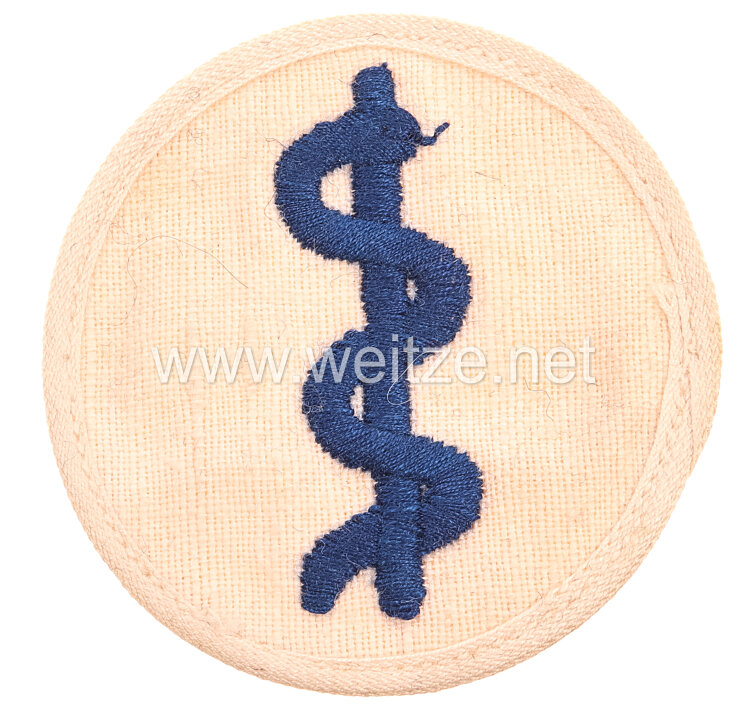
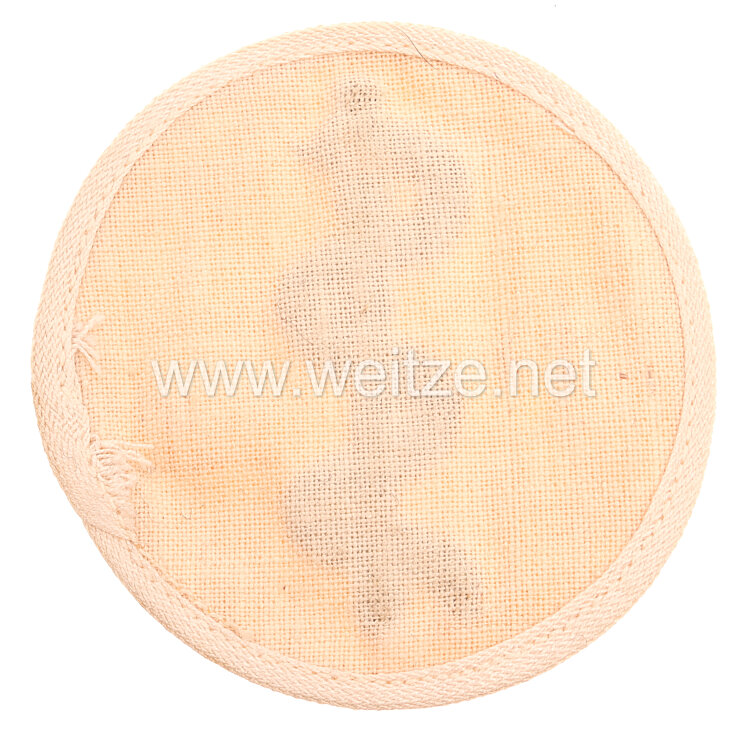
Kriegsmarine Enlisted Rank Sleeve Insignia Medical Corpsman
The Kriegsmarine sleeve badge for enlisted medical personnel represents a significant example of rank insignia and specialist identification in the German Navy during World War II. This particular badge was designed to be worn on the white service blouse (summer drill jacket) and identified members of the medical staff in enlisted ranks.
The Kriegsmarine, officially established on June 1, 1935, developed a complex system of uniforms and badges that built upon the traditions of the Imperial Navy. The uniform regulations were detailed in the Dress Regulations for the Kriegsmarine (M.Dv. Nr. 54). These regulations precisely governed which badges could be worn where and by whom.
The medical personnel of the Kriegsmarine played an indispensable role aboard warships, U-boats, and in shore establishments. Medical care at sea presented special challenges, particularly during extended combat patrols of submarines or on surface ships in distant waters. Medical orderlies had to handle a wide spectrum of medical emergencies, from combat injuries to illnesses and surgical procedures under the most difficult conditions.
Sleeve badges for medical personnel typically displayed the Aesculapius symbol – a staff with an entwined serpent – as the international emblem of healthcare services. These badges were worn on both upper arms of the uniform and were typically embroidered on a dark blue background for the dark blue uniform, or in corresponding execution for the white summer uniform.
The white service blouse was primarily worn during summer months, in tropical and subtropical operational areas, and for special occasions. It was part of the white dress uniform and represented the Navy at official events in warmer climates. The Mediterranean Fleet, ships in North Africa or the Pacific, as well as coastal units in southern latitudes regularly utilized this uniform.
The production of such badges was carried out by various authorized manufacturers who had to comply with Navy specifications. Quality and execution varied depending on the manufacturer and production period. Early war productions often showed higher quality with fine hand embroidery, while later war years increasingly brought simplifications and machine production. Unworn specimens in good condition are relatively rare today, as most badges actually entered service.
The training for medical orderlies in the Kriegsmarine included theoretical instruction and practical exercises in naval hospitals and aboard ships. After successful training, soldiers received their specialist badges, which identified them as qualified medical professionals. The career path could progress from simple medical sailor through medical lance corporal to medical leading seaman and higher ranks.
The hierarchical structure of the Kriegsmarine medical service included various enlisted ranks, each marked by corresponding rank insignia on the sleeve. In addition to rank badges, medical orderlies wore their specialist badge, which identified their function in the medical field. Physicians and higher medical officers wore different insignia corresponding to the officer corps.
The collector value of such badges today depends on several factors: condition, authenticity, rarity of the specific variant, manufacturer, and historical documentation. Unworn specimens are particularly sought after as they show the original condition without signs of use. The rating in condition 2 indicates very good preservation with possibly minimal storage traces.
From a historical perspective, these badges document the organizational structure and personnel system of the Kriegsmarine. They are material witnesses to the military culture and hierarchy of the Third Reich. For military-historical research, such artifacts provide important insights into uniform regulations, production methods, and the everyday reality of naval service during World War II.
The medical service of the Kriegsmarine maintained high standards throughout the war, despite increasing resource shortages. Medical orderlies were essential crew members, especially on submarines where space was extremely limited and every crew member had to fulfill multiple functions. The recognition of their specialist status through distinctive badges reflected the importance the Navy placed on maintaining the health and combat readiness of its personnel.