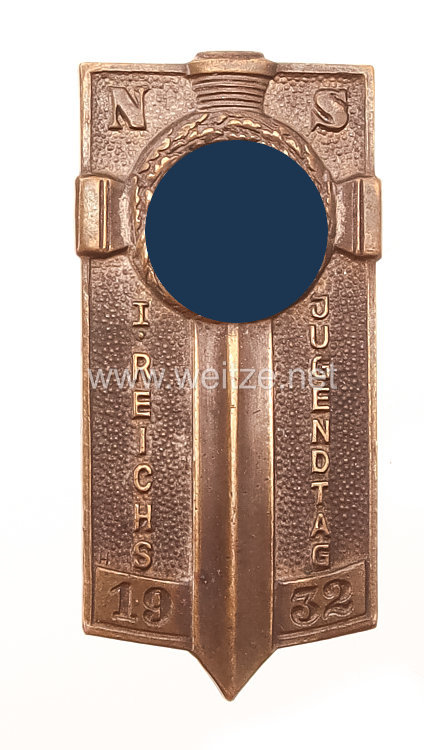
1st National Socialist Reich Youth Day 1932 in Potsdam Visitor's Badge in Bronze

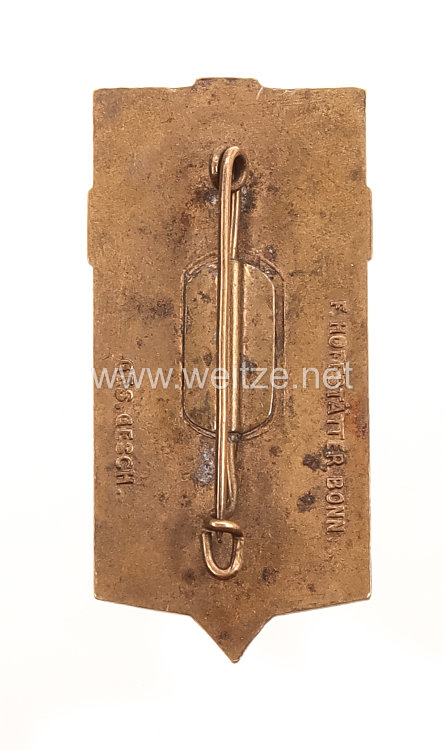
Non-ferrous metal, maker: “F. Hoffstätter Bonn GES.GESCH.”, condition 2.

432452
250,00

1st National Socialist Reich Youth Day 1932 in Potsdam Visitor's Badge in Bronze

The badge for the 1st NS-Reich Youth Day 1932 in Potsdam represents a significant historical artifact from the final phase of the Weimar Republic, a period characterized by intense political struggle and social polarization. This visitor's badge in bronze, manufactured by the firm F. Hoffstätter Bonn, documents a central event of the National Socialist youth movement immediately before the seizure of power.

The Reich Youth Day on October 1-2, 1932 in Potsdam was a mass gathering of the Hitler Youth (HJ) and the National Socialist German Students' League, attracting approximately 70,000 to 100,000 participants. This event took place at a decisive political moment - between the Reichstag elections of July and November 1932, when the NSDAP was already the strongest party in parliament but had not yet attained governmental power.

The choice of Potsdam as the venue was symbolically significant. The city was regarded as Prussia's garrison town and a symbol of Prussian military tradition. The National Socialists deliberately staged a connection between the Prussian past and their own movement to suggest legitimacy and historical continuity. This strategy would reach its culmination in 1933 with the “Day of Potsdam.”

The badge itself was made from non-ferrous metal in bronze, which was typical for visitor badges of this era. The manufacturing firm F. Hoffstätter of Bonn was an established company for orders, decorations, and badges that had been active since the Imperial era and throughout the Weimar Republic. The marking “GES.GESCH.” (legally protected) indicates a registered trademark or protected design, which was customary for official event badges.

Such badges served multiple functions: they facilitated access control at the event, served as mementos for participants, and functioned as propaganda tools. Wearing such badges publicly demonstrated political affiliation and was intended to reinforce the impression of a broad mass movement. In the highly politicized atmosphere of the early 1930s, such symbols were important markers of identity.

The Hitler Youth, which largely organized this event, was founded in 1926 and had already reached approximately 100,000 members by 1932. Under the leadership of Baldur von Schirach, who was appointed Reich Youth Leader of the NSDAP in 1931, the HJ developed into a tightly organized paramilitary youth organization. The Reich Youth Day of 1932 served to publicly demonstrate the strength and discipline of this organization.

The event encompassed mass marches, field sports exercises, competitions, and propaganda speeches. It was part of the National Socialist strategy to demonstrate political power through impressive mass spectacles and to mobilize supporters. Youth played a central role in NS ideology as the supposed bearers of Germany's “renewal.”

From today's perspective, this badge is an important contemporary historical document. It recalls the methods by which anti-democratic movements operated in the Weimar Republic and the vulnerability of large segments of youth to totalitarian ideology. The year 1932 was the last year of the democratic Weimar Republic; only a few months after this Reich Youth Day, on January 30, 1933, Hitler was appointed Reich Chancellor.

Collections of such historical objects today hold scientific and educational value. They serve in museums and educational institutions to inform about the mechanisms of totalitarian rule and to warn against the dangers of extremist ideologies. Proper contextualization is crucial to prevent glorification and to fulfill the educational mandate.

The badge for the 1st NS-Reich Youth Day 1932 thus stands exemplarily for the transitional period between democracy and dictatorship and documents the systematic mobilization of youth for anti-democratic purposes during one of the most critical phases of German history.

r