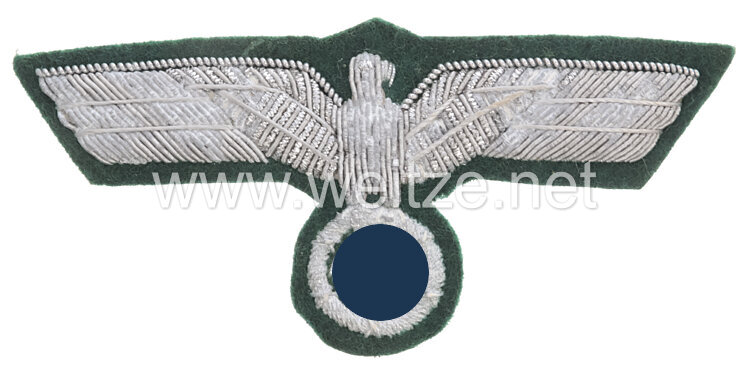
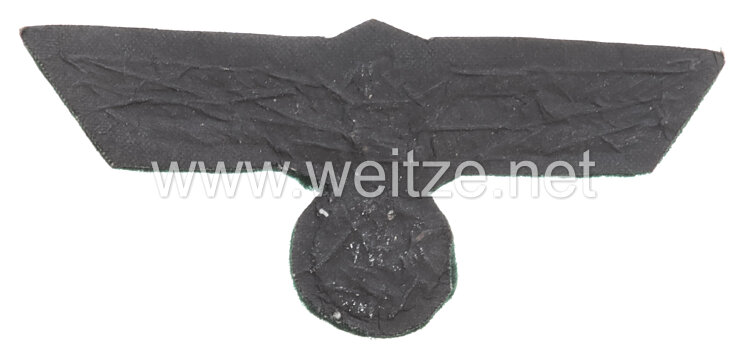
Wehrmacht Forestry Service Breast Eagle for Officers

hand-embroidered on light green base, partially oxidized, condition 2-3
464650
225,00

Wehrmacht Forestry Service Breast Eagle for Officers

The Wehrmacht Forestry Service Breast Eagle for Officers represents a remarkable example of specialized uniforming within the German armed forces during World War II. This hand-embroidered badge on light green background embodies the connection between military organization and the administration of German forests during the Nazi era.

The Wehrmacht Forestry Organization played an important, though often overlooked role in the military infrastructure of the Third Reich. A close connection between forestry administration and the military already existed in the Weimar Republic, but with the seizure of power in 1933 and subsequent rearmament, this relationship was systematically expanded. The Wehrmacht Forestry Service became responsible for various tasks, including ensuring timber resources for military purposes, managing training grounds in forested areas, and camouflaging military installations.

The present badge displays the characteristic German eagle in the typical Wehrmacht representation with spread wings and the swastika in its talons. The hand-embroidered execution on light green background is particularly characteristic of the Forestry Service, as the green color was traditionally associated with forestry. This coloring clearly distinguished forestry service badges from the standard field-grey or other colored backgrounds of other Wehrmacht branches.

The hand-embroidered manufacture of these breast eagles indicates an officer's version, as machine-made or woven variants were frequently used for enlisted men and non-commissioned officers. Hand embroidery required considerable craftsmanship and was performed in specialized workshops. Renowned manufacturers such as firms in Berlin, Munich, and other German cities produced these high-quality badges according to the precise regulations of the Army Clothing Regulations.

The oxidation of the present piece is a typical characteristic of badges from this era. The metal threads used, often aluminum or silver-plated wire, were susceptible to corrosion, especially when badges were worn under field conditions or stored for decades. This patina is today an authenticity feature valued by collectors.

The organizational classification of the Wehrmacht Forestry Service was complex. During the war, forestry offices were subordinate to various military and civilian authorities. The Reich Forestry Office under Hermann Göring, who served as Reich Master of Forestry and Reich Master of the Hunt, played a central role in coordinating between civilian forest administration and military requirements. Forestry Service officers were often specialists with forestry training who were integrated into the Wehrmacht for the duration of the war.

The wearing of the breast eagle followed the general uniform regulations of the Wehrmacht. The badge was attached to the right breast side of the uniform, above the breast pocket. The exact positioning was detailed in the clothing regulations and was strictly controlled to ensure uniformity of military appearance.

After 1945, all Nazi symbols, including these badges, were banned by the Allies. Many uniform pieces were destroyed or stripped of their insignia. The preserved specimens became historical documents that today bear witness to the history of this era in museums and private collections. The scientific and museum value of such objects lies in their function as primary sources for the study of uniforms and organizational history of the Wehrmacht.

For collectors and historians, these badges are important objects of study. They provide insights into manufacturing techniques, material usage, and the organizational structure of the German military. The condition rating of 2-3 indicates a piece that, despite signs of use and oxidation, is still well-preserved and has retained its essential features.

Research into such military-historical objects today takes place within the framework of critical historical scholarship, which contextualizes these artifacts as testimonies of a criminal dictatorship and contributes to education about the Nazi era.

r