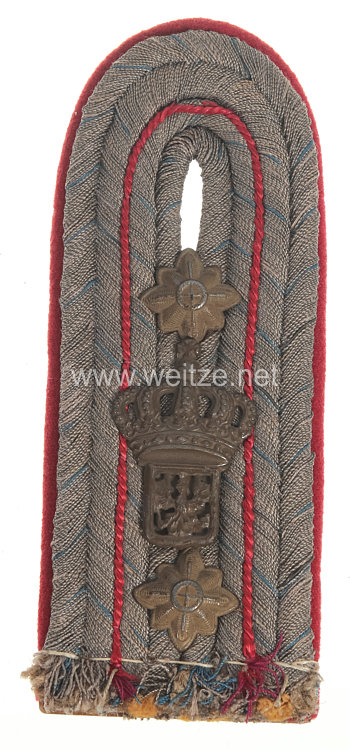
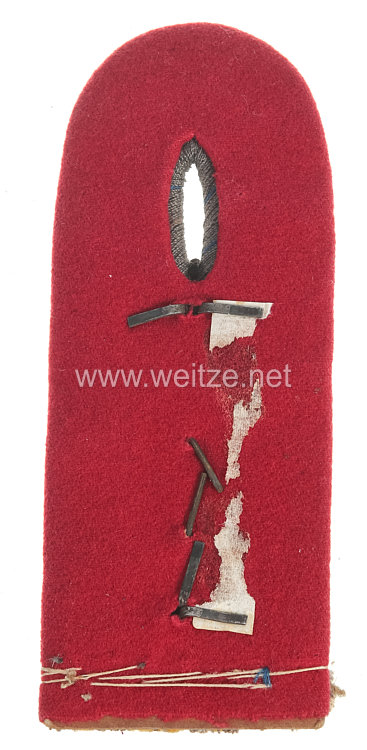
Prussia World War I Single Shoulder Board Field-Gray for a Military Construction Official in the Rank of Regierungsbaumeister

Circa 1916. Crimson cloth base and piping, blue interwoven stripes, for sewing in. Worn condition, Condition Grade 2.


366850
80,00

Prussia World War I Single Shoulder Board Field-Gray for a Military Construction Official in the Rank of Regierungsbaumeister

This shoulder strap represents a fascinating aspect of Prussian military administration during World War I. It is a rank insignia for a military construction official holding the rank of Regierungsbaumeister (government master builder), manufactured around 1916, displaying the characteristic colors and design features of this specialized service position.

The Prussian military administration was a highly complex system that extended far beyond regular combat troops. Military construction officials played a crucial role in planning, building, and maintaining military facilities. The rank of Regierungsbaumeister corresponded to a middle to senior civil service rank and typically required a completed degree in civil engineering as well as several years of practical experience.

The crimson red base color of the shoulder strap is of particular significance. Crimson red was traditionally the branch color in the Prussian army for various specialist units and technical services. The use of this color for construction officials emphasized their technical expertise and important role within the military organization. The blue piping served as an additional distinguishing feature, specifying the exact service position within the hierarchy of construction officials.

During World War I, the importance of military construction officials increased considerably. Warfare required the rapid construction of fortifications, dugouts, field hospitals, ammunition depots, and supply facilities. On the Western Front, complex trench systems emerged whose planning and construction required technical expertise. Construction officials were responsible for erecting concrete bunkers, ensuring water supply in the trenches, and building railway lines to supply the front.

The year 1916, to which this shoulder strap is dated, was a turning point in World War I. The Battle of Verdun and the Battle of the Somme demonstrated the importance of well-constructed defensive positions. German forces increasingly relied on building deep, concrete-reinforced dugouts that could withstand massive Allied artillery bombardments. Regierungsbaumeister were significantly involved in planning and implementing these construction measures.

The design as a single shoulder strap for sewing into the field-gray uniform corresponds to the dress regulations of the time. Unlike the paired shoulder straps worn by line troops, such rank insignia were worn individually on the right shoulder. The field-gray execution indicates that this was a piece for field service, in contrast to the often more elaborately designed shoulder straps for parade uniforms.

The manufacture of such shoulder straps was carried out in specialized workshops or by military tailors. The cord was carefully sewn onto the cloth backing, with various windings and patterns indicating the respective rank. The quality of workmanship was an indicator of the importance attached to the correct representation of military hierarchies.

In the context of military history, such shoulder straps document the professionalization and specialization of modern armies. The Prussian-German Army of World War I was not merely a combat organization but a complex system encompassing engineers, physicians, administrative officials, and technicians of various specialties. The precise identification of these different service positions through uniform components such as shoulder straps was essential for the functionality of this organization.

After the war, such rank insignia lost their official significance. Many became mementos or entered private collections. Today they are valuable sources for military history research, providing insights into the organizational structure and self-perception of the Imperial Army. They document an era in which technical expertise became increasingly decisive for warfare, and specialized officials played an indispensable role in military logistics.

r