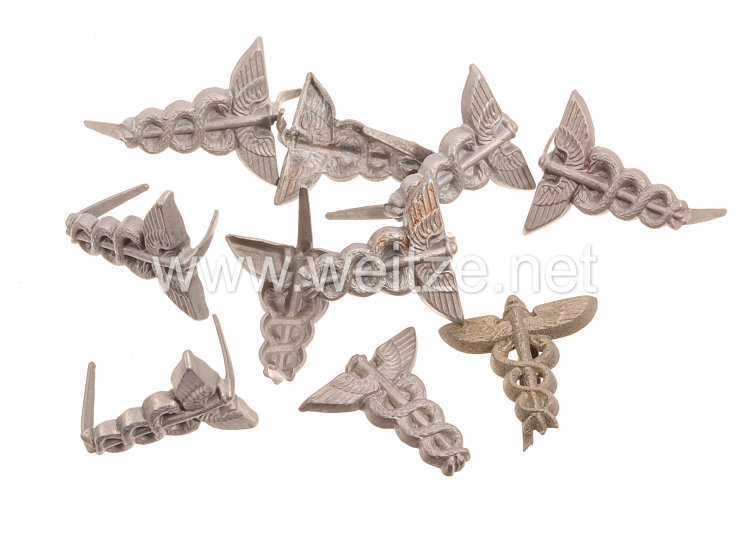
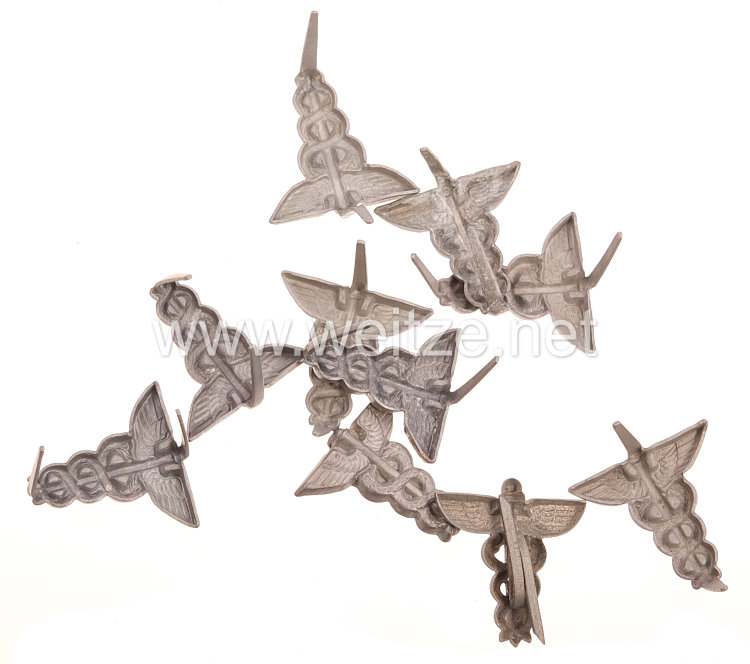
Kriegsmarine Pair of Shoulder Board Underlays for an Administrative Officer
Price per pair:
The shoulder strap badges for Kriegsmarine administrative officers represent an important aspect of the complex rank insignia system of the German Navy during World War II. These badges, manufactured from fine zinc and supplied as pairs, served to identify officers of the administrative service, an essential though often overlooked component of the Third Reich's maritime forces.
The Kriegsmarine, officially established on June 1, 1935, replaced the Reichsmarine, which had been severely restricted by the Treaty of Versailles. With the rebuilding of German naval forces under Grand Admiral Erich Raeder, a comprehensive system of uniform regulations and rank insignia was introduced. Army regulation bulletins and special naval ordinances meticulously regulated the design and wearing of all uniform components.
Administrative officers (Verwaltungsoffiziere) formed the administrative backbone of the Kriegsmarine. They were responsible for payroll, provisioning, clothing, material procurement, and all logistical administration. Without their work, no fleet could have operated effectively. Unlike sea officers who underwent nautical or technical training, administrative officers typically came from legal or commercial professions and completed specialized administrative training.
The shoulder strap badges (Schulterauflagen) were attached to the shoulder straps of various uniform types. They consisted of a metal frame with integrated clasps for attachment to the textile shoulder boards. The use of fine zinc was war-related - as the war progressed, substitute materials were increasingly used since non-ferrous metals like brass were needed for war-essential purposes.
The identification of administrative officers was achieved through specific colors and symbols. Administrative officers typically wore dark blue underlays with light blue (cornflower blue) piping. The gold or silver rank insignia on the shoulder boards distinguished the various ranks from paymaster candidates to fleet administrators. The system was clearly hierarchical and enabled immediate identification of rank and function.
The manufacture of such badges was carried out by various authorized producers throughout the Reich. Companies like Assmann in Lüdenscheid or other specialized military insignia factories produced these badges according to precise specifications. Quality controls ensured that the badges met official standards, although material quality inevitably declined as the war progressed.
The wearing regulations were strictly controlled. Shoulder badges were worn on the service uniform, the dress uniform, and partially on working uniforms. For full dress uniform, more elaborate epaulettes with fringes were used instead. The correct attachment and maintenance of badges was part of military discipline and was regularly inspected.
After the war's end in 1945, the Kriegsmarine was dissolved. Many uniform parts and badges were destroyed, while others were preserved as mementos or later became collectors' items. Today, authentic Kriegsmarine badges are sought-after military-historical artifacts that provide insight into the organization and structures of the German Navy.
The preservation and documentation of such objects is significant for military-historical research. They enable understanding of the complex administrative structures of military organizations and reconstruction of daily life and hierarchies within the armed forces. Simultaneously, they serve as material witnesses to a historical epoch that must be critically examined.
For collectors and historians, the condition of such objects is of particular importance. A condition grade of 2 typically denotes a well-preserved piece with slight signs of use but without significant damage - a condition that is remarkable for objects over 80 years old and indicates careful storage.
These shoulder strap badges thus represent more than mere military accessories. They are tangible evidence of the organizational complexity of a major 20th-century naval power and serve contemporary researchers as important sources for understanding military administration, material culture, and the social structures of armed forces during this historical period.