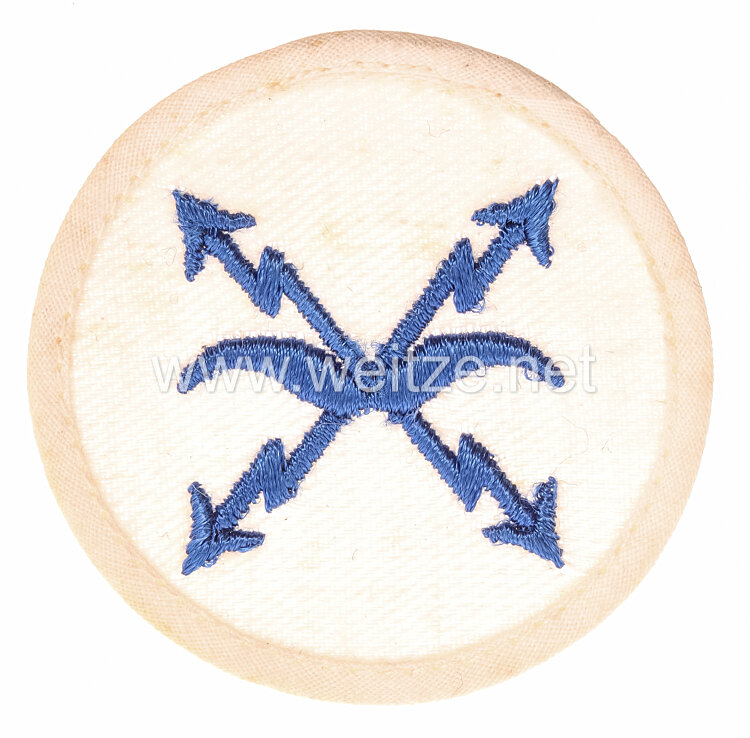
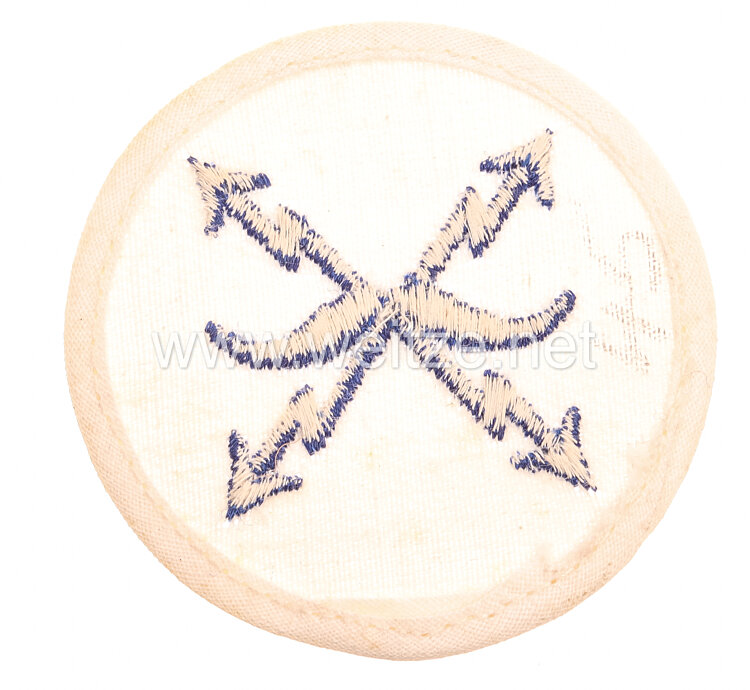
Kriegsmarine Enlisted Rate Sleeve Insignia Radar Operator Career Track

for the white blouse. Unissued condition, condition grade 2.
453650
45,00

Kriegsmarine Enlisted Rate Sleeve Insignia Radar Operator Career Track

The Kriegsmarine sleeve badge for enlisted radar personnel represents a fascinating aspect of German naval history during World War II. These specialized career badges were introduced to acknowledge the increasingly important role of radar technology in maritime warfare.

The Funkmesslaufbahn (radar career track) was established in the Kriegsmarine after Germany began intensive radar development in 1935. The first functional German naval radar device, the Freya, was developed in 1938, followed by Seetakt and later the Würzburg radar system. These technological advances required specially trained personnel, leading to the creation of dedicated career tracks and corresponding insignia.

The sleeve badge for the white blouse was part of the complex system of Laufbahnabzeichen (career badges) of the Kriegsmarine, introduced on October 1, 1938, by order of the Commander-in-Chief of the Navy. These badges served for quick visual identification of a sailor's professional specialization. For the radar career track, the badge typically displayed a stylized technical symbol representing radar technology.

The white blouse uniform, for which this badge was intended, was worn by enlisted ranks during summer months or in warmer climates. It consisted of a white cotton blouse with a dark collar and was combined with matching white trousers. Sleeve badges were affixed to the left upper arm, typically about 10 centimeters below the shoulder seam.

Training for the radar career track was demanding and required a high degree of technical understanding. Recruits had to learn not only the operation of complex radar equipment but also its maintenance and repair. The Naval School Flensburg-Mürwik and other specialized training facilities offered corresponding courses. The importance of this career track increased steadily, especially after experiences with British radar technology and its impact on naval battles.

Technically speaking, the sleeve badges were mostly made from blue or dark blue cloth, with embroidery in yellow or gold thread for the white uniform. Production was carried out both by official naval depots and by private manufacturers who received contracts from the Navy. Quality could vary, with earlier wartime productions often of higher quality than later ones, as material shortages increased.

The strategic significance of radar technology for the Kriegsmarine cannot be overstated. While the German Navy initially kept pace with Britain in radar development, the balance increasingly shifted in favor of the Allies. German U-boats suffered heavy losses as the Allies deployed advanced radar equipment for submarine detection. This led to the development of German radar warning devices such as Metox and Naxos, whose operation also fell within the responsibility of radar personnel.

The unworn specimen in condition 2 suggests a badge that was probably produced towards the end of the war or never issued. Many such uniform items remained unused when the Kriegsmarine capitulated in May 1945. The preservation of such objects enables an authentic insight into the material culture and organization of the German Navy today.

Collectors and historians value these sleeve badges as important testimonies to maritime military history. They illustrate not only technological development but also the organizational structure and hierarchy of the Kriegsmarine. Each of these badges tells the story of a highly specialized military career track that was of crucial importance in the context of the technological arms race of World War II.

The condition description “unworn, condition 2” indicates an artifact that has survived in excellent state, providing researchers with valuable information about manufacturing techniques, materials used, and the aesthetic standards of the period. Such well-preserved examples serve as important reference pieces for authentication and study of wartime naval insignia.

r