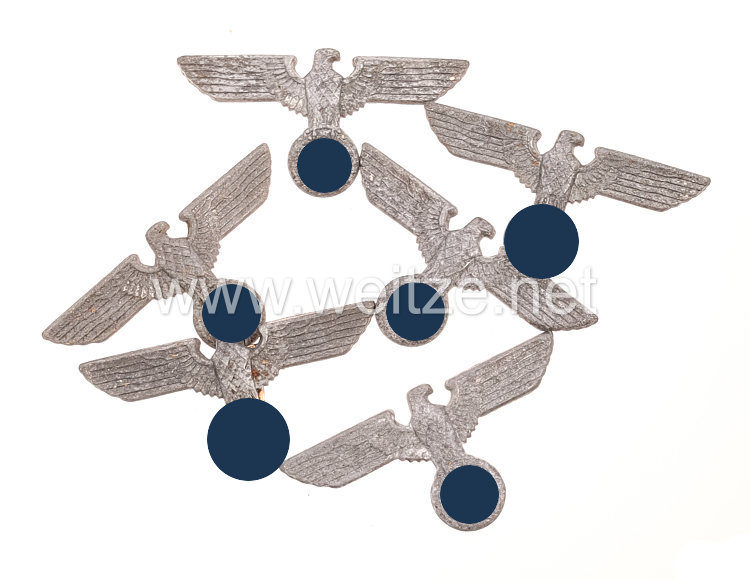
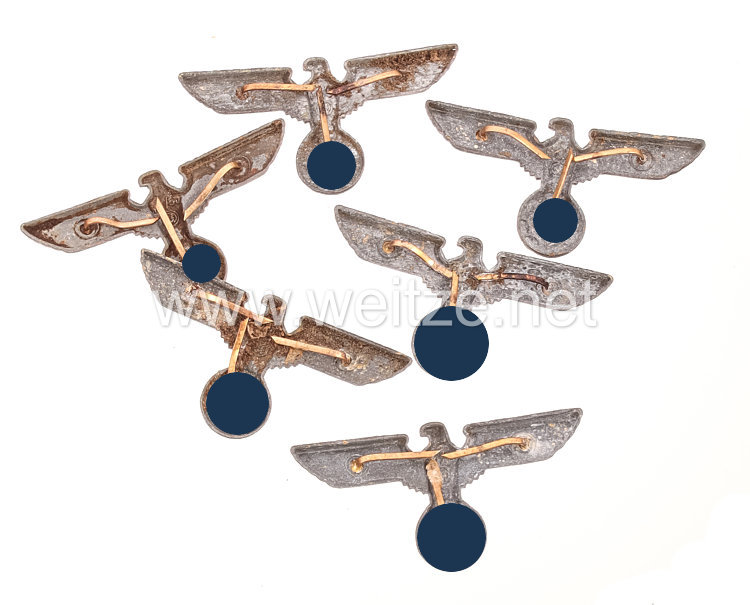
SA Hat Eagle for the Shako
Price per eagle:
Condition may vary:
The SA cap eagle for the peaked cap represents a significant emblem of the paramilitary organization Sturmabteilung (SA) during the National Socialist era. The present specimen corresponds to the second model, which was introduced after 1939 and featured important changes compared to earlier versions.
The Sturmabteilung was founded in 1921 and developed into the largest paramilitary formation of the NSDAP. Its members wore characteristic brown uniforms, which included the peaked cap with the distinctive eagle badge. The eagle as a heraldic symbol had a long history in German military tradition, but was combined with the swastika in the National Socialist context.
The RZM M 1/50 marking on the reverse of the eagle is of particular historical significance. The Reichszeugmeisterei (RZM) system was established in 1929 as a central procurement and control office for uniforms and equipment of NSDAP organizations. The RZM assigned manufacturer numbers to approved producers to ensure quality and uniformity. The marking “M 1/50” identifies a specific manufacturer of metal badges authorized by the RZM.
The second model of the SA cap eagle, used from 1939 onwards, differed in details from the earlier version. These changes reflected both technical and organizational developments. After the “Röhm Putsch” of 1934, in which the SA leadership was eliminated, the organization lost its previous political and military significance. The SS increasingly took over its functions, while the SA assumed more ceremonial and paramilitary training tasks.
Manufacturing from fine zinc was typical for the pre-war and war period, when strategic metals such as copper and brass were needed for the armaments industry. Zinc was available as a substitute material and still allowed detailed shaping of the insignia. The die-casting processes of the time enabled mass production of these emblems at relatively low cost.
The peaked cap itself was an important component of the SA uniform. Depending on the rank and function of the wearer, the design of the cap varied. The eagle was attached above the cap band and was an indispensable identifying feature. The exact wearing regulations were specified in the SA uniform regulations, which were revised several times.
The RZM system operated according to a strictly controlled distribution system. Only authorized dealers were allowed to sell these items, and SA members were required to obtain their uniform parts through official channels. This was intended to guarantee uniformity on the one hand, but also to provide a source of income for the party organization on the other.
The historical significance of such objects today lies in their testimonial value for the organizational structure and material culture of totalitarian systems. They document the importance of uniformity and symbolism for identity formation and hierarchy building within paramilitary organizations. At the same time, they raise questions about production, distribution, and the economic dimension of such mass-produced items.
Surface corrosion is a typical characteristic of zinc alloys that have been exposed to weather or unfavorable storage conditions for decades. Zinc tends to form oxide layers and can develop a characteristic white patina when exposed to moisture. This often makes it difficult today to determine the exact original surface treatment, which could vary for such badges.
For military historians and collectors, these objects provide important insights into the manufacturing techniques, material use, and organizational structures of the period. The RZM markings often enable precise dating and attribution to specific manufacturers, contributing to the reconstruction of production networks and supply chains.
The study of such artifacts contributes to understanding how totalitarian regimes utilized material culture and mass production to create cohesive organizational identities. The standardization efforts represented by the RZM system reflect broader attempts at centralization and control that characterized the National Socialist state apparatus.