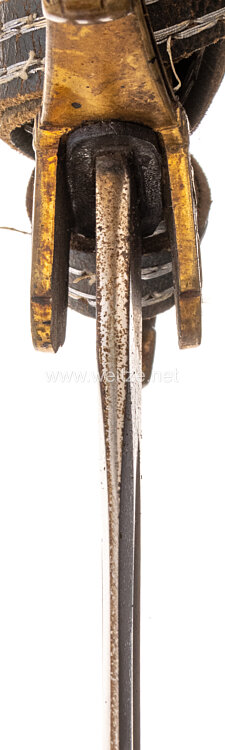
Reichswehr Saber for Officers

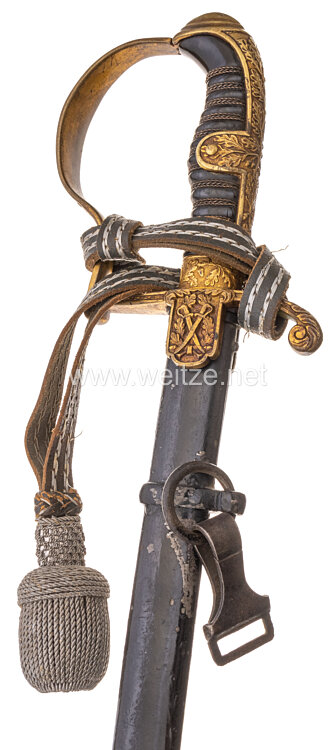
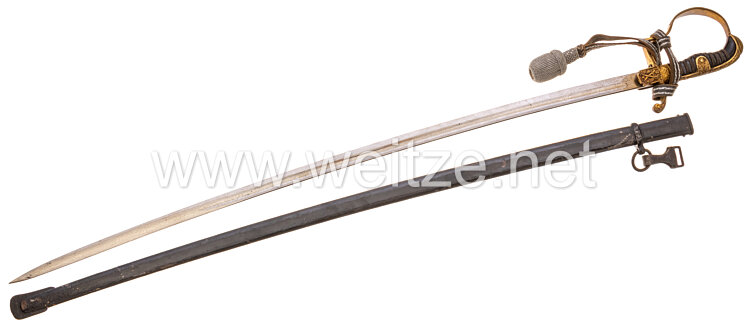
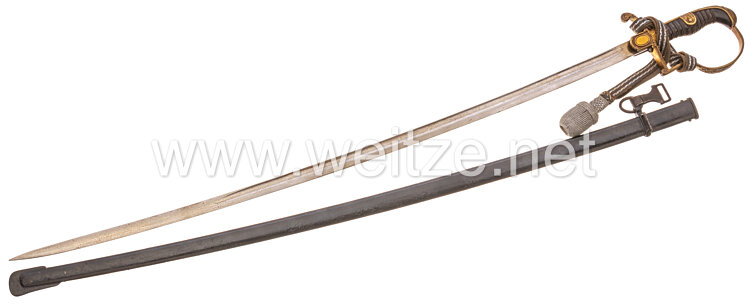
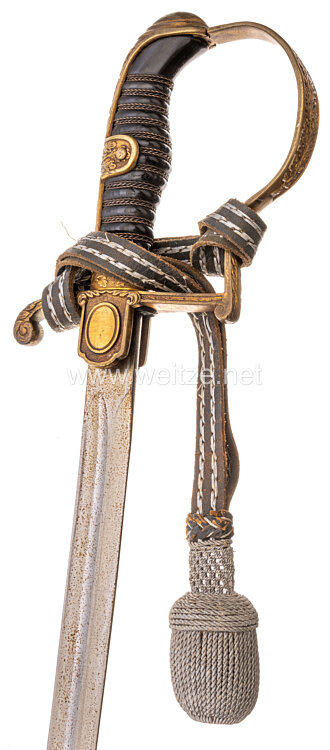
Slightly curved blade, without identifiable maker, brass hilt with oak leaf decoration, crossed sabers on the guard strap, black plastic grip with intact wire wrapping, the scabbard painted over in black, signs of age and use, with attached Wehrmacht sword knot. Condition 2-3
457149
550,00

Reichswehr Saber for Officers

This Reichswehr officer's saber represents a significant chapter in German military history between the two World Wars. Following World War I and the Treaty of Versailles in 1919, the German army was drastically reduced and transformed into the Reichswehr, a professional army limited to a maximum of 100,000 men.

The Reichswehr officer's sabers followed traditional German military standards that had evolved from the regulations of the Imperial Army. The army uniform and equipment regulations precisely governed the appearance and specifications of edged weapons. The characteristic officer's saber featured a slightly curved blade, typically measuring about 80-90 cm in length. The brass hilt with oak leaf decoration was an important design element symbolizing the connection to German military tradition. The oak had long been regarded as a symbol of strength, endurance, and German virtues.

The crossed sabers on the guard served as a military symbol and were characteristic of various branches of the Reichswehr. The black synthetic grip with intact wire wrapping represented a practical solution ensuring both durability and functionality. The wire wrapping, often made of silver-plated or gilt metal wire, provided a secure grip even under difficult conditions.

The Reichswehr era (1919-1935) was a transitional period in German military history. Despite the restrictions of the Treaty of Versailles, the Reichswehr endeavored to maintain military traditions. Officer's sabers were more than just weapons; they were status symbols and expressions of military honor. Officers wore their sabers at parades, ceremonial occasions, and as part of their dress uniforms.

The manufacture of officer's sabers was carried out by various Solingen blade smiths who possessed centuries-old traditions in weapons production. Notable manufacturers included Eickhorn, WKC (Weyersberg, Kirschbaum & Co.), and Carl Eickhorn. However, not all blades bore visible manufacturer's marks, as in the present case.

With the Nazi seizure of power in 1933 and the official renaming of the Reichswehr to Wehrmacht in 1935, the regulations for officer's sabers also changed. However, many Reichswehr officers retained their existing sabers and continued to wear them during the Wehrmacht era. This explains the frequent combination of Reichswehr sabers with Wehrmacht sword knots, as described in this case.

The sword knot (Portepee) was an important addition to the officer's saber. It consisted of a decorative strap attached to the grip that originally served practical functions – preventing the loss of the weapon in combat. Over time, the sword knot evolved into an important rank insignia. Wehrmacht sword knots differed in color and design depending on the branch of service and the officer's rank.

The black overpainting of the scabbard may have various reasons. During the war years, scabbards were sometimes repainted to prevent corrosion or to conceal damaged surfaces. Originally, officer's saber scabbards were often made of black-lacquered steel or wood with metal fittings.

Such sabers were often taken as war trophies or souvenirs after World War II. Many ended up in private collections and are now valued as historical artifacts. The condition rating of 2-3 indicates normal age and usage wear, which is to be expected for an object from this era and underscores its authenticity.

The preservation of such military-historical objects is important for understanding German military history. They document not only the technical development of edged weapons but also the ceremonial and symbolic aspects of military traditions. Today, well-preserved Reichswehr sabers are sought-after collector's items that make an important contribution to military-historical research.