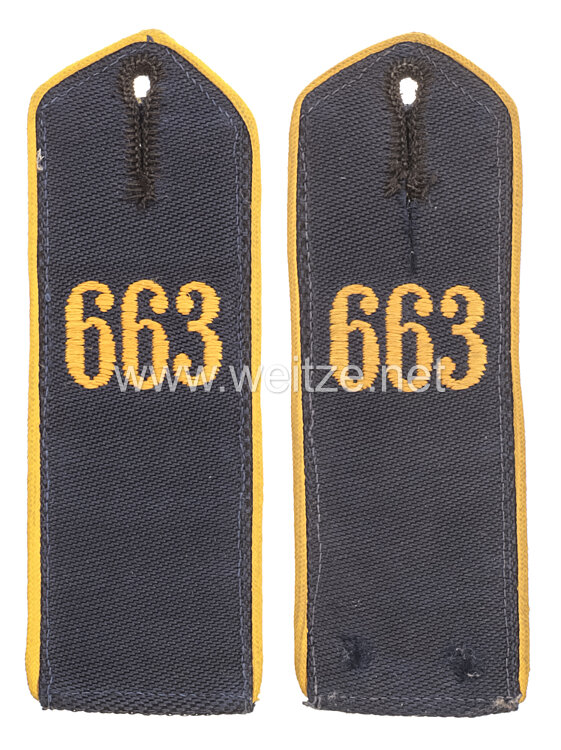
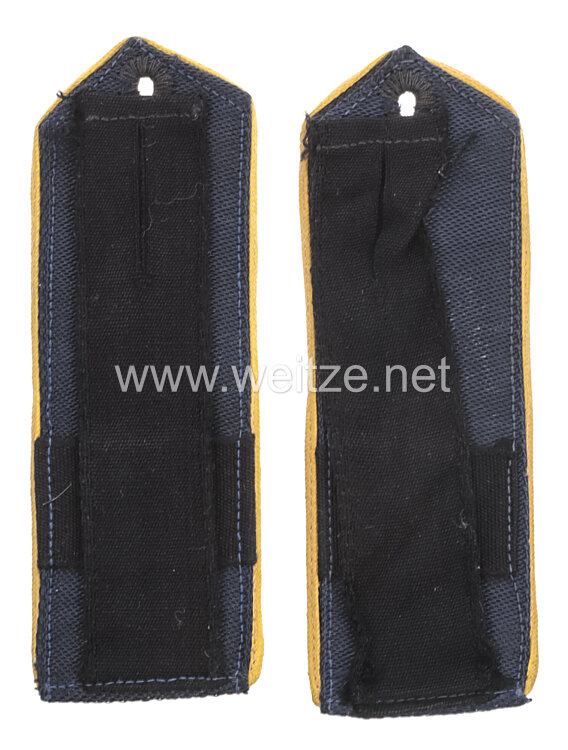
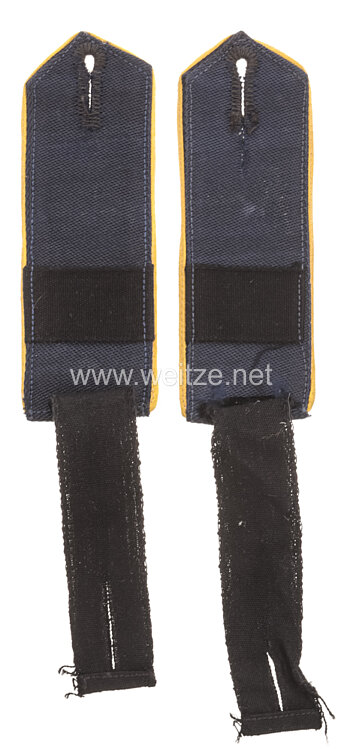
Pair of Shoulder Boards Marine-HJ, Bann "663"

(=Litzmannstadt/Wartheland), circa 1940, with loops, RZM label, rank stars removed, in good condition
462449
170,00

Pair of Shoulder Boards Marine-HJ, Bann "663"

These shoulder boards of the Marine-HJ (Marine Hitler Youth) from Bann 663 represent an interesting testament to the organization and structure of National Socialist youth organizations during World War II. These insignia were manufactured around 1940 and bear the characteristic RZM label (Reichszeugmeisterei), which identifies the central procurement office of the NSDAP.

Bann 663 was stationed in Litzmannstadt, the German occupation name for Łódź in the Wartheland. This region was part of the territories annexed in October 1939 following the invasion of Poland and was directly incorporated into the German Reich as Reichsgau Wartheland. Litzmannstadt developed into an important administrative center of the occupied territories and housed the second-largest ghetto in the German-controlled area.

The Marine Hitler Youth was founded in 1936 as a specialized formation within the HJ to prepare young people aged 14 to 18 for service in the Kriegsmarine (German Navy). This organization was part of the comprehensive pre-military training that the Nazi regime systematically developed. The Marine-HJ maintained its own units in coastal cities and larger inland towns, where young people were instructed in seamanship, navigation, and maritime skills.

The organizational structure of the Hitler Youth was hierarchically organized and modeled on military patterns. The Bann represented a middle administrative unit and roughly corresponded to a county. A Bann typically comprised 3,000 to 5,000 members and was further subdivided into Stämme (tribes), Gefolgschaften (retinues), and Kameradschaften (comradeships). The numbering of Banne was done throughout the Reich and enabled precise organizational assignment.

The shoulder boards served as rank insignia and were an integral part of the HJ uniform. They were worn on both shoulders of the service jacket and indicated the rank and affiliation of the wearer through various design elements. The shoulder boards described here feature loops for attachment, as well as originally rank stars, which have since been removed. The number and arrangement of stars indicated the position within the Marine-HJ hierarchy.

The RZM label is an important authenticity feature. The Reichszeugmeisterei was founded in 1929 and controlled the manufacture and distribution of uniforms, badges, and equipment for the NSDAP and its organizations. Each licensed manufacturer received an RZM number that was affixed to the products. This was intended to ensure quality standards and monitor production. The marking with the RZM label clearly dates these shoulder boards to the period between 1933 and 1945.

The dating to the year 1940 falls into a phase of expansion for both the Kriegsmarine and the HJ organization. After the successful campaigns against Poland and in the Western Campaign, the German Reich was at the height of its territorial expansion. The Marine-HJ gained considerable importance during this period, as the Kriegsmarine urgently needed recruits. The organization in newly annexed territories such as the Wartheland proceeded rapidly to consolidate German administration and control.

The presence of the Marine-HJ in Litzmannstadt, far from the coast, may seem unusual at first. However, the Marine-HJ also maintained units in inland cities that offered theoretical instruction and prepared young people for later service. Moreover, Litzmannstadt, as an industrial city, was of interest to the German occupation authorities, who established a comprehensive German administrative structure there.

The fact that the rank stars have been removed is not uncommon with historical uniform pieces. This can have various reasons: After the war, such insignia were frequently dismantled to make the objects less clearly identifiable, or the stars were treated as separate collector's items. The good state of preservation despite more than 80 years since their manufacture testifies to careful storage.

These shoulder boards are today historical documents that provide insight into the organization, uniforming, and geographical distribution of National Socialist youth organizations. They serve as reminders of a dark chapter in German history when young people were systematically ideologically indoctrinated and prepared for military service. For historical research and museum collections, such objects represent important sources for documenting and understanding the functioning of totalitarian systems and their penetration of all areas of life.