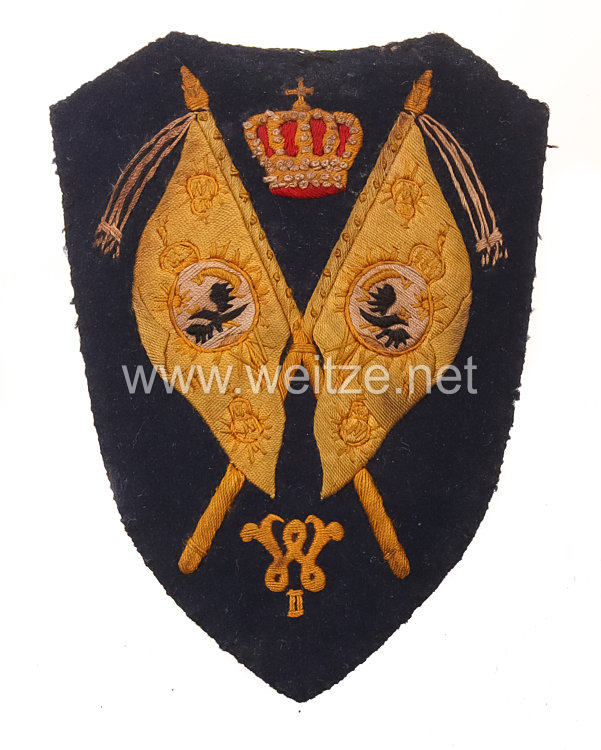
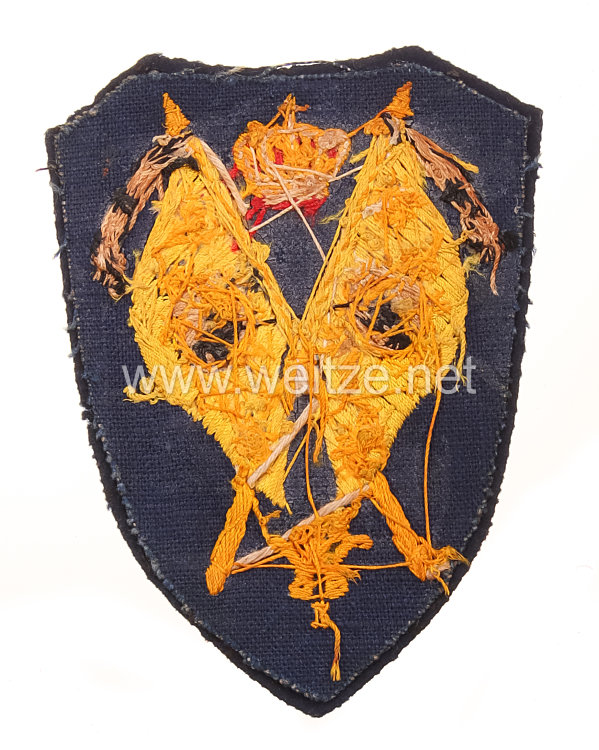
Prussian Sleeve Insignia for Color Bearer Infantry

Circa 1900. Hand-embroidered on dark blue. Condition 2.
433848
400,00

Prussian Sleeve Insignia for Color Bearer Infantry

The Prussian sleeve badge for infantry color bearers represents a fascinating testimony to the military distinction and rank identification practices of the German Empire. These special badges, worn around 1900, marked a significant function within Prussian infantry regiments and reflected the strict hierarchy and tradition of the Imperial Army.

The color bearers or flag officers held a prominent position in Prussian infantry units. The regimental colors were not merely a military symbol but embodied the honor, history, and tradition of the entire regiment. The loss of colors in battle was considered the greatest shame, while their defense was often rewarded with the highest military decorations. Accordingly, the duty of color bearer was entrusted only to particularly trustworthy and proven soldiers.

The hand-embroidered execution of these sleeve badges on dark blue backing was characteristic of the period around 1900. Unlike later machine-made badges, these early examples were produced with painstaking handwork, which underscored their special value. The dark blue base color corresponded to the traditional colors of the Prussian infantry, which had carried the characteristic dark blue as their branch color since the reforms of the Napoleonic Wars.

The development of special markings for color bearers traces back to the Prussian Army reforms of the 19th century. After the Napoleonic Wars and especially after the founding of the Empire in 1871, the Prussian uniform system was systematically regulated. The uniform regulations, which were updated at regular intervals, precisely specified which badges were to be worn by which ranks and function holders.

Around 1900, the German Empire under Kaiser Wilhelm II was in a phase of military expansion and modernization. The army was constantly growing, and the importance of military traditions and symbols was particularly emphasized. In this context, the external marks of military functions also received great attention. The sleeve badges served not only for functional identification but also for strengthening esprit de corps and military identity.

The art of embroidery in military badges had a long tradition in Prussia. Specialized craftsmen, often located near garrison towns, produced these badges with great care. The materials used - typically metal threads of gilded or silvered wire as well as colored silk threads - were of high quality and were intended to withstand the rigors of military service.

The manner of wearing these sleeve badges was precisely regulated. They were attached to the upper arm of the uniform, usually on the right arm, and had to be fastened at a specific height and orientation. The exact position was specified in the uniform regulations and was checked during inspections.

During World War I, the significance and use of such badges changed. The increasing mechanization of warfare and material shortages led to many traditional distinctions being simplified or replaced by more practical solutions. The hand-embroidered quality of the pre-war period was increasingly superseded by simpler, machine-made badges.

After the end of the Empire in 1918 and the dissolution of the Prussian Army, these badges lost their official function. However, they became coveted collector's items and historical documents that provide insight into the military culture of the Empire. Today, well-preserved hand-embroidered sleeve badges from around 1900 are rare and valuable objects for collectors and military historians.

The preservation of such textile badges over more than a century is remarkable. The quality of the materials used and the craftsmanship have contributed to these pieces surviving through time. They serve today as important sources for research into uniform history, military symbolism, and the craftsmanship of the late 19th and early 20th centuries.

These badges reflect not only military organization but also the broader social and cultural values of Imperial Germany, where honor, tradition, and hierarchical order were fundamental principles. The color bearer badge thus represents a small but significant piece of the complex tapestry of Prussian-German military history.

r