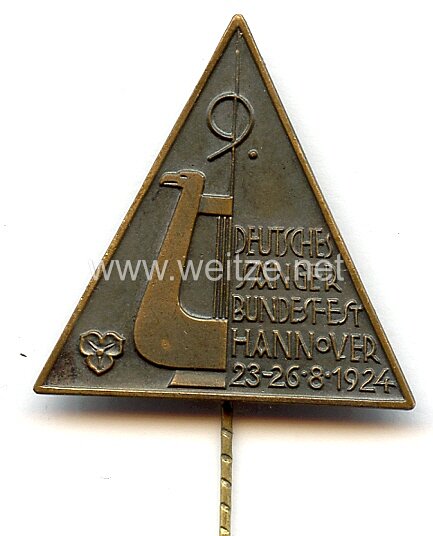
Weimar Republic - 9th German Singers Federal Festival Hannover 23-26 August 1924
This badge from the 9th German Singers' Federal Festival in Hanover, held from August 23-26, 1924, represents a fascinating chapter in German cultural history during the Weimar Republic. This event took place during a period of significant political and economic upheaval, as Germany attempted to establish a democratic order following World War I.
The German Singers' Federal Festivals had a long tradition dating back to the 19th century. The Deutscher Sängerbund (German Singers' League), founded in 1862 in Coburg, developed into one of Germany's most significant cultural organizations. These festivals served not only to cultivate choral singing but were also important social events that promoted national identity and bourgeois culture.
The year 1924 marked a turning point in the history of the Weimar Republic. After the catastrophic years of hyperinflation in 1923, the introduction of the Rentenmark initiated a phase of relative stabilization. The so-called “Golden Twenties” were beginning, and cultural events like the Singers' Federal Festival symbolized a return to a certain normalcy.
The choice of Hanover as the venue was significant. The city, Prussian since 1866, possessed a rich musical tradition and the necessary infrastructure for a major event. Thousands of singers from all over Germany gathered for this festival, which included choral competitions, concerts, and social events.
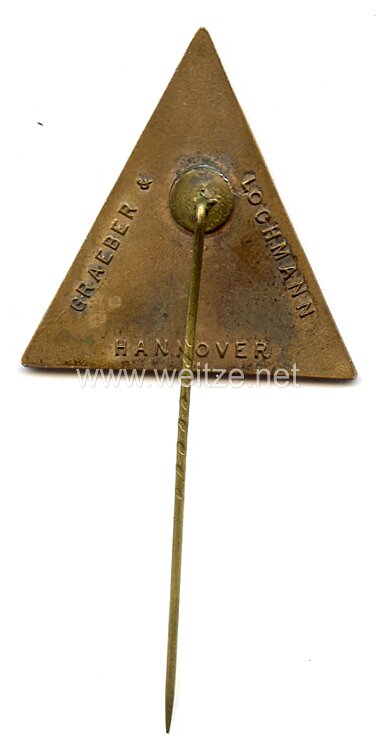
The badge was manufactured by Graeber & Lochmann of Hanover, a renowned producer of orders and decorations. The company was among the established firms specializing in the production of association badges, medals, and similar objects. The use of base metal was typical for such festival badges, as it was more cost-effective than precious metals while still offering an attractive appearance.
Festival badges of this type served multiple purposes: they were participant passes that granted access to events, mementos of a significant occasion, and expressions of belonging to the singers' movement. The long pin allowed wearing on clothing, typically on the lapel or chest.
The singers' movement in the Weimar Republic held an ambivalent position. On one hand, it cultivated democratic and humanistic ideals; on the other, it was permeated by nationalist currents. The festivals were meeting places for various political camps within bourgeois society.
The 9th German Singers' Federal Festival was one of the first major supra-regional cultural events after World War I. It stood under the sign of reconstruction and national reconciliation, even though the political tensions of the time could not be completely excluded. The participation of choirs from all parts of Germany demonstrated the will for unity despite regional and political differences.
Such badges are today important cultural-historical documents. They bear witness to the vibrant associational culture of the Weimar Republic and the significance attributed to cultural events during a time of great uncertainty. The cultivation of singing and music offered an anchor of continuity in turbulent times.
The preservation of such objects enables historians and collectors to reconstruct the everyday culture and social structures of the 1920s. The badge is not merely a craft object but a window into an epoch that oscillated between tradition and modernity, between hope and crisis.
The Weimar Republic (1918-1933) was characterized by the attempt to build a democratic society after the authoritarian German Empire. Cultural organizations like the Singers' League played an important role in this process, even though their political orientation was not always unambiguously democratic. The 1924 festival took place during a phase when many Germans were regaining optimism and believing in a better future—a hope that would later be destroyed by the Great Depression and the rise of National Socialism.
Today, these badges are sought after by collectors of Weimar Republic memorabilia and represent tangible connections to a pivotal period in German history. They remind us of the importance of cultural life in maintaining social cohesion during periods of political and economic uncertainty.