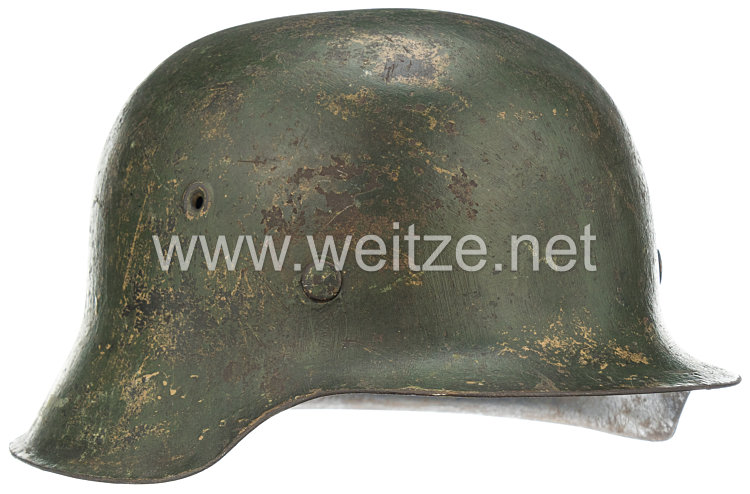
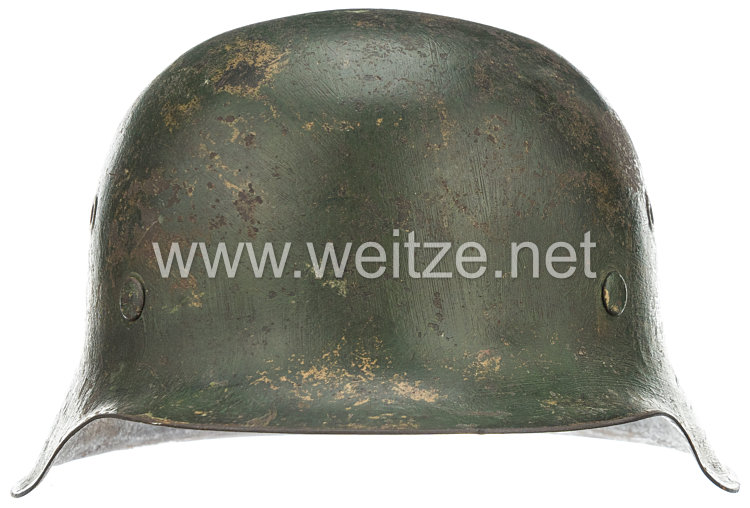
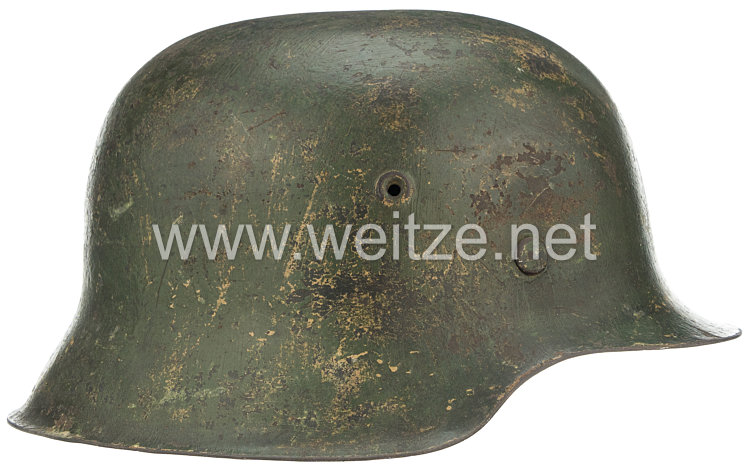
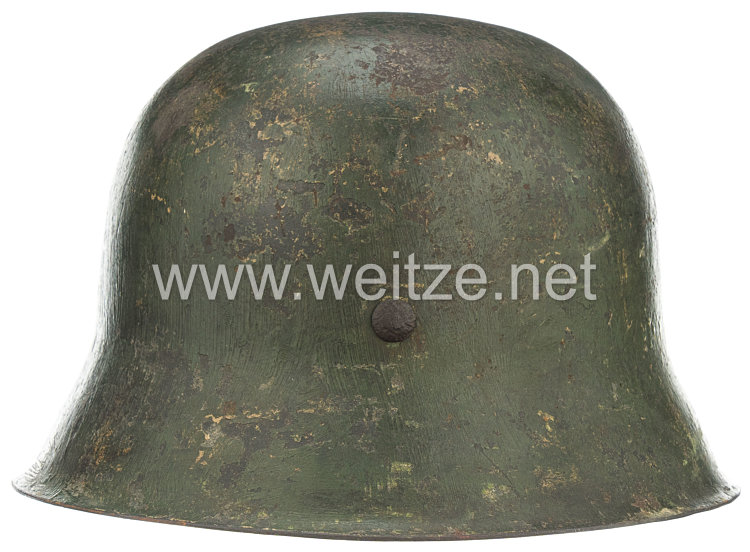
Wehrmacht Heer Steel Helmet M42 in Camouflage Paint
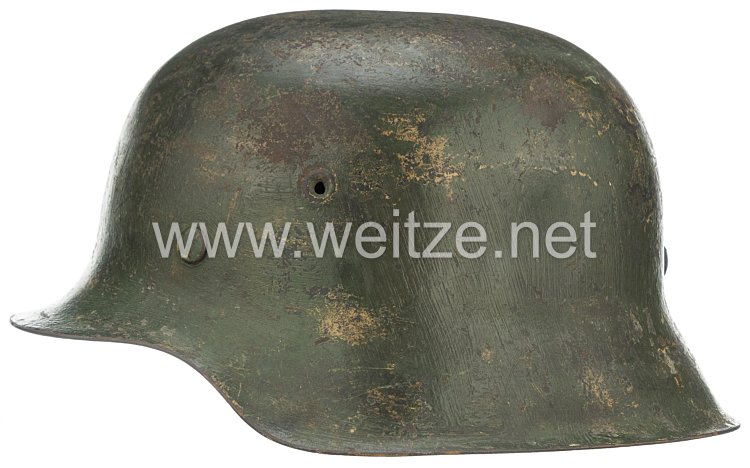
The presented Stahlhelm M42 represents the final developmental stage of German steel helmets during World War II and demonstrates through its multi-layered camouflage paint the eventful history of a soldier who was possibly deployed across various theaters of war.
The Model 42 was introduced in 1942 and represented a simplified production compared to the earlier M35 and M40 models. At a time when the German Reich was under increasing resource pressure, manufacturing had to be rationalized. The M42 eliminated the characteristic rolled rim of its predecessors and instead featured a sharp-edged, outward-flanged rim. This modification enabled faster and more cost-effective production without significantly compromising protective capabilities.
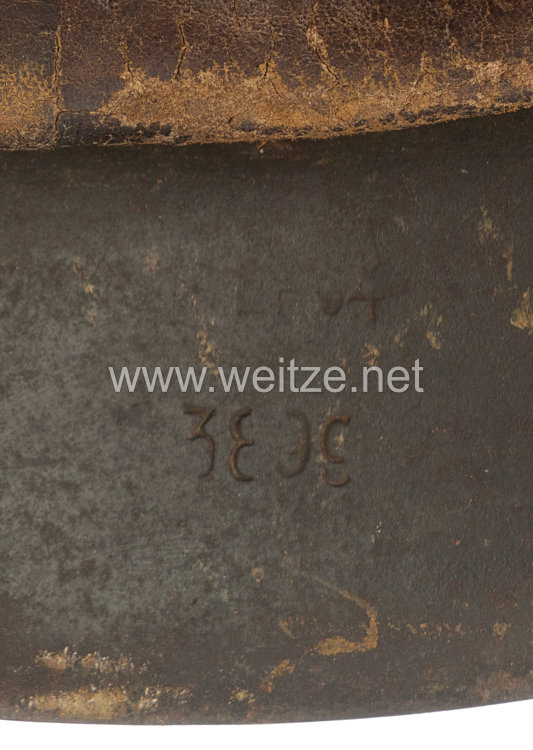
The manufacturer marking “E. 64” identifies the producing company. In the Wehrmacht manufacturer code system, “ET” or “E.” with numbers stood for various suppliers in the armaments industry. The number 3899 represents the individual lot number, allowing assignment to a specific production period.
Particularly noteworthy about this specimen is the double camouflage paint. Beneath the green camouflage, remnants of tropical sand-colored paint are visible. This indicates that the helmet was originally intended for deployment in the Afrika Korps campaign or other tropical/subtropical regions such as southern Italy, the Balkans, or southern Ukraine. Tropical paint schemes, usually in sand-yellow or light brown tones, were used from 1941 onward for the Afrika Korps and other units deployed in warm climates.
The subsequent overpaint in green suggests that after the end of the African campaign in May 1943, or following redeployment from southern regions, the helmet was repurposed for use in Central or Northern Europe. Green and brown camouflage patterns were standard for European theaters of war. It was not uncommon for equipment to be reused and adapted to respective deployment areas, especially as material shortages increased toward the war's end.
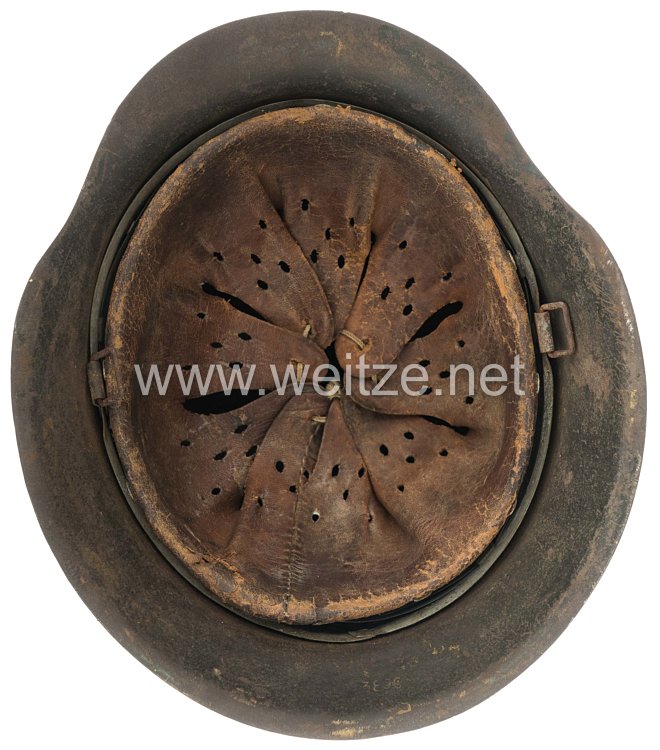
The present liner attached to the metal ring corresponds to the typical interior equipment of Wehrmacht helmets. The inner liner consisted of an aluminum ring with 31 holes to which the padded leather liner was attached. This system was designed to increase wearing comfort and better distribute impact energy from hits. The missing chin strap is common among surviving helmets, as these leather components were particularly susceptible to decay and were often replaced during the war or removed after its conclusion.
The described rust stains inside testify to decades of storage under possibly humid conditions. They are typical of steel helmets that were not conserved and represent an authentic aging characteristic. The condition described as “worn” emphasizes that this helmet was actually deployed in the field and was not merely warehouse stock.
The Stahlhelm itself had become a symbol of German armed forces since its introduction in 1916. Its characteristic shape offered superior protection compared to French and British helmets of that era. The further developments M35, M40, and finally M42 retained this basic form, which had proven extraordinarily effective.
During World War II, millions of these helmets were produced, yet each surviving example with traceable history is today an important testament to that dark epoch. The multi-layered paint of this helmet silently narrates the journeys of a soldier through various theaters of war, from the heat of North Africa or the Mediterranean to the temperate zones of Europe.
For collectors and historians, such objects are of particular interest as they offer authentic insights into military logistics, production methods, and the reality of wartime daily life. The condition rating 3 indicates a used helmet with visible signs of aging that is nevertheless structurally intact and valuable as a historical document.