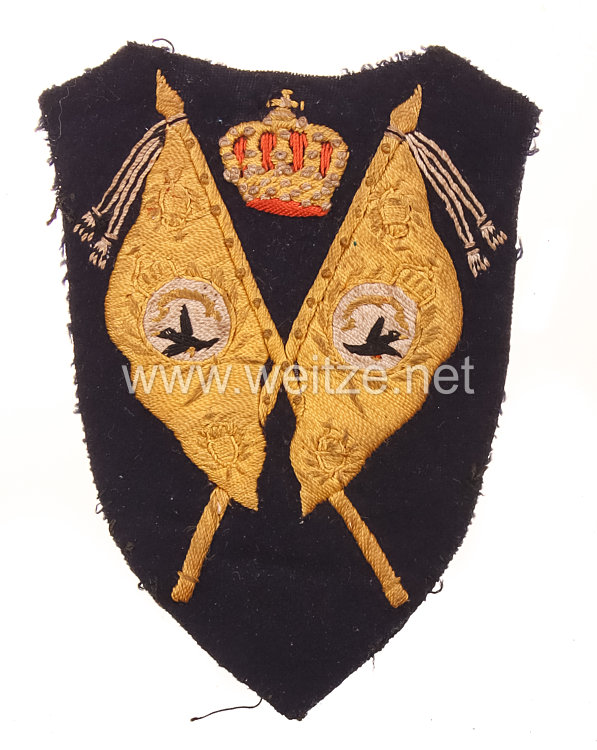
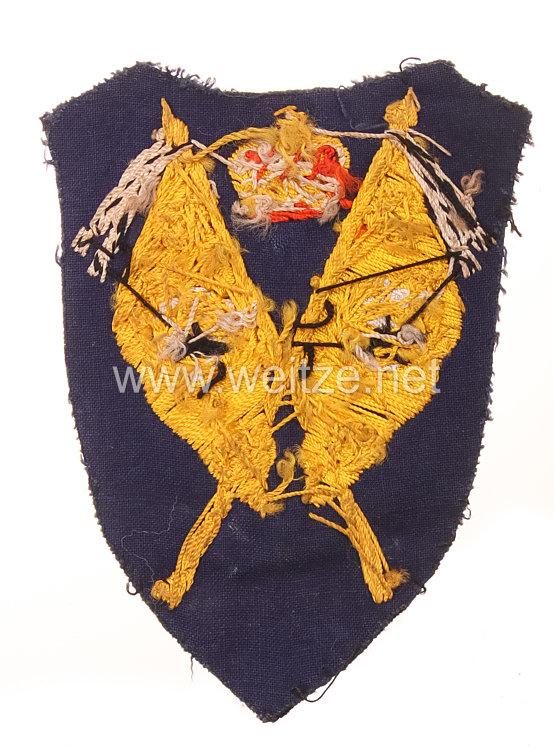
Prussian Sleeve Insignia for Color Bearer of the Infantry for Non-Prussian Contingents within the Prussian Army

Circa 1900. Hand-embroidered on dark blue, without the cipher “WII”. Lightly worn, condition 2.
The non-Prussian contingents included the regiments of Anhalt, Reuß, Thüringen, etc.
433847
400,00

Prussian Sleeve Insignia for Color Bearer of the Infantry for Non-Prussian Contingents within the Prussian Army

The sleeve insignia for infantry color bearers belongs to the special rank badges of the Prussian Army in the German Empire. This particular version for non-Prussian contingents within the Prussian Army represents the complex federal structure of the German Empire and its military organization around the turn of the century.

The Prussian Army formed the backbone of German armed forces after the founding of the Reich in 1871. Nevertheless, smaller German states such as Anhalt, Reuss, and various Thuringian principalities retained a certain degree of military autonomy. Their troops were integrated into the Prussian army structure but maintained specific identity markers, which were reflected in uniforms and insignia.

This sleeve insignia dates from around 1900, a period of intense military modernization under Kaiser Wilhelm II. The hand-embroidered execution on dark blue base fabric corresponds to the high craftsmanship quality characteristic of uniform insignia from this era. Particularly noteworthy is the absence of the cipher “WII” (Wilhelm II), which was normally found on many Prussian military insignia of this period.

The function of the color bearer (Fahnenjunker or Fähnrich) was of great symbolic and practical significance. The colors embodied the honor and tradition of the regiment. The color bearer had to protect them under all circumstances, if necessary with his life. This position was only entrusted to particularly reliable and brave soldiers. The special sleeve badge identified the bearer of this honorable duty and made him recognizable on the battlefield.

The non-Prussian contingents represented a significant portion of the Imperial Army. The Duchy of Anhalt, for example, maintained Infantry Regiment No. 93, while the Principalities of Reuss (elder and younger lines) and various Thuringian states jointly raised regiments. These units wore Prussian uniforms with regional particularities, which included specific insignia.

Hand-embroidered manufacture was typical for higher-quality uniform pieces of the Imperial era. While machine-embroidered badges were increasingly common, handwork remained the standard for officers and certain honorary insignia. The dark blue base material corresponds to Prussian uniform blue, which was used for infantry tunics.

The military regulations of the Prussian Army, established in various dress codes and regulations, precisely defined which insignia could be worn where and by whom. The sleeve insignia for color bearers was worn on the left upper arm and was part of the official service uniform. The differences between insignia for Prussian and non-Prussian contingents reflected the federal nature of the Empire.

Around 1900, the German Army was in a phase of expansion and modernization. Naval armament under Admiral von Tirpitz and general rearmament led to an increased emphasis on military tradition and symbolism. Uniforms and insignia gained importance as expressions of pride and belonging.

The historical significance of such insignia lies not only in their military function but also in their cultural-historical value. They document the self-image of Wilhelmine society, in which the military played a central social role. The careful differentiation between various contingents demonstrates respect for the federal tradition of the Reich.

After the end of World War I and the collapse of the monarchy in 1918, these insignia lost their official function. However, they became sought-after collector's items and historical documents of a bygone era. Today they provide insights into the complex military organization of the Empire and the significance of symbols and traditions in Prussian-German military culture.