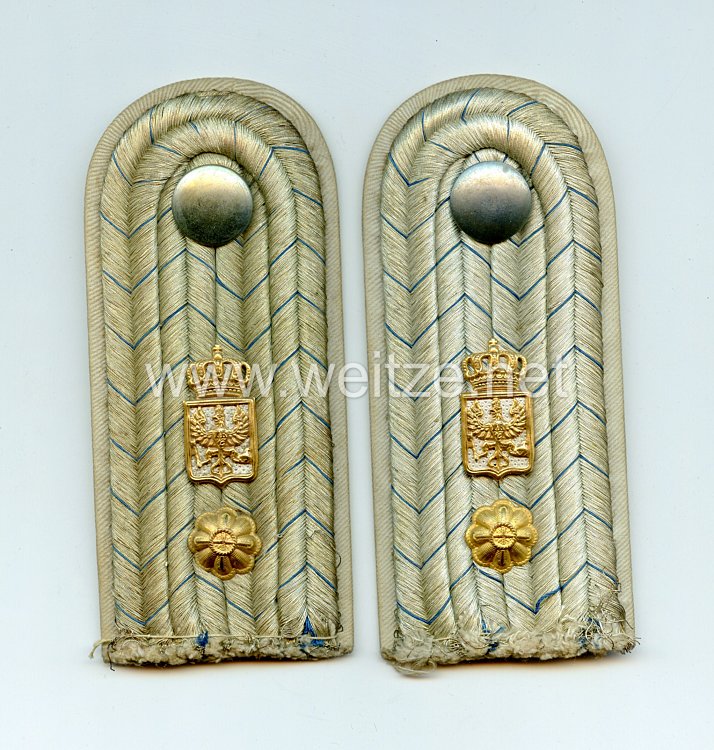
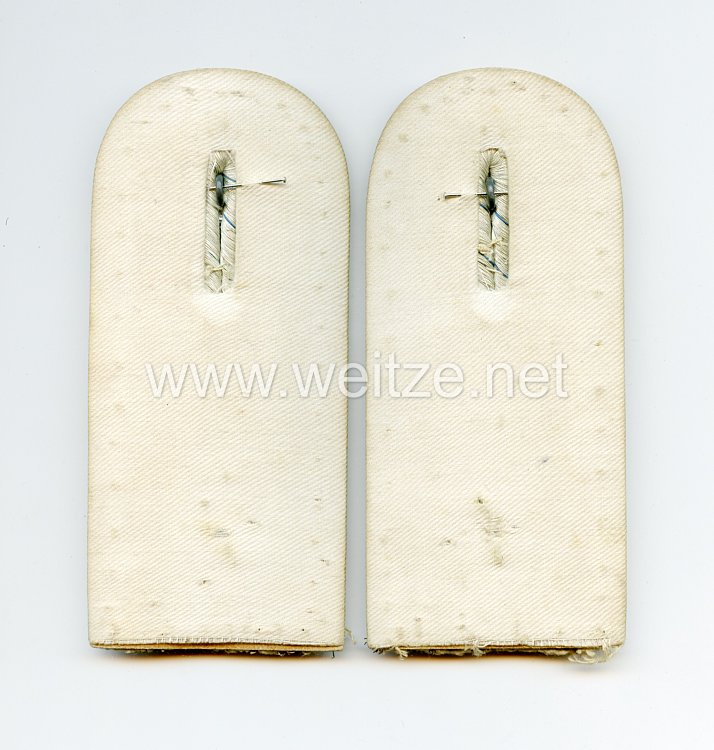
Prussia World War I Treasury/Finance Department Pair of Shoulder Straps for a Paymaster or Privy Secretary
Prussian Shoulder Boards for Paymasters and Secret Secretaries in World War I
These shoulder boards represent an important aspect of the military administrative organization of the German Empire during World War I. They served as rank insignia for members of the military finance system, particularly for Paymasters (Zahlmeister) or Secret Secretaries (Geheime Sekretäre), who fulfilled indispensable administrative functions within the Prussian Army.
The Prussian Military Finance System
The finance system of the Prussian Army formed the backbone of military financial administration. Paymasters were responsible for the proper management of pay disbursements, subsistence allowances, and other financial transactions. The position required not only mathematical skills and precision but also absolute trust and integrity. Secret Secretaries, on the other hand, were higher administrative officials often entrusted with confidential matters in staffs and commands.
The uniform regulations of the Prussian Army were regulated down to the smallest detail. The dress regulations (Adjustierungsvorschriften) precisely defined which rank insignia were to be worn by which grades. Shoulder boards (also called epaulettes or shoulder pieces) were among the most important identifying features for determining the rank and function of a soldier or official.
Construction and Design
Shoulder boards for members of the finance system differed in their execution from those of the combat troops. They were typically made of cloth, often in the branch color of the respective formation, and bore specific markings for administrative functions. The base color and the applied symbols - frequently numbers, letters, or special emblems - enabled precise assignment to a particular unit and function.
For Paymasters and Secret Secretaries, the shoulder boards were often provided with special features that identified their non-combatant but essential administrative role. Wearing them as a pair on both shoulders was standard in the Prussian Army and allowed recognition of rank from both front and back.
Historical Context Around 1915
The dating to around 1915 is of particular significance. By this time, World War I had already left behind its initial phase of mobile warfare and transitioned into the grinding war of attrition in the trenches. The German Army had expanded massively, which presented an enormous challenge for military administration. The number of paymasters and administrative officials had to be increased accordingly to ensure the financial support of an army numbering in the millions.
During this phase of the war, increasing emphasis was placed on simplifications and rationalizations. Nevertheless, the Prussian Army largely maintained its traditional uniform regulations, even though practical considerations often took precedence in the field. Shoulder boards for non-combat functions such as the finance system continued to be manufactured and worn according to established regulations.
The Role of Military Administration in World War I
The importance of a functioning military administration can hardly be overstated. Without the reliable work of paymasters and administrative officials, the supply of troops with pay, provisions, and equipment would have collapsed. Each division, regiment, and larger unit had its own administrative personnel, who frequently served in the rear areas but also in sectors near the front.
The Secret Secretaries formed a special category. They were often concerned with confidential correspondence, secret files, and sensitive administrative processes. Their position required discretion and loyalty to the highest degree.
Preservation and Collector Value
Shoulder boards from World War I today have considerable historical and collectible value. They are authentic witnesses to the military organization of the German Empire and provide insights into the structure and hierarchy of the armed forces. The indicated condition 2 suggests good preservation, which is remarkable for textiles over a hundred years old.
For military historians and collectors, such objects offer the opportunity to study the often-overlooked administrative aspects of warfare. While combat units and their equipment often take center stage, shoulder boards from paymasters and administrative officials remind us that wars were won or lost not only at the front but also in the offices and account books.
These particular shoulder boards thus represent more than mere uniform accessories; they are tangible evidence of the complex organizational apparatus that kept the Imperial German Army functioning during one of history's most devastating conflicts.