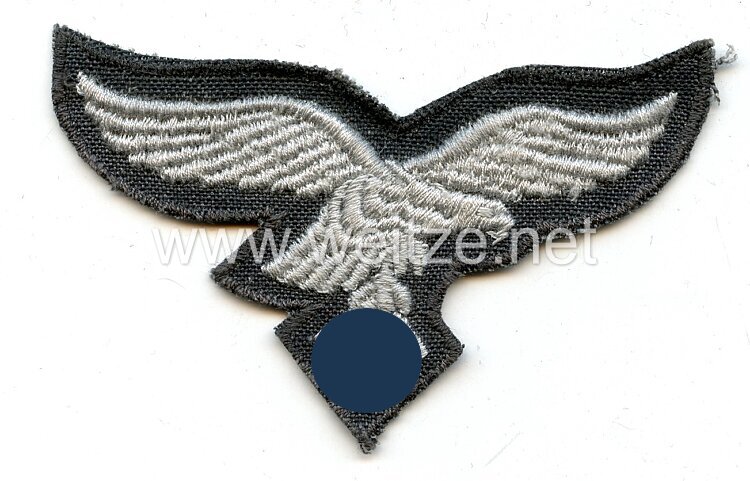
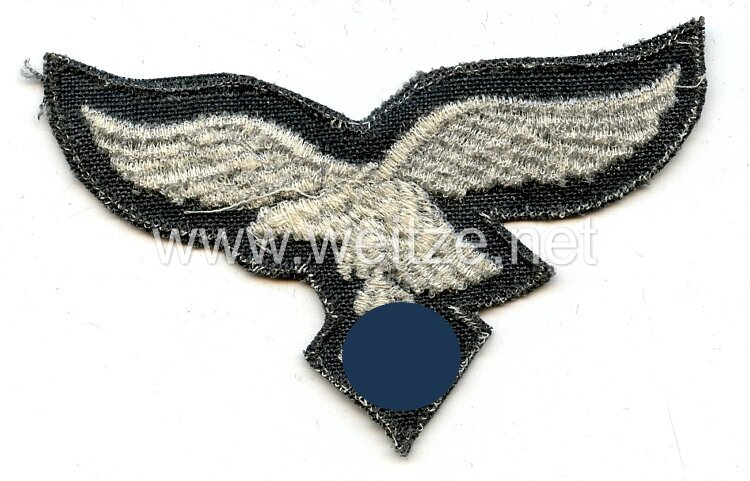
Luftwaffe Overseas Cap Eagle for Enlisted Men on Light Drill Fabric

machine-embroidered version, unissued, condition 2+
462247
75,00

Luftwaffe Overseas Cap Eagle for Enlisted Men on Light Drill Fabric

The Luftwaffe Schiffchen Eagle for Enlisted Personnel on Light Drill Fabric represents a characteristic insignia of the German Air Force during World War II. This machine-embroidered badge was worn on the Schiffchenmütze (flight cap or side cap), a typical headgear for enlisted ranks of the Luftwaffe.

The introduction of the Schiffchen cap for the Luftwaffe occurred after the official establishment of this branch of service in March 1935. The Reich Aviation Ministry regulations detailed the design and wearing of all uniform components, including headgear and their insignia. The national emblem in the form of an eagle clutching a swastika was a central element of National Socialist uniform symbolism and had to be displayed on all military headgear.

The execution on light drill fabric described here indicates use for summer or tropical uniforms. Drill was a durable, tightly woven cotton fabric particularly suitable for warm climates. The Luftwaffe employed such uniforms primarily in the Mediterranean region, North Africa, and southern occupied territories. The light-colored drill fabric offered better protection against solar radiation than the darker standard uniform materials.

The machine-embroidered execution was the standard manufacturing method for enlisted insignia. Unlike the often hand-embroidered or woven badges for officers, enlisted badges were machine-produced, enabling cost-effective mass production. The eagle was typically embroidered in gray-blue or silver-gray thread onto the base fabric. Machine production guaranteed consistent quality and enabled rapid production of large quantities for the rapidly expanding Luftwaffe.

The Schiffchen eagle itself displayed the characteristic Reich eagle with spread wings, clutching a swastika within an oak wreath in its talons. The stylized representation was specially adapted for the flat shape of the Schiffchen cap. The dimensions and exact execution were specified by service regulations, though certain simplifications in manufacturing occurred during the course of the war.

The Schiffchen cap was worn by enlisted men and non-commissioned officers without Portepee and was part of the walking-out uniform as well as service uniform in certain areas. It differed from the field cap (M43) and other headgear through its characteristic flat, laterally collapsible form. The name “Schiffchen” (little boat) derives from the boat-like silhouette when the cap was folded.

The unworn condition of the specimen described here is of particular interest to collectors, as many of these badges were exposed to natural wear, weather conditions, and the rigors of military service during wartime. Unworn pieces allow for authentic assessment of the original manufacturing quality and coloration.

Production of such badges was carried out by numerous civilian suppliers throughout the Reich territory. The textile industry, particularly in regions like Saxony and the Rhineland, was intensively involved in manufacturing military equipment. Toward the end of the war, material and resource shortages led to simplified designs and reduced quality.

After 1945, all National Socialist symbols were banned in Germany. Collecting such military-historical objects is permitted today under strict conditions and serves historical documentation and research. Museums and military-historical collections preserve such objects as testimony to a dark epoch in German history.

For military-historical research, such uniform items offer valuable insights into organizational structure, material economy, and the everyday reality of the Wehrmacht. The various designs, manufacturing variants, and wearing methods document the development of the Luftwaffe from its founding to the end of the war in 1945.

The study of these insignia contributes to understanding the complex system of ranks, units, and distinctions within the Luftwaffe. Each variation in material, manufacturing technique, and design reflects specific periods, theaters of operation, and supply situations during the six-year existence of the wartime Luftwaffe.