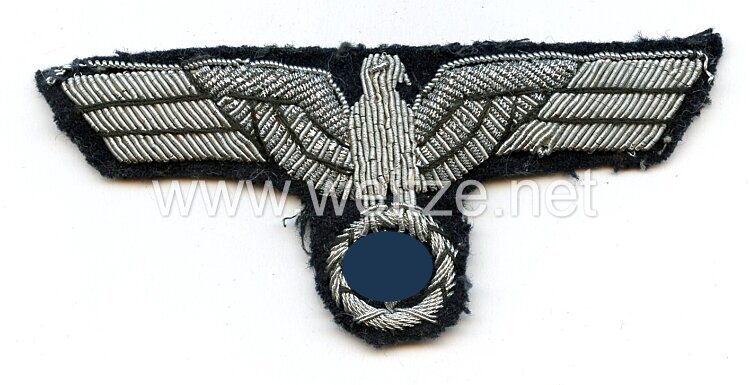
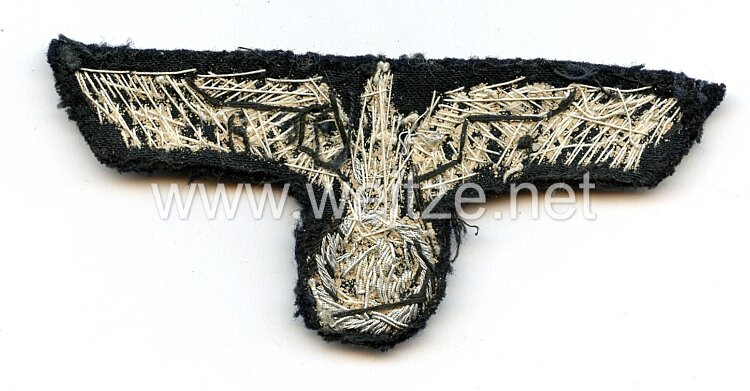
Kriegsmarine Breast Eagle for Naval Officials

Hand-embroidered design in silver on dark blue. Lightly worn, condition 2.
451947
160,00

Kriegsmarine Breast Eagle for Naval Officials

The Kriegsmarine Breast Eagle for Naval Civil Servants represents a significant example of military insignia and uniform equipment of the German Kriegsmarine during the Second World War era. This hand-embroidered badge in silver on a dark blue background embodies the high craftsmanship quality and strict hierarchy that characterized the National Socialist military system.

The Kriegsmarine, the official designation of the German Navy from 1935 to 1945, was created after the reintroduction of universal conscription and the official departure from the Treaty of Versailles. Under the High Command of the Kriegsmarine, a complex system of ranks, uniforms, and insignia developed, encompassing both military personnel and civil naval officials.

Naval civil servants (Marinebeamte) formed a special category within the Kriegsmarine. Unlike regular naval officers and enlisted personnel, they were civil servants with military status who performed specialized administrative, technical, or scientific duties. Their ranks included engineers, administrative specialists, physicians, dentists, pharmacists, and other specialists who were essential for the smooth operation of the navy.

The uniform regulations of the Kriegsmarine were laid down in various service regulations and orders, particularly in the Anzugordnung für die Kriegsmarine (Dress Regulations for the Navy). These regulations precisely specified which insignia, effects, and uniform parts were to be worn by the various ranks and functional groups. The breast eagle was a central national emblem symbolizing allegiance to the German state and the Wehrmacht.

The hand-embroidered execution in silver on dark blue background indicates high-quality manufacture. Such hand-embroidered insignia were typically produced by specialized manufacturers such as BeVo (Bekleidungswerke Vohwinkel) or other authorized suppliers. Hand embroidery required considerable craftsmanship and was significantly more elaborate than machine-made or woven variants. Often such high-quality versions were privately procured, as they were qualitatively superior to the standard issued versions.

The Reich Eagle (Reichsadler) as a national symbol had a long tradition in German military history. In the Kriegsmarine version, the eagle with spread wings held a swastika in its talons. The depiction differed in details from the eagles of other Wehrmacht branches: the Army used a right-facing eagle, for example, while the Kriegsmarine had specific proportions and design characteristics.

The wearing of the breast eagle was precisely regulated. For naval civil servants, it was attached to the right breast side of the uniform, above the pocket. The position and orientation were exactly specified in the uniform regulations, and deviations were not permitted. The dark blue background corresponded with the traditional color of naval uniforms, which differed from the field gray uniforms of the Army and the blue-gray of the Air Force.

The use of silver embroidery was also significant. It corresponded to the color scheme for naval civil servants and differed from other rank insignia within the Kriegsmarine. Officers wore gold effects, for example, while enlisted men and non-commissioned officers had other markings. This color differentiation enabled immediate identification of a wearer's service position.

The production of such insignia took place under state supervision and licensing. Manufacturers had to meet certain quality standards and were regularly inspected. Nevertheless, there was a certain range of variation in execution, particularly with hand-embroidered specimens, where each piece represented a unique item. These variations mainly concern fine details in the eagle's feathering, the design of the swastika, and the proportions.

After the end of the Second World War in May 1945, the Kriegsmarine was dissolved, and all National Socialist symbols were banned by Allied control laws. Wearing or publicly displaying such insignia became punishable in Germany, with exceptions for historical research, education, and documentation. Today such objects serve as important historical sources for researching military history and the study of uniforms from this period.

From a conservation perspective, textile insignia present special challenges. The embroidery can fade over time, threads can loosen, and the base fabric can be damaged by light, moisture, and mechanical stress. The described lightly worn condition indicates actual historical use, with the piece having largely retained its structural integrity.

The study of such insignia contributes to understanding the organizational structure, hierarchy, and visual representation of power in the Third Reich's military apparatus. These objects, when properly contextualized and studied, provide valuable insights into the material culture and administrative systems of this historical period.

r