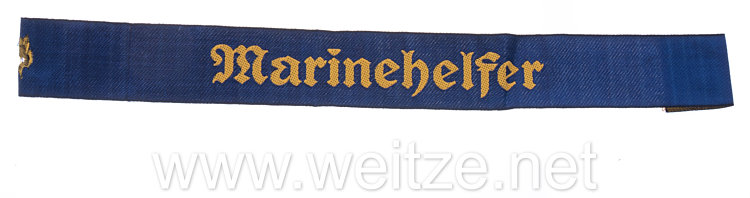
Kriegsmarine Sleeve Band "Marinehelfer"

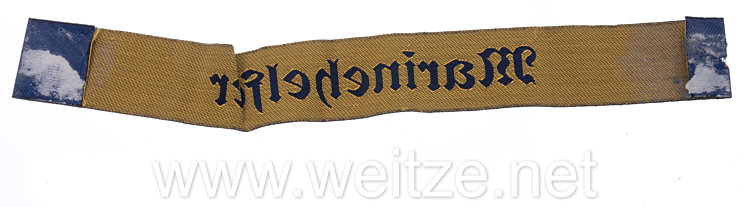
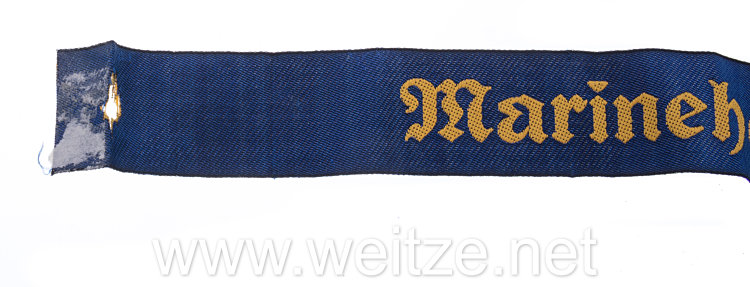
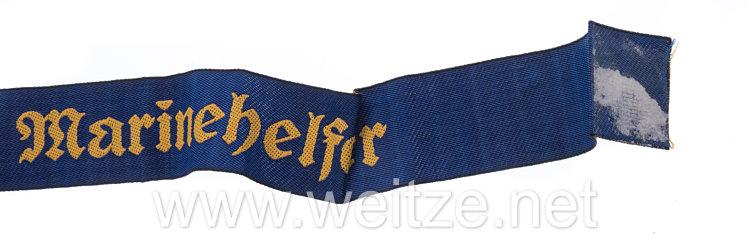
Yellow woven on blue ground, length 32.5 cm. Unissued condition, adhesive residue on edges, condition grade 2.
The Marinehelfer of the Kriegsmarine were members of the Marine-HJ.
326547
230,00

Kriegsmarine Sleeve Band "Marinehelfer"

The Kriegsmarine armband “Marinehelfer” represents a significant insignia of the German Navy during World War II. This armband was worn by young members of the Marine-Hitlerjugend (Marine-HJ) who served as naval auxiliaries in the Kriegsmarine.

The Marinehelfer were part of a comprehensive system of mobilizing German youth for military auxiliary services during World War II. Beginning in 1943, as the military situation of the German Reich deteriorated, young people from the Hitler Youth were increasingly deployed as auxiliaries with various branches of the Wehrmacht. The Marine-HJ formed a specialized formation within the Hitler Youth that was specifically trained for service with the Kriegsmarine.

The armband in question is characteristically woven with yellow lettering on a blue background. This color combination was typical for the Kriegsmarine and corresponded to the traditional maritime colors of the German Navy. The yellow inscription “Marinehelfer” on the navy blue background made the wearers immediately identifiable and indicated their special status as youth auxiliaries.

The deployment areas of the Marinehelfer were diverse. They were used as anti-aircraft auxiliaries in the air defense of naval bases, as support personnel in naval offices, in equipment maintenance, and in communications centers. Many Marinehelfer also served at coastal flak positions or with naval units inland. Their duties included technical support services, courier runs, office work, and increasingly direct deployment at weapons, particularly in air defense.

The legal basis for deploying these youth auxiliaries was created through various decrees. The systematic deployment of HJ members in Wehrmacht-related functions intensified from 1943 onwards. The Marinehelfer were formally still under HJ leadership but were factually integrated into the military command structure of the Kriegsmarine. They wore HJ uniforms with special markings, including this armband.

The specimen described here, with a length of 32.5 cm, corresponds to the standardized measurements for armbands of the Wehrmacht and Kriegsmarine. The fact that it is unworn makes it a particularly well-preserved historical artifact. The adhesive residue on the edges suggests that the armband may have been kept in a collection or for documentation purposes without ever being attached to a uniform.

The production of such armbands was carried out in specialized textile companies that manufactured for the Wehrmacht. The weaving technique was high-quality, with the inscription woven directly into the fabric, ensuring a permanent and durable marking. The quality of workmanship varied depending on the time of manufacture and available materials, with later wartime productions often more simply executed.

The use of young people in military and military-related functions was part of the NS regime's total war effort. The Marinehelfer represent a particularly problematic chapter of German history in which minors were systematically involved in war operations. Many of these young people, often aged 15 to 17, experienced traumatic events and many lost their lives in bombing raids or during the final months of the war.

From a military-historical perspective, such armbands document the increasing desperation and personnel shortages of the German armed forces in the final phase of the war. They are material witnesses to a time when the NS regime sacrificed its own youth to continue an already lost war.

Today, such armbands are important study objects for military historians and serve in museums and educational institutions as illustrative material for education about the mechanisms of totalitarian rule and the instrumentalization of youth under National Socialism.