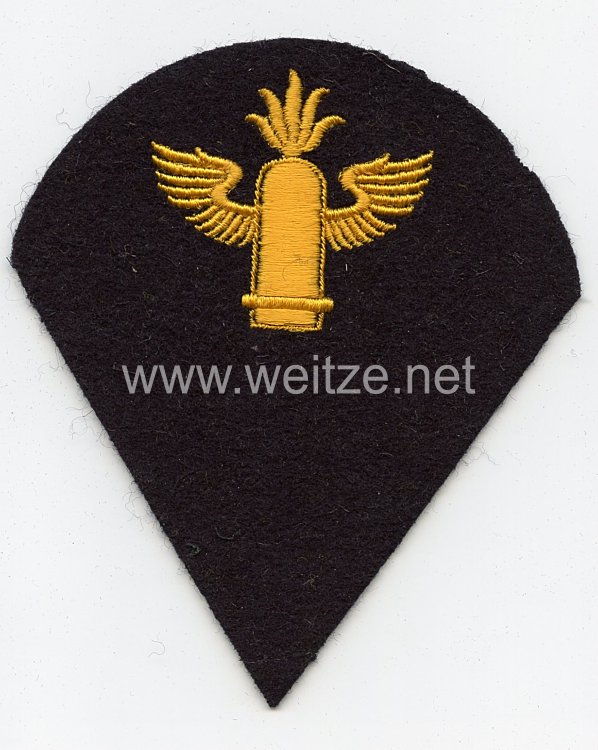
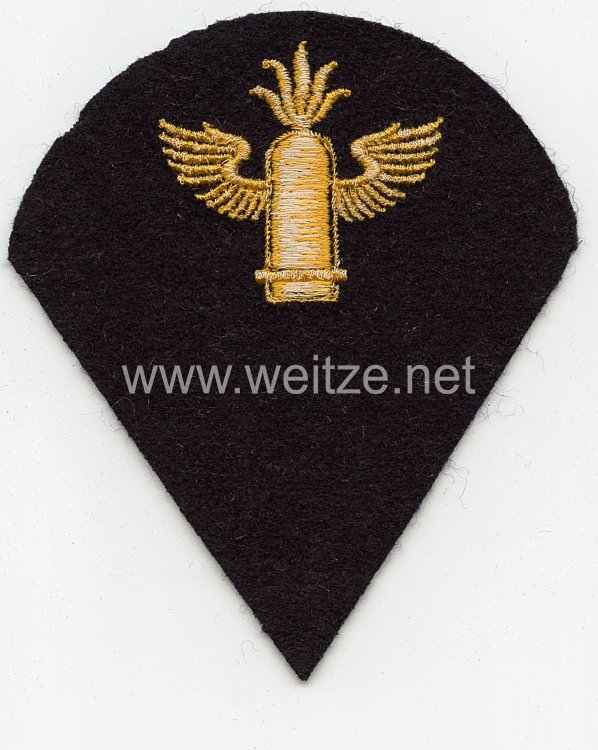
Kriegsmarine Enlisted Men's Sleeve Insignia Naval Artillery Career Path

Version for blue uniform, condition 2.
376647
20,00

Kriegsmarine Enlisted Men's Sleeve Insignia Naval Artillery Career Path

The Kriegsmarine sleeve badge for enlisted personnel of the naval artillery career path represents a characteristic example of the complex rank insignia and career identification systems of the German Kriegsmarine during World War II. This specific version for the Colani (the dark blue working uniform) illustrates the differentiated uniform design of the German naval forces between 1935 and 1945.

The Kriegsmarine, officially established on June 1, 1935, developed a comprehensive system of career badges to visibly identify the various specializations within the enlisted ranks. The naval artillery career path was among the most prestigious technical careers and included personnel responsible for operating, maintaining, and fire-directing naval artillery – from small-caliber anti-aircraft guns to the heavy main batteries of battleships and cruisers.

Career badges were worn on the left upper arm according to the Uniform Regulations for the Kriegsmarine (A.O.K.). For the naval artillery career, the badge typically displayed crossed gun barrels or a stylized shell symbol, embroidered in yellow on dark blue cloth. This color scheme corresponded to regulations for enlisted ranks, while petty officers and commissioned officers wore different versions.

The Colani was the practical working uniform of the Kriegsmarine, named after its navy blue color. This uniform was worn during shipboard work, watch duty, and other service activities for which more representative uniforms were unsuitable. Unlike the white summer suit or parade uniform, the Colani was durable and designed for daily service. The sleeve badges for this type of uniform were correspondingly robustly manufactured, often in machine weaving or through direct embroidery on the base fabric.

The introduction of systematic career badges occurred in the Reichsmarine of the Weimar Republic and was adopted and refined by the Kriegsmarine. The system distinguished approximately twenty different career paths, including torpedo, communications, machinist, and medical careers alongside artillery. This differentiation made it possible to recognize a crew member's function at a glance – an important organizational necessity on large warships with crews ranging from several hundred to over two thousand men.

The production of these badges was carried out by specialized companies fulfilling naval contracts. Well-known manufacturers included firms in Hamburg, Kiel, and Wilhelmshaven, the most important naval bases. Quality varied depending on production period and manufacturer. Early badges from the pre-war and early war period often showed higher craftsmanship quality than later productions under wartime conditions.

For collectors and military historians, such sleeve badges are important objects of study. Condition 2 designates, according to common collector nomenclature, a good used condition with slight signs of wear but without significant damage. Such pieces typically show moderate wear marks, possibly slight fading of the embroidery or minor fabric wear, but remain well-preserved in their overall appearance.

The historical significance of these badges lies in their function as material witnesses to the naval organization of the Third Reich. They document not only military hierarchies and specializations but also textile techniques, design aesthetics, and production methods of their time. After the war's end in 1945, such badges were sometimes kept by former naval personnel as mementos or entered private and public collections through various channels.

The scientific examination of these objects contributes to understanding the daily reality of German naval personnel. Unlike large weapon systems or strategic documents, uniform components offer insights into the material culture and service execution of the common sailor. The naval artillery career path was of particular importance, as naval artillery remained the main armament of most surface units until the late war years, even as aircraft carriers and submarines became increasingly important.

The study of these insignia also reveals the organizational complexity of the Kriegsmarine and its emphasis on technical specialization. Each badge represented years of training and service in a specific field, creating an identity and esprit de corps among specialists. The artillery branch, in particular, required extensive technical knowledge of ballistics, fire control systems, and the mechanical operation of increasingly sophisticated weapon systems.