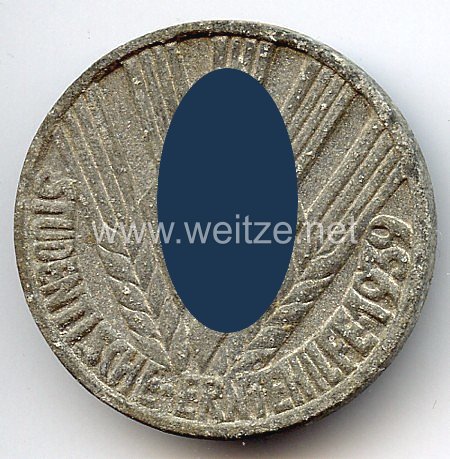
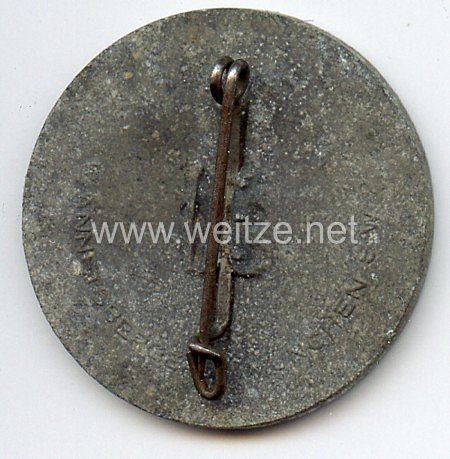
HJ / Reichsstudentenfuehrung - Student Harvest Aid 1939

Zinc construction, pin-back, maker: W.Annetsberger München SW2, condition 2.
358947
220,00

HJ / Reichsstudentenfuehrung - Student Harvest Aid 1939

This badge for the Student Harvest Aid 1939 represents a significant testimony to the mobilization of German students in the last year of peace before World War II. Manufactured from zinc by the Munich producer W. Annetsberger, this piece documents the close interweaving between the Hitler Youth (HJ) and the Reich Student Leadership in National Socialist Germany.

Harvest aid operations held special significance in the Third Reich within the framework of National Socialist agricultural policy and ideology. As early as the 1930s, the Reich Student Leadership under Gustav Adolf Scheel systematically organized the deployment of students in agriculture. These operations served multiple purposes: they were intended to alleviate the chronic labor shortage in agriculture, promote the “Volksgemeinschaft” (people's community), and familiarize academic youth with rural populations and physical labor.

The year 1939 marks a particular turning point. With the beginning of World War II on September 1st, the labor shortage became dramatically more severe as millions of men were drafted for military service. Harvest aid transformed from an ideologically motivated measure into an economic necessity. Students who had previously worked in the fields voluntarily or as part of mandatory service were now systematically deployed to secure the nutritional foundation of the German Reich.

The Reich Student Leadership, subordinated to the Reich Ministry of Education since 1936, was the central organization for the coordination of German students. It coordinated not only the political alignment of universities but also practical deployments such as harvest aid. The close connection to the Hitler Youth is evident in the joint production of this badge, illustrating the continuous organization of National Socialist youth policy from school age through university.

The manufacturer W. Annetsberger from Munich SW2 (Southwest 2) belonged to the numerous Munich firms that produced badges, medals, and decorations for NS organizations. Munich, as the “Capital of the Movement,” was a center for the production of National Socialist insignia. The manufacture from zinc was common during this period, as more valuable metals were increasingly needed for the armaments industry. The choice of material reflects the war economy priorities of 1939.

Such badges served multiple functions: they served as recognition for work performed, as propaganda instruments to promote the sense of community, and as visible signs of integration into the National Socialist system. Bearers of such badges demonstrated their participation in regime-organized activities and their willingness for “service to the people's community.”

Harvest aid deployments often lasted several weeks and took place during semester breaks. Students worked on farms, helped with grain harvest, potato harvest, and other agricultural activities. These deployments were accompanied by strong propaganda efforts and were extensively praised in the NS press. They were part of a comprehensive system of labor services, which also included the Reich Labor Service (RAD).

From today's historical perspective, such badges are important sources for researching National Socialist rule. They document the total mobilization of society, the instrumentalization of youth, and the economic constraints of the regime. The year 1939 stands symbolically for the transition from peace to war and the accompanying radicalization of all areas of society.

The preservation and scholarly documentation of such historical objects is of great importance for historical research. They provide material access to history and help understand the mechanisms of totalitarian rule. At the same time, they require responsible handling that prioritizes historical education.