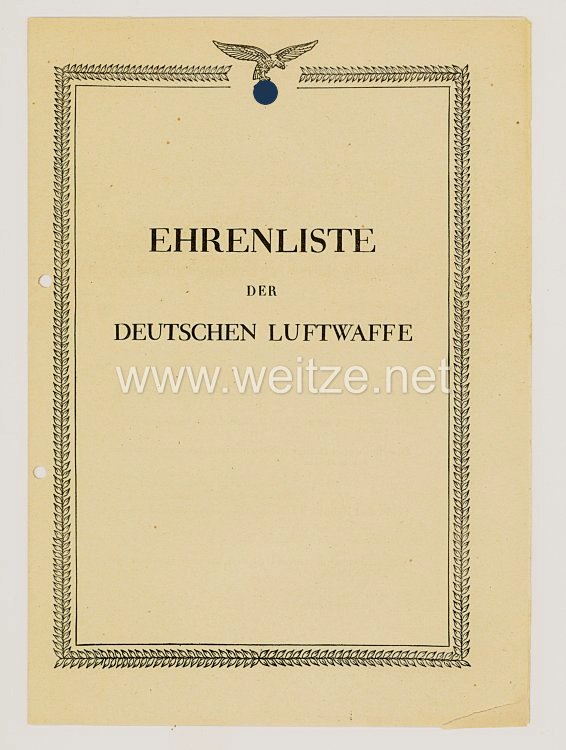
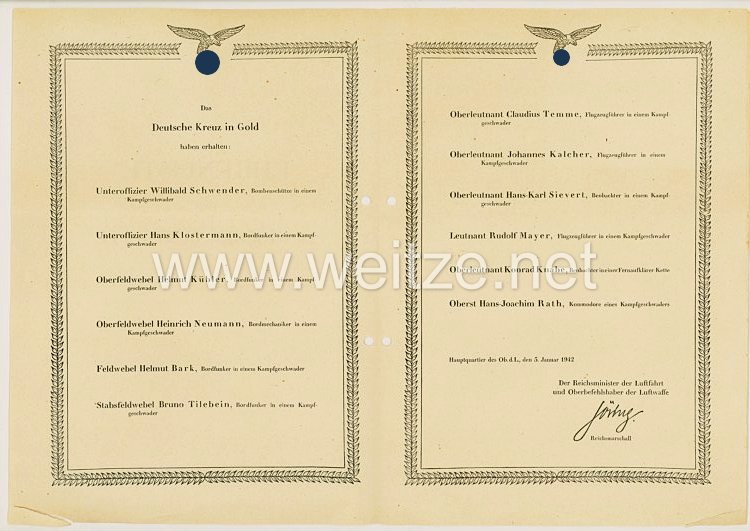
Honor Roll of the German Luftwaffe - Issue of January 5, 1942 Awards of the Knight's Cross in Gold
The Honor Roll of the German Luftwaffe dated January 5, 1942, represents a significant historical document from the history of German military decorations during World War II. These official publications documented the awarding of the highest military honors, particularly the Knight's Cross of the Iron Cross with Golden Oak Leaves (DK in Gold).
The Knight's Cross of the Iron Cross was instituted on September 1, 1939, by Adolf Hitler as the highest grade of the Iron Cross and was awarded throughout World War II. The various grades included the Knight's Cross itself, the Knight's Cross with Oak Leaves, with Swords, with Diamonds, and finally the highest grade with Golden Oak Leaves, Swords, and Diamonds. These decorations were not merely military honors but also served Nazi propaganda and war morale purposes.
The Honor Rolls were published by the High Command of the Wehrmacht and issued regularly to publicly acknowledge the bravery and special achievements of soldiers. These documents were typically produced as DIN-A4 double sheets and distributed to military offices, troop units, and archives. The perforation indicates that this copy was filed in a binder or collection, which was common practice for administrative documents of that era.
The edition of January 5, 1942, falls into a phase of the war when the German Wehrmacht still controlled significant territories in Europe but was already experiencing initial setbacks, particularly before Moscow during the winter of 1941/42. The Luftwaffe played a central role in German warfare during this period, both in air defense of Reich territory and in offensive operations on all fronts.
The format and design of these honor rolls followed strict military regulations. They typically contained the name of the recipient, their rank, their unit, and a brief justification for the award. The documents often bore official stamps and signatures of the responsible command posts. As official Wehrmacht documents, they possessed legal and administrative character.
The used condition of this copy testifies to its authentic use during wartime. Many of these documents were kept under difficult conditions in field command posts, air base offices, or military administrative units. The traces of time—discoloration, creases, or signs of wear—are typical of documents that were actually used in military service operations.
From a historical perspective, such honor rolls are important primary sources for military history research. They enable the reconstruction of career paths, analysis of decoration practices, and provide insight into the military culture and propaganda mechanisms of the Nazi regime. At the same time, they document the individual military history of the persons named.
The collection and archiving of such documents also raises ethical questions. They are testimonies of a criminal regime and a war of aggression that cost millions of lives. Their significance today lies primarily in their source value for historical research and in the warning they represent for subsequent generations.
For collectors of military historical documents, Wehrmacht honor rolls are of interest, though the historical-documentary value should be paramount. Perforated copies like this one are often archive specimens from former service offices and thus have a special provenance. They differ from later reproductions in paper quality, printing technique, and aging characteristics.
In summary, this honor roll from January 5, 1942, represents an authentic testimony of German military administration during World War II and offers insights into the decoration practices and documentation culture of the Luftwaffe of that time.