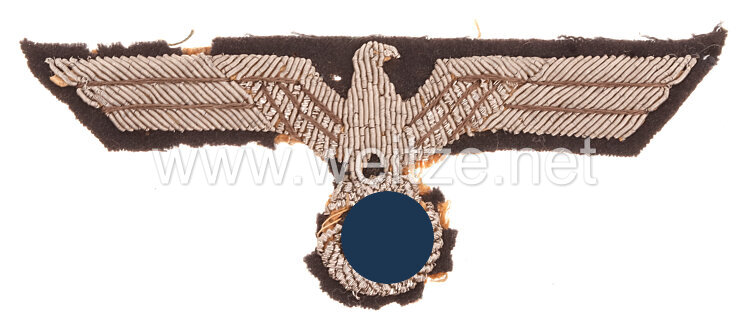
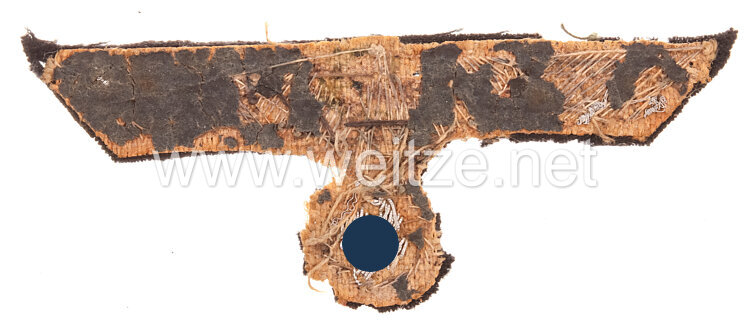
Kriegsmarine Breast Eagle for Naval Officials

Hand-embroidered version in silver on dark blue. Moth damage, condition 2-3.
452046
65,00

Kriegsmarine Breast Eagle for Naval Officials

The Kriegsmarine Breast Eagle for Naval Officials represents a significant example of military rank insignia and uniform emblems of the German Kriegsmarine during the Third Reich era. This hand-embroidered version in silver on dark blue fabric embodies the high craftsmanship quality that was characteristic of official insignia from this period.

The Kriegsmarine, as the official designation of the German Navy from 1935 to 1945, developed a complex system of uniform regulations and insignia that distinguished various ranks, functions, and affiliations. The breast eagle, also known as the national emblem (Hoheitsabzeichen), was an essential component of the uniform and had to be worn by all members of the Kriegsmarine.

An important distinction existed between military personnel and naval officials (Marinebeamte). While officers and enlisted men belonged to the military sphere, the Kriegsmarine's official apparatus included administrative specialists, technical experts, physicians, lawyers, and other professionals who held civil service status but wore military uniforms. These officials played an indispensable role in the administration, logistics, and technical support of the navy.

The hand-embroidered execution of the breast eagle indicates a high-quality private manufacture. While the Kriegsmarine produced standardized, machine-made insignia for general issue, officials and officers frequently preferred hand-embroidered variants from specialized manufacturers. These were made from finer materials and showed more detailed execution. The use of silver thread on dark blue cloth backing corresponded to the color regulations for naval officials, with the dark blue reflecting the traditional color of the navy.

The eagle itself, with outstretched wings and the swastika in its talons, followed regulations valid after 1935. The design was based on the Reich eagle and had to be worn on the right breast side of the uniform. The exact placement and size were detailed in the Kriegsmarine's dress regulations (Anzugsordnungen).

The technical execution of such breast eagles required considerable craftsmanship. Specialized embroidery workshops, often located in traditional naval cities such as Wilhelmshaven, Kiel, or Hamburg, manufactured these insignia to order. The embroidery process involved several work steps: first, the design was transferred to the backing fabric, then the contours were embroidered with fine silver or aluminum threads, and finally the interior of the figure was filled in. Quality was demonstrated in the uniformity of stitches and the three-dimensional quality of the representation.

The mentioned condition 2-3 with moth damage is typical for textile militaria from this period. The natural materials – wool, silk, and cotton – were susceptible to insect damage, especially when objects were stored under suboptimal conditions for decades. While such damage diminishes the state of preservation, it simultaneously documents the authenticity and age of the piece.

In historical context, these insignia served not only for identification but also for representing National Socialist state ideology. The national emblem was omnipresent on all uniform parts and symbolized the union of state power and military organization. After 1945, wearing such symbols was prohibited in Germany, and many uniform pieces were destroyed or stripped of their insignia.

Today, such breast eagles possess primarily historical and collector value. They document the uniform history of the German Navy, traditional craftsmanship in textile processing, and the complex hierarchy of military organizations. For museums, historians, and serious collectors of military-historical objects, they are important sources for understanding the material culture of this era.

The distinction between different wearer groups – officers, enlisted men, officials – based on details such as embroidery type, material, and coloring demonstrates the importance that National Socialist Germany placed on visual hierarchy and distinction. The breast eagle for naval officials was part of this comprehensive system of symbolic communication.

From a museological perspective, such pieces require careful conservation and contextualization. They must be presented within their historical framework, neither glorifying nor suppressing their origins, but serving as educational objects that illuminate a dark chapter of German and European history. The craftsmanship evident in hand-embroidered insignia also represents traditional textile arts that have largely disappeared in the age of industrial mass production.

r