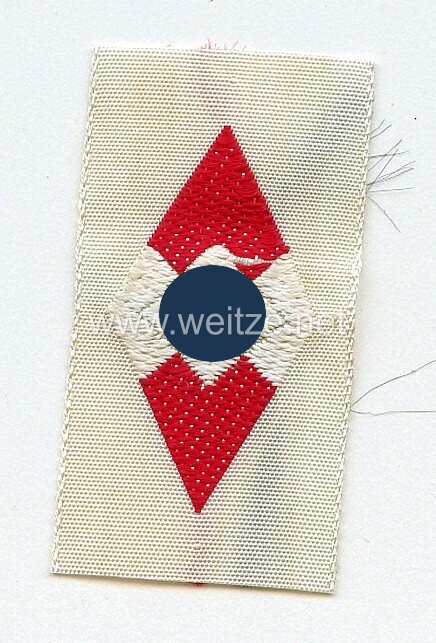
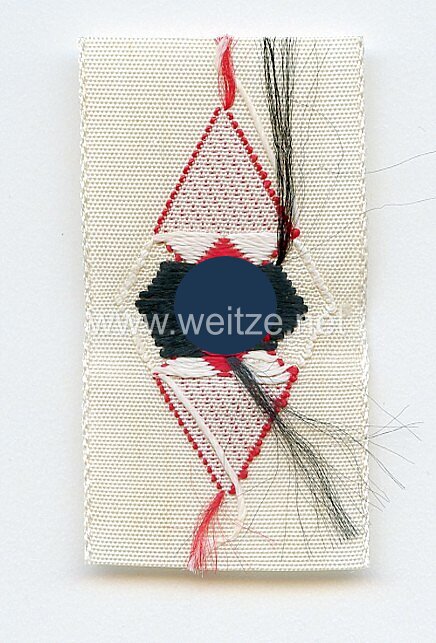
Hitler Youth (HJ) Emblem for Side Cap

BeVo woven version, Condition 2.

Price per piece: 30 Euro.

Condition may vary.
453446
30,00

Hitler Youth (HJ) Emblem for Side Cap

The Hitler Youth emblem for the side cap represents a characteristic badge of the National Socialist youth organization, worn by members of the Hitler Youth (Hitlerjugend - HJ) on their headgear. This particular type of specimen was manufactured using the high-quality Bevo weaving technique, a process that was widely used during the Third Reich era.

The Hitler Youth was officially founded on July 4, 1926, and developed into the largest youth organization in National Socialist Germany. After the seizure of power in 1933, the HJ was increasingly expanded into a state organization. With the Law concerning the Hitler Youth of December 1, 1936, it was declared the only state-recognized youth organization. The Youth Service Obligation of March 25, 1939, made membership effectively mandatory for all German youth between 10 and 18 years of age.

The Schiffchen (side cap) was one of the standardized headgear items within the HJ uniform. It was a flat, elongated-oval cap without a visor, similar to the military field cap. The emblem was attached centrally to the front of the side cap and served as an immediate identifying mark of the organization.

The Bevo weaving technique was developed and perfected by the company Bandfabrik Ewald Vorsteher (BeVo) from Wuppertal. This process enabled the machine production of complex badges and emblems with fine details and multiple colors. Unlike embroidered badges, Bevo-woven emblems were more cost-effective in mass production and exhibited consistently high quality. The weaving technique produced a flat, robust badge in which the threads were directly incorporated into the fabric.

The typical HJ emblem displayed the characteristic HJ rune insignia – a stylized Sig rune in white or silver color on a dark background, usually black or dark blue. This symbol was designed by Karl Wilhelm Krause in 1933 and officially introduced as the sovereign emblem of the Hitler Youth on May 1, 1933. The design was intended to embody dynamism, youth, and National Socialist ideology.

The uniforming of the Hitler Youth followed strict regulations that were detailed in the HJ service regulations. The uniform clothing was intended to level social differences and strengthen the sense of community. At the same time, it served the military shaping of young people and their preparation for later military service.

The production of HJ uniform parts and badges was carried out by numerous manufacturers throughout the Reich territory. Quality varied depending on the time of manufacture and producer. Early pieces from the 1930s often exhibit higher processing quality than later specimens from the war years, when material shortages and the conversion of the economy to war production impaired civilian manufacturing.

After World War II, the Hitler Youth and all its subdivisions were banned and dissolved by Control Council Law No. 2 of October 10, 1945. The possession, manufacture, and distribution of HJ uniforms and badges are subject to §86a StGB (Use of symbols of unconstitutional organizations) in Germany, with exceptions for historical, scientific, and educational purposes.

From a military-historical perspective, such emblems are important historical documents that provide insight into the organization, uniforming, and visual propaganda of the National Socialist regime. They document the systematic indoctrination of youth and the militarization of society in the Third Reich. The technical execution, particularly the Bevo weaving technique, also demonstrates the state of textile production and processing of that time.

Collectors and historians distinguish various variants of these emblems according to manufacturing method, period, and purpose of use. The Bevo-woven version is considered particularly characteristic of the standardized mass production of the NS era. Condition assessments usually follow a scale, with lower numbers indicating better preservation condition.